
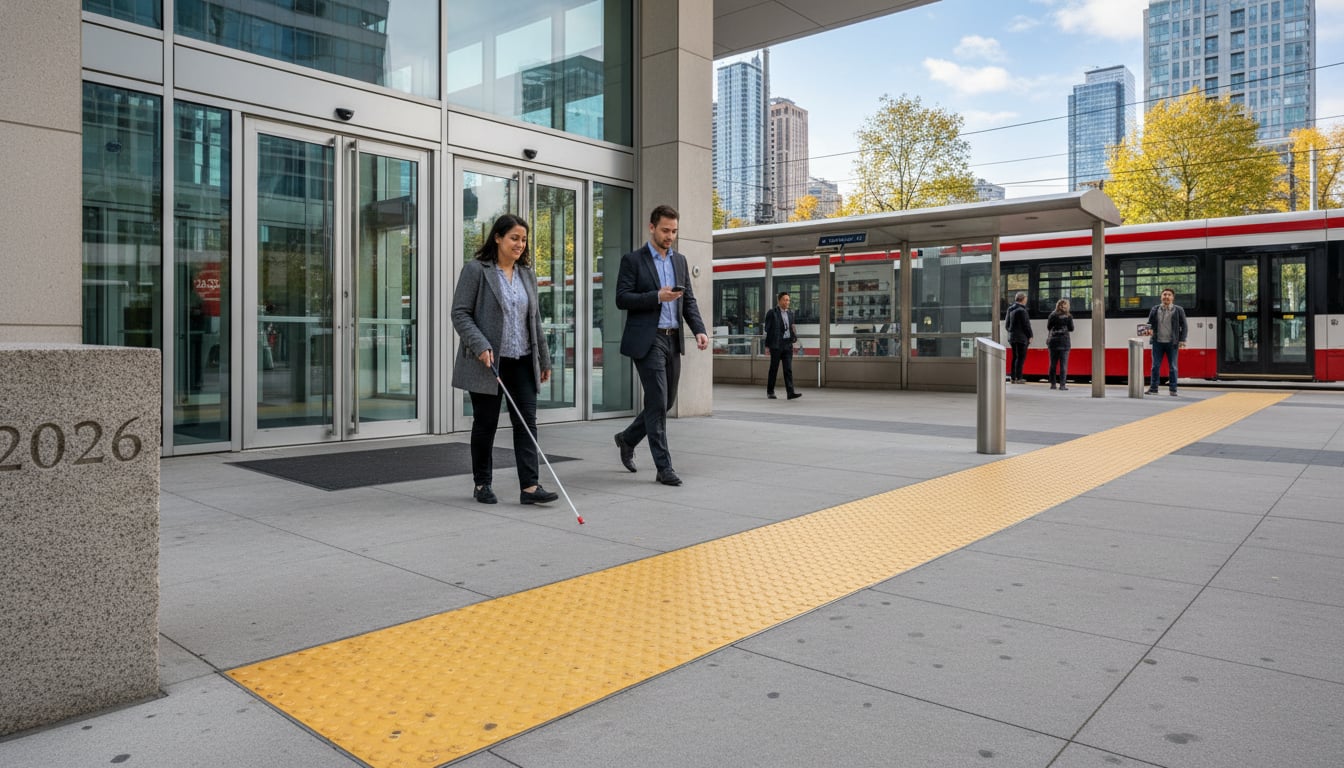
TLDR
TWSI stands for tactile walking surface indicator, a textured surface that warns or guides people who are blind, have low vision, or use a white cane. Canadian public buildings often require TWSIs at stairs, curb ramps, transit platforms, and large open areas, but there is no single national rule. The legal requirement depends on the provincial or territorial building code, accessibility legislation (such as Ontario’s AODA or Nova Scotia’s Built Environment Accessibility Standard), municipal standards, and the authority having jurisdiction (AHJ). CSA/ASC B651:23 is the main technical standard that defines TWSI design, dimensions, and contrast, but it does not decide where every project must apply them.
In Canada, TWSIs are commonly required in public-facing built environments such as stairs, curb ramps, transit platforms, unprotected drop-offs, and some large open wayfinding areas. But the exact legal requirement depends on the province or territory, the adopted building code, accessibility regulation, municipal standard, project type, and authority having jurisdiction.
This matters because getting it wrong leads to failed inspections, costly rework, or, worse, an inaccessible building. Consider the scale: in 2022, 27% of Canadians aged 15 and older (8 million people) had one or more disabilities, and 56% of people with disabilities reported barriers related to features inside or outside public spaces such as entrances, exits, and sidewalks source. About 2.2 million Canadians had a seeing disability that same year source. TWSIs are not paperwork. They are a practical safety and independence system for millions of people.
This guide covers what TWSI means, how the two main types differ, where they go, what dimensions apply under CSA/ASC B651:23, how requirements vary by province, and which mistakes cause the most problems on real projects.
This article is not legal advice. Always confirm requirements with the applicable code, accessibility regulation, project specification, and your authority having jurisdiction before ordering or installing products.
What Does TWSI Mean?
TWSI stands for tactile walking surface indicator. It is a textured surface installed on floors, landings, sidewalks, curb ramps, or platforms that provides a warning or wayfinding cue. The texture is detected visually, underfoot, or by a long white cane.
CSA/ASC B651:23 (the current edition of Canada’s main accessibility design standard) uses the term “tactile walking indicator surfaces” and defines two main functions: warning people about hazards and guiding people along a route source.
You may hear TWSIs called “truncated domes,” “detectable warning surfaces,” “tactile paving,” or simply “the yellow bumps.” These informal names create confusion because they blur the distinction between the two TWSI types, which serve very different purposes.
The Two Main TWSI Types
Tactile Attention Indicators (Truncated Domes)
Attention indicators are raised truncated domes arranged in a square grid pattern. They mean: stop and pay attention, you are approaching a hazard or a change in condition.
Under CSA/ASC B651:23, attention indicators signal caution at changes in elevation, vehicular routes, train tracks, curb ramps, transit platform edges, and similar hazards source.
They do not tell you which direction to walk. This is one of the most common misunderstandings. Practitioners on Reddit have discussed this confusion directly. In one r/accessibility thread, a user worried that tactile paving near crosswalks might lead blind pedestrians diagonally into traffic. Commenters clarified that truncated domes typically indicate the sidewalk edge or hazard, not the walking direction source.
Common locations for attention indicators:
- Top of stairs
- Curb ramps and blended transitions
- Depressed curbs at pedestrian crossings
- Transit platform edges
- Entries into vehicular routes where no curb or separating element exists
- Unprotected drop-off edges
Tactile Direction Indicators (Directional Bars)
Direction indicators use raised, elongated flat-top bars running parallel to the direction of travel. They mean: follow this path.
CSA/ASC B651:23 says direction indicators facilitate wayfinding in large, open areas and indicate a possible route from entrances to major destinations such as information kiosks, registration desks, stairways, elevators, or service doors source.
An important caution from the standard: too many directional paths create confusion. CSA/ASC B651:23 notes that one or two paths should be considered in a discrete space such as a lobby or transit facility source.
A Calgary Reddit thread about blue tactile strips at CTrain stations shows how confusing inconsistent systems can be. Many sighted users did not know what the new strips meant, and Calgary Transit explained that the pilot included surveys and focus groups with low-vision customers to test effectiveness source. The takeaway: a good TWSI system is consistent, simple, and tested where possible.
If your project requires directional bar tiles, make sure the layout supports simple, logical wayfinding rather than decorative floor patterns.
Are TWSIs Required in Public Buildings in Canada?
Often, yes. But not through one universal national rule.
Canada’s TWSI requirements for public buildings work through a layered system, and misunderstanding this hierarchy is one of the most common compliance errors. Here is how it works, from the top down:
| Level | What It Does |
|---|---|
| Authority having jurisdiction (AHJ) | Final approval and interpretation for a specific project |
| Provincial or territorial building code | Enforceable construction code adopted (and often amended) from the NBC model |
| Accessibility legislation | Laws like Ontario’s AODA or Nova Scotia’s accessibility regulations, which can add requirements beyond the building code |
| National Building Code of Canada (NBC) | A model code, not automatically law until a province or territory adopts it |
| CSA/ASC B651 | The technical standard for accessible design; tells you how to design TWSIs |
| Municipal or owner standards | Local rules that may be stricter than provincial minimums |
| Project specifications | The contract documents for a specific building project |
CSA/ASC B651:23 is explicit about this: it provides technical requirements for accessible buildings and the exterior built environment, but the extent of application is the responsibility of authorities having jurisdiction source. Accessibility Standards Canada confirms that CSA/ASC B651 is referenced in the National Building Code and other legislation across Canada source.
The National Research Council published the National Building Code of Canada 2025 on December 22, 2025, but provinces and territories may still use adopted or amended versions based on earlier NBC editions. The NRC advises users to contact provincial or territorial officials to find out which codes apply locally source.
Bottom line: CSA/ASC B651 tells you how a compliant tactile surface should be designed. Your code, regulation, project specification, and AHJ tell you when it must be installed.
Where Are TWSIs Commonly Required or Used?
This table summarizes the most common TWSI locations in Canadian public buildings and public spaces:
| Location | TWSI Type | Practical Note |
|---|---|---|
| Top of stairs | Attention (domes) | Typically starts one tread depth back from the stair edge |
| Curb ramps | Attention (domes) | Setback from curb edge varies by province |
| Depressed curbs | Attention (domes) | Often near pedestrian crossing transitions |
| Transit platform edges | Attention (domes) | Full-width hazard warning |
| Vehicular route entries | Attention (domes) | Where no curb or separating element exists |
| Large lobbies and open areas | Direction (bars) | Guide to reception, elevators, service counters |
| Transportation terminals | Direction (bars) | Keep routes simple and limited |
TWSIs are not only exterior sidewalk products. CSA/ASC B651:23 covers both interior and exterior built environments, including stairs, transit facilities, shopping malls, open lobbies, and routes to elevators and service points source.
For transportation safety and accessibility projects, transit platform edges and station wayfinding are among the most common TWSI applications.
Key CSA/ASC B651:23 TWSI Dimensions
Always confirm which CSA B651 edition is referenced by your applicable code or project specification. Some current documents still reference CSA B651-18, where TWSI requirements appear in Clause 4.3.5, while CSA/ASC B651:23 places them in Clause 4.4.5 source. Section numbering and some dimensional details differ between editions.
Attention Indicator Dimensions
| Feature | CSA/ASC B651:23 Requirement |
|---|---|
| Dome height | 4 to 5 mm |
| Top diameter | 12 to 25 mm |
| Base diameter | Top diameter plus 10 ± 1 mm |
| Pattern | Square grid |
| Centre-to-centre spacing | 42 to 70 mm (depends on dome size) |
| Field depth at hazards | 600 to 650 mm |
| Luminance contrast | Minimum 50% with adjacent surface |
| Panel edge | Level with surrounding surface, or bevelled max 3 mm above |
| Slip resistance | Required |
| Adjacent smooth surface | At least 600 mm wide |
CSA/ASC B651:23 also notes that product selection should consider potential wear, especially in high-traffic areas or exterior applications where snow and ice clearing equipment is used source. In a Canadian climate, durability is a compliance issue, not just a maintenance issue.
Direction Indicator Dimensions
| Feature | CSA/ASC B651:23 Requirement |
|---|---|
| Bar height | 4 to 5 mm |
| Top width | 17 to 30 mm |
| Base width | Top width plus 10 ± 1 mm |
| Top length | At least 270 mm |
| Max gap between in-line bar ends | 30 mm |
| Centre-to-centre spacing | 57 to 85 mm (depends on bar width) |
| Route width | 250 to 300 mm |
| Clear space each side | 600 mm free of obstructions |
| Luminance contrast | Minimum 50% |
| Colour restriction | Direction indicators should not be yellow |
Browse tactile indicators to see surface-applied, cast-in-place, and flexible tile options that address these dimensional requirements.
TWSIs at Public Stairs
Stair TWSI placement is one of the most inspected details in Canadian public buildings. CSA/ASC B651:23 specifies the following for tactile attention indicators at stairs:
- Located at the top of stairs
- Continuous across the stair width, with a maximum 75 mm gap to the stringer or end of tread
- 600 to 650 mm in length (depth)
- Begin one tread depth back from the stair edge
Tactile attention indicators are required at stairs that are not enclosed, at each landing with an entrance into a stair system, where the regular stairway pattern is broken, and where the run of a landing without a continuous handrail exceeds 2100 mm source.
Watch for Intermediate Landings
On multi-flight open stairs, do not assume only the very top landing needs a tactile warning surface. The BC Building Code Interpretation Committee addressed this directly in 2024. When asked whether TWSIs are required at intermediate landings in an open stair and whether the one-tread-depth setback applies, the committee answered yes to both. It also cautioned that the local AHJ has final responsibility for interpretation source.
This is a real field issue that catches contractors off guard. Check each flight and verify with your local building official.
Stair Nosings Are a Related Requirement
TWSIs at stairs are only one part of stair accessibility. CSA/ASC B651:23 also requires stair nosings to project no more than 38 mm, have a leading-edge radius not exceeding 13 mm, and include a 50 ± 10 mm horizontal contrast strip with at least 50% luminance contrast extending the full tread width source. Tactile indicators do not replace the need for compliant nosings, slip-resistant treads, or contrast strips. For public stair projects, anti-slip stair tread nosings address the slip-resistance and visibility requirements that work alongside TWSIs.
Provincial Examples: Why TWSI Requirements Must Be Checked Locally
A generic “Canada TWSI requirement” can be wrong on a live project. The differences between provinces are real and measurable. Here are four examples.
Ontario
Ontario’s 2024 Building Code applies accessibility requirements to most new construction and extensive renovations. Existing buildings are not affected unless an extensive renovation is planned source.
Ontario’s AODA Integrated Accessibility Standards set specific TWSI requirements for exterior paths of travel:
- Exterior stairs: TWSIs at the top of all flights, full tread width, minimum 610 mm depth, beginning one tread depth from the stair edge source
- Curb ramps at pedestrian crossings: setback 150 to 200 mm from the curb edge, full width of the curb ramp, minimum 610 mm depth source
- Depressed curbs: setback 150 to 200 mm from the curb edge, minimum 610 mm depth source
Nova Scotia
Nova Scotia’s Built Environment Accessibility Standard Regulations require tactile attention indicators to be slip-resistant, durable, arranged in a square grid pattern, and have high colour contrast with adjacent surfaces source.
Key differences from Ontario:
- Curb ramps: 600 to 650 mm depth, 300 to 350 mm setback from the curb edge source
- Exterior stairs: top of each flight, full tread width, at least 610 mm depth, one tread depth back source
Notice the curb ramp setback: Nova Scotia requires 300 to 350 mm, while Ontario uses 150 to 200 mm. This is exactly why you cannot assume one province’s numbers apply everywhere.
British Columbia
The BC Building Code 2024 took effect for permits applied for after March 8, 2024. It is mostly based on the National Building Code of Canada 2020 with BC-specific changes source. The BOABC interpretation on intermediate landings and stair setbacks (discussed above) shows how local interpretation committees handle grey areas.
Alberta
Alberta’s current building code is the National Building Code, 2023 Alberta Edition, in force since May 1, 2024 source. Project teams should check the Alberta-specific edition and their local AHJ rather than relying on generic NBC language.
| Jurisdiction | Example Requirement | Why It Matters |
|---|---|---|
| Ontario | Curb ramp setback: 150 to 200 mm | Shows AODA-specific exterior path rules |
| Nova Scotia | Curb ramp setback: 300 to 350 mm | Proves Canadian requirements vary by province |
| British Columbia | Intermediate stair landings may require TWSIs | Shows inspection interpretation issues |
| Alberta | Uses 2023 Alberta Edition of NBC | Provincial editions matter |
Existing Buildings: Do You Need to Retrofit?
One of the most common questions from facility managers is whether older public buildings must be upgraded with TWSIs. The answer is not automatic, but not simple either.
Ontario provides a clear example: its Building Code accessibility requirements apply to most new construction and extensive renovations, while existing buildings are not affected unless an extensive renovation is planned source.
However, obligations can arise from renovations, redevelopment, public-sector internal standards, lease requirements, human rights accommodation duties, owner policies, or AHJ direction. If you manage an existing public building, do not assume every older stair, entrance, or curb ramp must be retrofitted tomorrow. But do not assume you are exempt either. Ask the AHJ or an accessibility consultant before ordering products.
Public buildings should not depend on every visitor having recent orientation and mobility training, a support person, or detailed prior knowledge of the facility. First-hand accounts from Canadians with vision loss, shared in communities like r/Blind, describe difficulties accessing mobility training and timely support services source. Physical cues in buildings need to be consistent, detectable, and maintained regardless of what support each visitor has available.
Surface-Applied vs Cast-in-Place TWSIs
Choosing the right product type depends on the project conditions, not just the price.
Surface-Applied Tactile Panels
Best for retrofits, existing concrete or finished surfaces, smaller projects, and situations requiring faster installation. Risks include edge lift, adhesive failure, snow-removal damage, and trip hazards if the edge height or bevel exceeds the 3 mm limit in CSA/ASC B651:23.
Cast-in-Place Panels
Best for new concrete pours, curb ramps, civic and transit exterior settings, and high-traffic public spaces. They are harder to relocate, and an incorrect setback becomes expensive to fix after the concrete cures.
Cast Iron Plates
Best for exterior municipal, transit, and curb ramp conditions where long-term durability against snow, ice, salt, and heavy pedestrian traffic is critical. CSA/ASC B651:23 directly says product selection should consider wear in high-traffic and exterior snow/ice clearing applications source. For these demanding environments, cast iron tactile plates offer the kind of durability the standard anticipates.
Flexible Tiles
Flexible 300 x 300 mm PU tiles can work for temporary installations or small-area applications, but may not be suitable for every high-traffic exterior condition. They are useful for testing layouts or providing short-term accessibility during construction phases.
In all cases, the installation still needs to meet requirements for edge height, bevel, slip resistance, contrast, dimensions, and placement. A compliant TWSI is not just “bumps stuck to the floor.”
Common TWSI Compliance Mistakes
These are the errors that cause the most rework, failed inspections, and wasted money on Canadian public building projects.
Mistake 1: Treating CSA B651 as automatically enforceable everywhere. CSA/ASC B651:23 states the extent of application belongs to other authorities having jurisdiction source. Confirm the adopted code and AHJ first.
Mistake 2: Using domes where directional bars are needed. Domes warn. Bars guide. They are different products for different situations.
Mistake 3: Installing stair TWSIs at the wrong offset. At stairs, the panel starts one tread depth back from the stair edge, not flush with it.
Mistake 4: Forgetting intermediate landings in open stairs. BC’s interpretation committee confirmed that the top of each flight in a multi-flight open stair requires a TWSI source.
Mistake 5: Assuming curb ramp setbacks are the same across Canada. Ontario uses 150 to 200 mm. Nova Scotia uses 300 to 350 mm. Check your province.
Mistake 6: Ignoring luminance contrast. CSA/ASC B651:23 requires at least 50% luminance contrast for both attention and direction indicators source. Measure the contrast, do not just pick a colour name.
Mistake 7: Choosing products that cannot survive the environment. Snow plows, salt, freeze-thaw, heavy carts, and foot traffic wear down domes. If domes lose their profile, the TWSI stops functioning as intended.
Mistake 8: Creating too many directional paths. CSA/ASC B651:23 warns that excessive tactile direction indicator paths create confusion source. One or two paths per lobby or transit area is the recommended approach.
Quick TWSI Checklist for Public Buildings in Canada
Use this before finalizing drawings, specifications, or product orders.
- Identify the project location. Province, municipality, property type, and AHJ all matter.
- Confirm the project trigger. New construction, extensive renovation, redevelopment, public-sector standard, or voluntary retrofit?
- Confirm the adopted code and CSA edition. Do not assume CSA/ASC B651:23 is the referenced edition for your project.
- Identify the TWSI type. Attention (domes) for hazards. Direction (bars) for wayfinding.
- Confirm locations. Stairs, curb ramps, depressed curbs, platform edges, vehicular entries, lobbies, elevator approaches, service counters, transit paths.
- Confirm dimensions. Depth, width, offset, dome/bar geometry, grid spacing, and stair setback.
- Check contrast. Measure luminance contrast using the Michelson formula, not just a colour swatch.
- Check slip resistance and surrounding surface. CSA/ASC B651:23 requires both source.
- Choose material for the environment. Consider snow clearing, salt, freeze-thaw, and traffic volume.
- Document the installation. Keep product data sheets, code references, layout drawings, photos, and AHJ approvals on file.
For institutional, government, and military projects, this checklist helps procurement teams document compliance from specification through installation.
Falls and Accessibility: Why This Matters Beyond Code Compliance
TWSIs are not just a regulatory checkbox. Falls are the leading cause of hospitalizations and death among older adults in Canada. In 2022, there were 78,076 fall-related hospitalizations among adults 65 and older (excluding Quebec), and falls accounted for 89% of injury-related hospitalizations in this age group. Fall-related hospital stays typically last nine days longer than the average stay for people over 65 source.
Visual impairment increases fall risk. The Public Health Agency of Canada identifies decreased mobility, muscle weakness, and visual impairment among the factors that put older adults at increased risk source. A well-placed, high-contrast, properly maintained TWSI at the top of a staircase or the edge of a transit platform is not bureaucratic overreach. It is a physical warning that prevents people from walking into danger.
Frequently Asked Questions
What does TWSI stand for?
TWSI stands for tactile walking surface indicator. It is a textured surface that provides warning or wayfinding information, detectable visually, underfoot, or by a long white cane source.
Are TWSIs required in all public buildings in Canada?
Not by one single national rule. TWSI requirements for public buildings in Canada depend on the adopted building code, accessibility legislation, municipal or owner standard, project type, and AHJ. CSA/ASC B651 provides the technical requirements but does not decide the extent of application source.
What is the difference between tactile attention indicators and direction indicators?
Attention indicators use truncated domes to warn of hazards such as stairs, platform edges, curb ramps, and vehicular routes. Direction indicators use elongated bars to guide people through open areas such as lobbies, malls, and transit terminals. Attention indicators warn. Direction indicators guide source.
Where do TWSIs go at stairs?
Under CSA/ASC B651:23, tactile attention indicators are located at the top of stairs, run across the stair width (max 75 mm gap to the stringer), are 600 to 650 mm deep, and begin one tread depth back from the stair edge source.
Are TWSIs only for exterior sidewalks?
No. TWSIs are used in both exterior and interior built environments, including stairs, transit facilities, large open lobbies, platform edges, and routes to key destinations such as elevators or service counters source.
Do existing buildings need TWSIs?
It depends on the jurisdiction and project circumstances. Ontario, for example, says its Building Code accessibility rules apply to new construction and extensive renovations, while existing buildings are not affected unless an extensive renovation is planned source. Renovations, public ownership, lease obligations, and human rights duties can all trigger accessibility upgrades.
What colour should TWSIs be?
The key requirement is luminance contrast with the surrounding surface, not a specific colour name. CSA/ASC B651:23 requires at least 50% luminance contrast for attention and direction indicators. It also specifies that direction indicators should not be yellow source.
Can surface-applied TWSIs be compliant?
Yes, where allowed by the applicable code, specification, substrate, and AHJ. The installation still needs to meet requirements for edge height (level or bevelled, max 3 mm above the adjacent surface), slip resistance, contrast, dimensions, and placement source.
Need tactile indicators or directional bar tiles for a Canadian public building project? Safety Step Canada supplies tactile indicators, directional bar tiles, cast iron plates, and related stair and anti-slip products for public, commercial, institutional, and transportation environments. Confirm your project requirements with the AHJ before ordering, then contact Safety Step Canada to match products to your specification.