
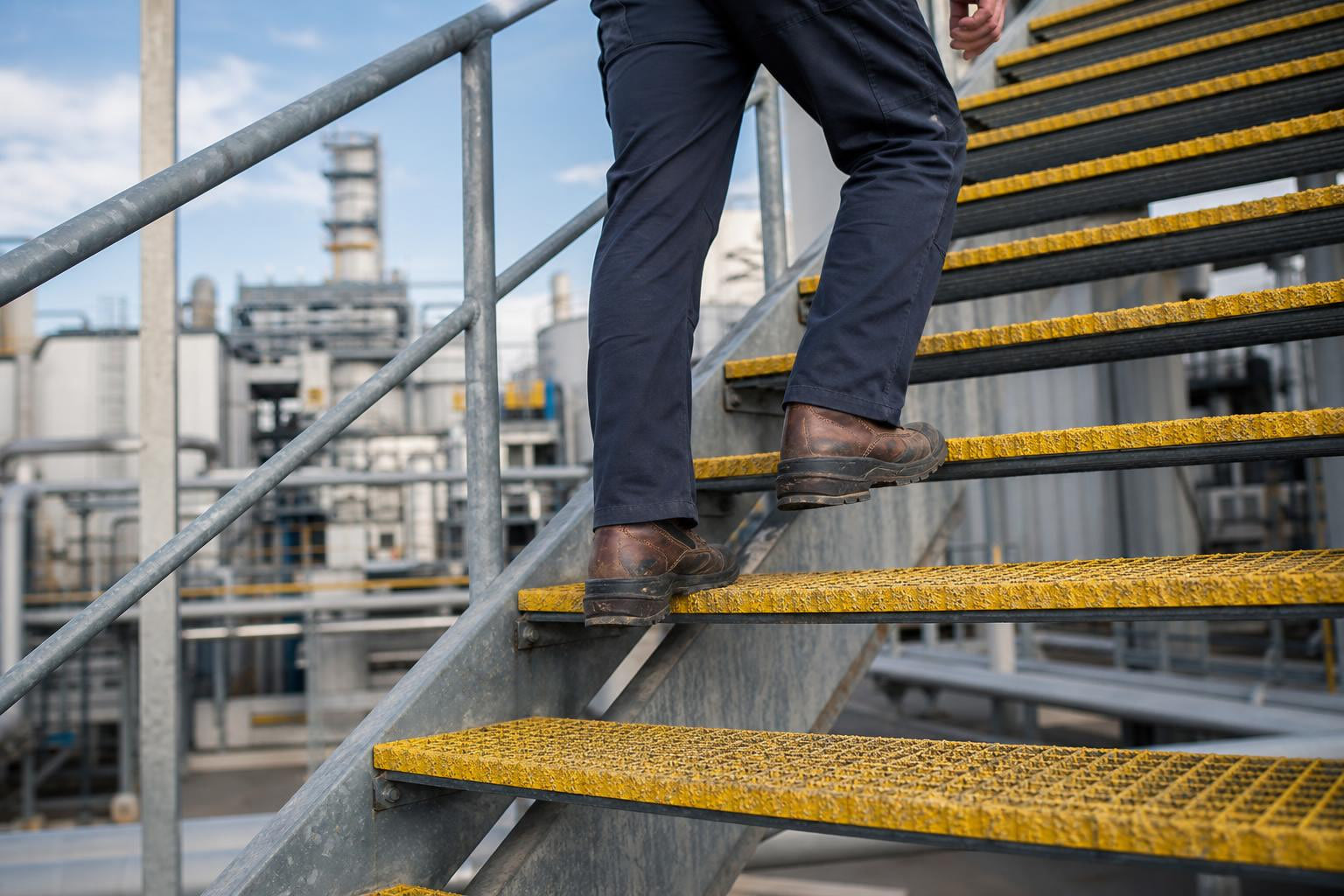
TL;DR
FRP (fiberglass reinforced plastic) stair treads outperform rubber in outdoor, industrial, and harsh-weather environments, with higher slip resistance, longer lifespan (20+ years vs. 18 months to 4 years outdoors), and a working temperature range that handles Canadian winters. Rubber stair treads are a solid choice for indoor commercial settings like schools, offices, and hospitals where noise dampening and underfoot comfort matter. The deciding factor is almost always whether the stairs are indoors or outdoors.
Facility managers, contractors, and safety officers comparing FRP vs rubber stair treads usually already know they need better traction on their stairs. The question is which material. Both reduce slip risk, but they solve different problems in very different environments. This guide breaks down the performance data, lifespan numbers, and best-fit scenarios so you can make a confident purchasing decision.
Stair falls cause roughly 12,000 deaths and over 1 million injuries annually in the United States alone. The right tread material directly affects whether your stairs are safe or a liability.
Browse FRP stair tread nosings to see available sizes and pricing.
What Are FRP Stair Treads?
FRP stands for fiberglass reinforced plastic. It’s a composite material made from a polymer resin matrix reinforced with glass fibers, producing a product that is roughly one-third the weight of steel but with a high strength-to-weight ratio.
FRP stair treads are manufactured through two primary processes. Molded FRP uses a compression mold to create panels with a woven fiberglass pattern. Pultruded FRP pulls continuous glass fibers through a resin bath and heated die, producing a denser, more uniform cross-section with superior structural consistency. Pultruded treads resist delamination better than molded alternatives and generally last longer in demanding environments.
Key properties of FRP stair treads:
- Corrosion and chemical resistant: won’t rust, rot, or degrade from chemical exposure
- Non-conductive: safe around electrical equipment
- UV resistant: many products include UV-resistant coatings
- Lightweight: easy to transport and install, about 1/3 the weight of steel
- Low thermal conductivity: doesn’t get scorching hot in summer sun like metal treads
An industrial equipment professional with over a decade of experience noted that “not all FRP stair treads are created equal, as some use cheaper resins or less fiberglass reinforcement, which compromises longevity.” This is worth remembering when comparing quotes from different suppliers.
For applications requiring full coverage rather than nosing strips, FRP grating panels serve as complete tread replacements on open-grated stairs.
What Are Rubber Stair Treads?
Rubber stair treads are made from natural or synthetic rubber compounds, formed into full-coverage mats, nosing wraps, or adhesive strips. They come in various patterns and textures, some with embedded grit strips for additional traction, others with aesthetic designs suited for visible commercial spaces.
Rubber treads are commonly found in schools, offices, hospitals, and retail stores. Their strengths center on indoor comfort and functionality:
- Noise dampening: rubber absorbs foot strike sound, making stairwells quieter
- Cushioning: provides some underfoot comfort on hard substrates like concrete
- Design variety: available in colors, patterns, and profiles that suit architectural requirements
- Moderate slip resistance: meets commercial-grade friction standards for dry indoor use
Rubber treads are designed for heavy-use commercial locations and are a well-established product category for interior stairs. Industry sources describe them as “the appropriate product for office buildings, schools, hospitals, high-traffic retail stores, and the like.”
Key Differences: FRP vs Rubber Stair Treads
This comparison table is the fastest way to evaluate which material fits your environment. The numbers below are drawn from manufacturer data, ASTM testing standards, and published field performance reports.
| Property | FRP Stair Treads | Rubber Stair Treads |
|---|---|---|
| Slip resistance (COF, dry) | 0.65 to 0.90+ | ≥ 0.50 (ASTM D2047) |
| Slip resistance (COF, wet) | 0.80+ | Reduced; not rated for wet outdoor use |
| Outdoor suitability | Yes, designed for outdoor use | No, interior use only |
| Lifespan (indoor) | 20 to 30+ years | 10 to 20+ years |
| Lifespan (outdoor) | 10 to 25+ years | 18 months to 4 years |
| Temperature range | -40°C to 120°C (-40°F to 248°F) | Degrades in freezing and extreme heat |
| Corrosion resistance | Fully resistant | Not applicable |
| Chemical resistance | High (acids, alkalis, solvents) | Low to moderate |
| UV resistance | High (with UV coating) | Degrades, discolors, cracks |
| Weight | ~1/3 the weight of steel | Heavier per unit area than FRP |
| Noise dampening | Minimal | Excellent |
| Underfoot comfort | Rigid | Cushioned |
| Installation method | Mechanical fastening (saddle clips, bolts) | Adhesive bonding |
| Maintenance | Periodic cleaning only | Periodic cleaning; outdoor replacements needed |
| Typical cost per step | Higher upfront | Lower upfront; $40 to $150 per step in replacement costs over 20 years outdoors |
| Best environments | Outdoor, industrial, marine, chemical, food processing | Indoor commercial, institutional, residential |
The Numbers That Matter Most
The coefficient of friction (COF) gap is significant. FRP treads commonly deliver a COF of 0.65 or higher in dry conditions, with some manufacturers reporting 0.90+ dry and 0.80+ wet. Rubber treads meet the ASTM D2047 standard of ≥ 0.50 static COF, which is acceptable for indoor use but falls short of FRP’s traction in wet or contaminated conditions.
Lifespan is the other decisive number. Indoors, both materials perform reasonably well. Outdoors, the gap becomes dramatic: FRP treads can last 20 to 30 years with minimal maintenance, while rubber treads exposed to weather typically need replacement every 18 months to 4 years.
If you’re also considering aluminum as a third option, aluminum stair nosings offer another outdoor-rated alternative worth evaluating.
When to Choose FRP Stair Treads
FRP is the clear winner in any environment where moisture, temperature extremes, chemicals, or UV exposure are part of daily reality.
Outdoor stairs exposed to Canadian weather. FRP operates in temperatures from -40°C to 120°C, which covers every climate zone in Canada. It won’t crack in a Winnipeg January or soften in a southern Ontario July.
Industrial and processing facilities. Chemical plants, food processing lines, water treatment facilities, mining operations, and marine environments all involve corrosive substances that would destroy rubber treads. FRP resists acids, alkalis, and solvents without degradation.
Grated or expanded metal stairs. Expanded metal or grated stairs flex under foot traffic. FRP flexes with the substrate, maintaining grip and structural integrity. Rubber adhesive bonds tend to fail on surfaces that move.
Electrical safety. FRP is non-conductive, making it appropriate for substrates near electrical panels, switchgear, or machinery.
Long-term cost control. The upfront cost of FRP is higher, but the total cost of ownership over 10 to 20 years is typically lower because you’re not replacing degraded treads every few years.
One field practitioner shared that after installing FRP treads at a facility, “the maintenance team reported zero slip incidents, even after heavy rain and chemical spills” over a multi-month observation period.
For demanding industrial environments, Hi-Traction step covers provide another high-grip FRP option designed for severe conditions.
When to Choose Rubber Stair Treads
Rubber stair treads are a legitimate, well-proven product for the right application. Dismissing them entirely would be dishonest.
Indoor commercial and institutional stairs. Schools, office buildings, hospitals, government buildings, and retail stores with moderate to heavy foot traffic are rubber’s strongest environment. The material handles indoor wear well and can last 10 to 20+ years.
Noise-sensitive environments. Libraries, hospitals, residential buildings, and any space where stairwell sound carries. Rubber’s noise-dampening quality is a real advantage that FRP simply doesn’t match.
Comfort and cushioning. For stairs used by people standing or walking for long periods (hospital staff, for example), rubber’s slight cushioning reduces fatigue.
Budget-constrained, short-term projects. If the installation is temporary, or if budget limits are strict and the environment is indoors, rubber’s lower upfront cost makes sense.
Aesthetic applications. Rubber treads come in colors and patterns that fit architectural design requirements in lobbies, residential buildings, and public spaces.
Why This Decision Matters More in Canada
The indoor-vs-outdoor distinction is the single most important factor when comparing FRP vs rubber stair treads, and it becomes even more critical in Canadian conditions.
Freeze-Thaw Cycles Break Adhesive Bonds
Rubber treads are typically installed with adhesive. In environments with freeze-thaw cycling (which describes most of Canada from October through April), moisture gets underneath the tread, freezes, expands, and breaks the adhesive bond. Product listings consistently warn that “rain or moisture can reduce friction on smooth surfaces if water gets underneath the tread.” In a climate with 100+ freeze-thaw cycles per year, this isn’t a theoretical risk.
FRP treads use mechanical fastening with stainless steel saddle clips and bolts. The attachment doesn’t depend on adhesive chemistry surviving temperature swings.
Cold Reduces Rubber’s Effectiveness
Winter conditions can make rubber surfaces slick. Freezing temperatures stiffen the material, and snow or ice accumulation on top of rubber treads eliminates their traction advantage. Rubber mats need frequent cleaning and monitoring in winter to remain effective, which adds labor cost.
FRP’s Temperature Range Matches Canadian Extremes
FRP’s operating range of -40°C to 120°C covers the full spectrum of Canadian weather. From a deep-freeze prairie winter to a hot summer day on a sun-exposed fire escape, the material doesn’t become brittle or soft.
The Industry View Is Clear
Sure-Foot Corp, a major North American stair tread supplier, states plainly: “Rubber and vinyl products would never be recommended for outdoor use; they are designed for interior use only.” This isn’t controversial. It’s the consensus position among practitioners who install these products.
For a broader look at how to approach outdoor stair safety in cold climates, the stair nosing buyer’s guide covers material options, codes, and costs in more detail.
Installation Differences
How a stair tread attaches to the substrate matters as much as the material itself, especially in harsh conditions.
FRP Installation
FRP treads are mechanically fastened using stainless steel or zinc-plated saddle clips and bolts. The treads can be cut to size on site with standard tools. They install on concrete, wood, metal, and even fiberglass ladder rungs. Mechanical fastening means the attachment doesn’t weaken from moisture, temperature changes, or vibration.
For detailed instructions, the guide on how to cut and fit pultruded FRP nosings walks through the process.
Rubber Installation
Rubber treads are typically adhesive-bonded. The substrate must be sanded, cleaned, and fully dry. Adhesive is applied evenly, the tread pressed from center to edges, and a roller used to ensure full contact. Temporary pins may hold the tread while the adhesive cures.
On smooth surfaces (painted concrete, sealed wood, glossy tile, metal), product listings note that additional mechanical fastening is required because adhesive alone may not hold. This adds complexity and cost to an installation that’s marketed as simple.
Understanding the Limits of Both Products
No anti-slip product eliminates all slip risk. A few important realities:
- Surfaces still need regular cleaning. Debris, oil, ice, and standing water reduce traction regardless of tread material.
- Anti-slip treads reduce risk significantly but are part of a system that includes housekeeping, drainage, lighting, and handrails.
- Code and accessibility requirements vary by province and municipality. Check your local building code and workplace safety regulations before specifying products. Standards like OSHA, ANSI, and ASTM provide context for slip resistance benchmarks, but meeting a specific COF number doesn’t guarantee code compliance in every jurisdiction.
- FRP quality varies. Cheaper products with less fiberglass reinforcement or lower-grade resins won’t deliver the 20+ year lifespan that quality pultruded treads achieve.
How to Choose the Right Stair Tread for Your Facility
Run through this checklist:
- Indoor or outdoor? If outdoor, FRP wins. Rubber is not designed for prolonged weather exposure.
- Chemical or corrosive exposure? FRP. Rubber has limited chemical resistance.
- Freeze-thaw cycles? FRP with mechanical fastening. Adhesive-bonded rubber will fail.
- Noise a concern? Rubber is superior for noise dampening indoors.
- Budget horizon? If you’re budgeting over 5+ years, FRP’s lower replacement cost likely saves money. For a 1 to 2 year budget window indoors, rubber’s lower upfront cost may be justified.
- Substrate type? Grated metal, expanded metal, or any flexible substrate needs FRP. Flat, stable indoor concrete or wood can support rubber.
- Electrical environment? FRP is non-conductive. Rubber is not rated for electrical safety.
If you’re still unsure which product fits your stairs, contact Safety Step Canada for guidance on product selection.
Frequently Asked Questions
What does FRP stand for?
FRP stands for fiberglass reinforced plastic. It’s a composite material made from glass fibers embedded in a polymer resin, creating a product that is lightweight, strong, corrosion-resistant, and non-conductive.
Can rubber stair treads be used outdoors?
No. Industry consensus is that rubber and vinyl stair treads are designed for interior use only. Outdoor exposure to UV, moisture, and freeze-thaw cycles causes rapid degradation. Typical outdoor lifespans range from 18 months to 4 years, compared to 10 to 20+ years indoors.
How long do FRP stair treads last?
Quality pultruded FRP stair treads last 20 to 30 years or more depending on the environment and maintenance. Even in demanding industrial or outdoor conditions, lifespans of 10 to 25+ years are common.
What is the coefficient of friction for FRP vs rubber stair treads?
FRP stair treads typically achieve a COF of 0.65 to 0.90+ in dry conditions and 0.80+ when wet. Rubber stair treads meet the ASTM D2047 standard of ≥ 0.50 static COF in dry conditions, with reduced performance when wet.
Are FRP stair treads suitable for Canadian winters?
Yes. FRP operates effectively from -40°C to 120°C, covering the full range of Canadian weather. Mechanical fastening with stainless steel clips eliminates the adhesive failure risk that affects rubber in freeze-thaw conditions.
Do FRP stair treads require painting or coating?
No. FRP treads require no painting, coating, or sanding. Periodic cleaning is the only maintenance needed. Some products include UV-resistant coatings applied during manufacturing.
Which is cheaper, FRP or rubber stair treads?
Rubber treads cost less upfront. Over 10 to 20 years, FRP is typically cheaper because it doesn’t need replacement. Outdoor rubber tread replacement costs commonly add up to $40 to $150 per step over a 20-year period, while FRP treads installed once can last the entire span.
Shop FRP stair tread nosings or contact Safety Step Canada for help choosing the right product for your stairs.