
TL;DR
This procurement checklist for anti-slip products walks contractors through the terms, product types, materials, compliance rules, and logistics details they need to buy the right anti-slip products the first time. It covers coefficient of friction thresholds, FRP vs. aluminum materials, visual contrast requirements that fail inspections, and a 10-step checklist you can reference on every project.
This guide is for contractors, facility buyers, and procurement managers who need to order anti-slip products for a construction, renovation, or safety retrofit project. It helps you understand every term you’ll encounter during the buying process, avoid common specification mistakes, and match the right product to the right surface.
Why does this matter? In Canada, over 42,000 workers are injured each year due to falls, representing about 18% of all lost-time claims. Roughly 67% of those falls happen on the same level, from slips and trips. The problem isn’t that contractors don’t care about slip prevention. It’s that procurement is often ad hoc, with products chosen based on whatever is familiar rather than what actually fits the surface, the environment, and the code requirements.
A proper procurement checklist for anti-slip products turns that guesswork into a repeatable process. No page currently on the first page of Google actually answers this specific question for contractors buying anti-slip products. Generic procurement templates and generic fall-prevention checklists exist, but nothing bridges the two. This guide fills that gap.
Browse FRP stair nosings to see published pricing by size and colour as you read through the checklist.
Section 1: Define the Slip Problem Before You Shop
Before opening a supplier catalog, identify the specific slip hazard you’re solving. Anti-slip products are not interchangeable. A product that works perfectly on a dry indoor stairwell may be dangerously inadequate on an outdoor loading dock in January.
Here are the slip conditions that should drive your product selection:
Wet surfaces. Rain, snowmelt, mopping water, or condensation. The most common slip scenario in Canadian workplaces, and the one that exposes the gap between products rated for dry conditions and those rated for wet.
Icy surfaces. Canadian winter conditions significantly increase slip-and-fall accident rates, according to data from the Canadian Institute for Health Information. Ice requires products with aggressive grit surfaces, not smooth rubber or vinyl.
Oily or greasy surfaces. Common in kitchens, manufacturing floors, and loading docks. Oil dramatically reduces the coefficient of friction on any surface. Standard anti-slip tape often fails in these environments within weeks.
Worn stair edges. Over time, the leading edge of a stair tread rounds off and becomes smooth. This is where most stair slips actually happen, because the nosing takes the brunt of all foot traffic.
Smooth metal or concrete. Bare steel grating, aluminum diamond plate, and polished concrete can all become dangerously slick when wet. Each requires a different anti-slip solution and a different fastening method.
Poor visibility. Dim stairwells, power outages, and step edges that blend into the tread surface create trip hazards even when the surface itself has adequate traction. Visual contrast and photoluminescent markings address this.
High foot traffic. Public buildings, transit stations, hospitals, and industrial facilities put thousands of footsteps per day on every surface. Temporary solutions like tape wear out fast. These environments need engineered, permanent products.
The mistake contractors make most often is jumping straight to a product without clearly defining the hazard. Write down the specific conditions for every surface on the project before you request a single quote.
Section 2: Identify Every Surface That Needs Treatment
The second step in any procurement checklist for anti-slip products is a complete surface audit. Different substrates require different products and different installation methods. Miss a surface, and you have an unprotected hazard. Mis-identify a substrate, and you’ll order the wrong fasteners or adhesive.
Concrete
The most common substrate for commercial and industrial stairs, ramps, and walkways. Concrete accepts both adhesive-mounted and screw-down anti-slip products. For new pours, cast-in-place tactile indicators can be embedded directly.
Metal (Steel, Aluminum, Steel Grating)
Metal stairs and platforms are common in industrial facilities, fire escapes, and exterior access points. Steel grating requires specialized mounting hardware like saddle clamp assemblies rather than standard screws. Aluminum surfaces need corrosion-compatible fasteners to avoid galvanic corrosion.
Wood
Wooden decks, porches, and exterior stairs are common in residential and hospitality settings. Wood expands and contracts with moisture, so adhesive-only solutions can lift over time. Screw-down nosings or adhesive strips designed for wood (like anti-slip deck strips) are better long-term options.
Tile
Glazed tile in lobbies, washrooms, and commercial kitchens can be extremely slick when wet. Anti-slip treatments or overlay products need to be compatible with the tile finish without damaging it.
Fiberglass (FRP Grating)
Existing FRP grating that has worn smooth can be retrofitted with anti-slip overlay products rather than replaced entirely.
Ladder Rungs
Fixed ladders in industrial settings, tank farms, and utility access points have round or square steel rungs that become slippery with moisture, oil, or dust. These require ladder rung covers sized to the rung diameter.
Ramps, Walkways, and Entrances
Any sloped or level surface that people walk on qualifies as a walking-working surface under occupational health and safety regulations. Ramps are particularly hazardous because gravity works against the pedestrian. Entrances collect water, snow, and mud tracked in from outside.
As safety professionals from CCOHS have noted, close examination of floors, walkways, catwalks, stairs, scaffolds, ladders, truck beds, rail-car floors, outdoor yards, and all other walking surfaces will likely reveal hidden slip, trip, or fall hazards. The point is simple: audit everything, not just the obvious stairs.
Section 3: Understand the Product Types
Once you know the hazard and the surface, you need to match them to the correct product. Here is a plain-language glossary of every anti-slip product type contractors encounter during procurement.
Stair Nosing
A profiled strip installed on the leading edge of a stair tread, typically 2 to 4 inches deep. Nosings take the brunt of all foot traffic and are the single most effective retrofit for reducing stair slips. Because they cover only the step edge (not the entire tread), they are a less costly option compared to full tread covers.
Stair nosings are available in FRP and aluminum, in various widths and lengths, and with optional features like glow-in-the-dark strips or high-visibility yellow edges. For a full breakdown of types, codes, and costs, see the stair nosing buyer’s guide.
Stair Tread Cover
Covers the entire tread surface, not just the edge. Use tread covers when the existing step is badly worn, cracked, or too smooth across its full depth. They cost more than nosings and take longer to install, but they’re the right choice when the entire tread surface has failed, not just the edge.
Anti-Slip Tape
Pressure-sensitive adhesive strips with an abrasive grit surface. Tape is the fastest, cheapest solution, but it is temporary by nature. In high-traffic, outdoor, or wet environments, tape wears through or lifts within months. It’s appropriate for light-duty indoor applications or as a stopgap while permanent products are on order.
Anti-Slip Deck Strip
Adhesive strips designed specifically for decks, ramps, and walkways. Unlike tape, deck strips are typically thicker and more durable, with better adhesion to wood, concrete, brick, stone, or metal. They can be cut to size on site and come in standard lengths.
Ladder Rung Cover
An FRP or composite cover that fits over an existing steel ladder rung (round or square). The grit surface provides traction in wet, oily, or dusty conditions. These install quickly over existing rungs without replacing the ladder.
Tactile Walking Surface Indicator (TWSI)
Raised truncated domes installed at curb ramps, transit platform edges, stairway approaches, and building entries to warn visually impaired pedestrians of a hazard. TWSIs are a code requirement for accessibility compliance in Canadian public buildings.
Directional Bar Tile
Raised linear bars that guide pedestrian flow. Directional bars indicate a safe path of travel, while truncated domes indicate a warning. These are different products with different code applications, and confusing the two is a common procurement error.
Ramp Plates and Walkway Sheets
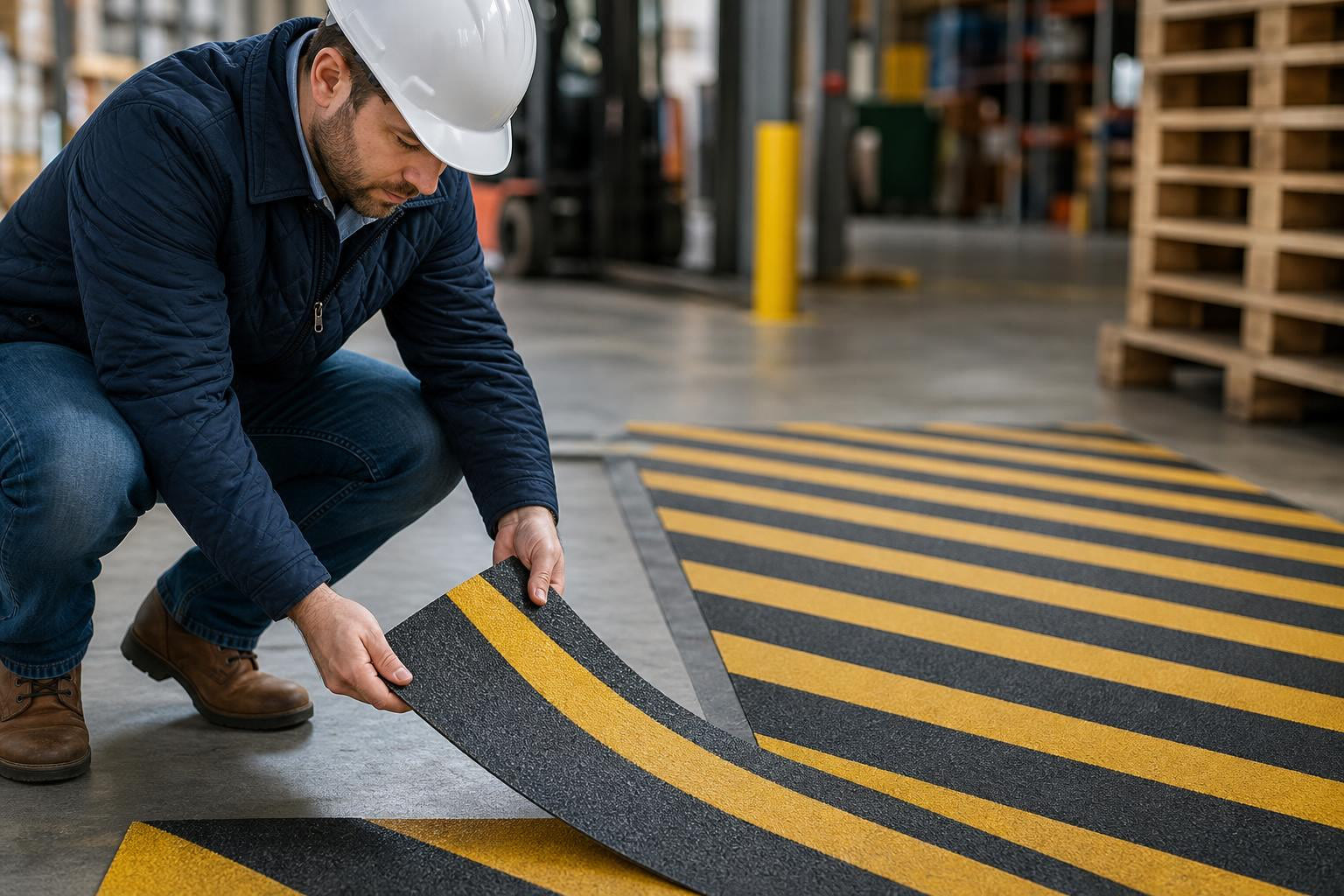
Full-surface anti-slip sheets for platforms, ramps, and walkways. These are used in industrial settings where the entire walking surface needs high traction, such as loading docks, maintenance platforms, and marine decks.
Choosing Between These Products
The general rule: nosings address the step edge where the vast majority of stair slips occur. Full tread covers are for heavily damaged surfaces. Tape is temporary. Deck strips are for flat or low-slope surfaces. Rung covers are for ladders. Tactile panels are for accessibility compliance, not general traction.
Section 4: Know the Terms That Determine Product Selection
This is where the procurement checklist for anti-slip products gets technical. These are the specification terms you’ll see in product data sheets, building codes, and supplier quotes. Understanding them prevents you from ordering the wrong product.
Indoor vs. Outdoor
Outdoor products must resist UV degradation, freeze-thaw cycles, and sustained moisture. Indoor-only products (certain rubber or vinyl nosings) will crack, fade, or delaminate outdoors within a season. Always confirm the product is rated for exterior use before specifying it for an outdoor stair or ramp.
Wet vs. Dry
The Coefficient of Friction (CoF) is the number that quantifies how slippery a surface is. CoF breaks into two categories:
Static Coefficient of Friction (SCOF) measures the force needed to start an object sliding. The ADA advisory recommends an SCOF of 0.6 for level surfaces and 0.8 for ramps.
Dynamic Coefficient of Friction (DCOF) measures the force needed to keep an already-moving object sliding. ANSI A137.1 requires a DCOF of 0.42 or greater for tile flooring intended to be walked on when wet.
A SCOF of 0.50 or higher is classified as “slip resistant” under UL 410 and ASTM D2047 standards. When comparing products, ask the supplier for CoF test results and the specific test method used. A product that only lists a “slip resistant” claim without a number is not giving you enough information.
Ice and Snow Exposure
Canadian winters are the highest-risk season for slip-and-fall injuries. Products for outdoor stairs, ramps, and walkways in Canada must have aggressive grit surfaces (carborundum inserts), not smooth rubber. Practitioners on contractor forums consistently note that rubber and vinyl nosings become skating rinks in freezing rain. FRP and aluminum with embedded grit are the standard choices for Canadian winter conditions.
Chemical Exposure
Industrial environments with acids, solvents, or cleaning chemicals require corrosion-resistant materials. FRP (fibre-reinforced plastic) is the go-to material for chemical plants, marine environments, and food processing facilities because it resists chemical attack without degrading.
Foot Traffic Volume
Low-traffic residential stairs can get by with lighter-duty products. High-traffic commercial, industrial, or public-access stairs need heavier materials and more aggressive grit. A product rated for 500 daily foot passages will fail on a transit station stairway handling 10,000.
Cart and Wheeled Traffic
Loading docks, warehouses, and hospital corridors see wheeled carts, dollies, and equipment. Anti-slip products in these areas need to be flush-mounted to avoid creating a trip edge, and durable enough to withstand wheel impact.
Installation Method
Three primary methods:
- Adhesive (fastest, lowest labour cost, but weakest bond for outdoor/wet applications)
- Screw-down (strongest mechanical fastening; requires drilling into the substrate)
- Clamp-on (for open steel grating where screws can’t be used)
The installation method dictates labour time, tool requirements, and total installed cost. For guidance on installing FRP nosings specifically, see the FRP installation guide for concrete steps.
Visibility
This is the specification contractors forget most often, and the one that fails inspections. Two terms matter:
Light Reflectance Value (LRV): A measurement of how much light a surface reflects. Building codes require a minimum 30% difference in LRV between the stair nosing and the surrounding tread. A dark nosing on a dark tread, or a light nosing on a light tread, will fail this test.
The 2-Inch Rule: The visually contrasting strip on the step edge must be at least 2 inches (51 mm) wide. A thin stripe of yellow paint does not meet this requirement.
If your project includes stairs, check the visual contrast requirement before ordering. A high-traction nosing that blends into the tread colour is a code violation waiting to happen.
Photoluminescent / Glow-in-the-Dark
For emergency egress stairs, glow-in-the-dark nosing strips charge under ambient light and remain visible during power outages. These are specified in building egress codes for high-rise buildings and assembly occupancies.
Maintenance
Anti-slip products reduce slip risk, but they do not eliminate it. Surfaces still need regular cleaning to remove oil, debris, algae, and ice. Grit surfaces can clog over time if not maintained. No anti-slip product is a substitute for a maintenance program.
Section 5: Understand the Materials
Material choice is the most consequential decision in the procurement checklist for anti-slip products for contractors. The wrong material fails prematurely, costs more in replacement and labour than the savings on the initial purchase, and can create liability rather than reducing it.
FRP (Fibre-Reinforced Plastic)
Also called GRP (glass-reinforced plastic) in some markets. FRP is a composite material made through a process called pultrusion, where continuous fibres are pulled through a resin bath and shaped into a profile. The result is lightweight, corrosion-proof, and can be cut to size on site with standard tools.
FRP has a longer lifespan than wood or aluminum in corrosive environments, with virtually zero maintenance cost once installed. It resists rust, chemical attack, and bending. In quality FRP nosings, anti-slip grit is permeated into the parent resins during manufacturing, which dramatically reduces the delamination common in inferior steel-type nosings.
FRP is the best material choice for chemical plants, marine environments, food processing facilities, and any location with aggressive corrosion. Browse FRP stair tread nosings to see available sizes and colours.
Aluminum
Aluminum is inherently resistant to corrosion, UV damage, and heavy wear. It maintains its structural integrity in high-traffic, constant-duty environments regardless of temperature fluctuations or moisture. High-quality aluminum anti-slip stair nosings can last 20+ years with minimal maintenance.
Aluminum is heavier and more rigid than FRP, which makes it a better fit for applications where structural stiffness matters, like heavily loaded industrial stairs. It also has a cleaner appearance for commercial and hospitality settings.
Carborundum / Grit Insert
The abrasive mineral bonded into or onto the nosing surface. Carborundum (silicon carbide) grit delivers the highest coefficient of friction of any common nosing surface. For outdoor stairs, emergency egress, or moisture-prone areas, grit inserts are strongly recommended over standard rubber by safety professionals.
Delamination: The Failure Mode to Watch For
Delamination occurs when the anti-slip surface layer separates from its base material. This is the primary failure mode in lower-grade metal nosings where a grit strip is simply glued onto an aluminum or steel channel. When the adhesive bond fails (from moisture, temperature cycling, or chemical exposure), the grit strip peels off, leaving a smooth metal edge that’s worse than no nosing at all.
Pultruded FRP avoids this problem because the grit is integrated into the resin matrix during manufacturing, not applied as a separate layer after the fact.
Material Selection Summary
| Environment | Recommended Material | Why |
|---|---|---|
| Chemical/marine/food processing | FRP | Corrosion-proof, chemical-resistant |
| Outdoor, high-traffic commercial | Aluminum with grit | Weather-resistant, 20+ year life |
| Canadian winter outdoor stairs | FRP or aluminum with grit | Ice/snow/salt resistance |
| Indoor commercial | FRP or aluminum | Both work; choose by budget and aesthetic |
| Temporary or light indoor | Anti-slip tape | Low cost, fast install, short lifespan |
Section 6: The Procurement Checklist (Condensed Reference)
Here is the complete procurement checklist for anti-slip products for contractors, distilled into 10 steps you can print or save for every project.
1. Identify every surface that needs anti-slip treatment.
Walk the entire site. Include stairs, ramps, walkways, ladders, decks, entrances, loading docks, platforms, and any other walking-working surface.
2. Record the substrate material for each surface.
Concrete, wood, metal, steel grating, tile, or existing FRP. The substrate determines what fasteners and adhesives you can use.
3. Note the exposure conditions.
Outdoor vs. indoor. Wet, oily, chemical, or dry. Winter ice and snow exposure. Covered or uncovered. Each combination narrows the product and material options.
4. Determine traffic volume.
Residential foot traffic, moderate commercial, high-volume public access, or heavy industrial. This dictates material grade, grit aggressiveness, and product thickness.
5. Check code requirements for your province and municipality.
Visual contrast (LRV difference of at least 30%), the 2-inch rule for nosing strips, TWSI requirements at stairs and curb ramps, and any local building code provisions for accessibility compliance. Code requirements vary by jurisdiction. Verify them against the specific standard for your project location.
6. Match each surface to the correct product type.
Stair nosing for step edges. Tread cover for full-surface damage. Deck strips for flat or low-slope surfaces. Rung covers for ladders. Tactile panels for accessibility. Ramp plates for sloped surfaces.
7. Specify the material.
FRP for corrosive or marine environments. Aluminum for weather resistance and long life. Grit inserts for any outdoor or wet application. Avoid rubber or vinyl for Canadian exterior use.
8. Measure every surface.
Stair width, riser height, nosing depth, tread depth, ladder rung diameter (round or square), ramp width, and walkway dimensions. Wrong measurements mean wrong orders, wasted material, and project delays.
9. Calculate quantities.
Count the number of stairs, rungs, ramp sections, and walkway areas. Add 5 to 10% for cuts, waste, and any field adjustments.
10. Confirm supplier logistics.
Lead time (stock vs. custom fabrication), shipping destination, return policy, and restocking fees. For tight project schedules, prioritize suppliers with stocked SKUs, published pricing, and confirmed handling times over custom fabrication.
Section 7: What Anti-Slip Products Cannot Do
Anti-slip products are engineering controls that reduce slip risk. They do not eliminate all slip risk. A few honest limits:
Surfaces still need cleaning and maintenance. Grit nosings clogged with mud, grease, or ice are not providing their rated traction. A maintenance schedule is not optional.
Ice, oil, and debris still need to be managed. An anti-slip nosing on an outdoor stair does not replace snow clearing, salting, or drainage management. It provides better traction between maintenance cycles, not a permanent substitute for maintenance itself.
Code and accessibility claims should be verified against the specific project location. Building codes differ by province, territory, and municipality. This guide references common thresholds (0.42 DCOF, 30% LRV contrast, the 2-inch rule), but the specific standard that applies to your project depends on the jurisdiction and the building classification. When in doubt, confirm with the authority having jurisdiction before finalizing your specification.
No single product covers every scenario. A procurement checklist for anti-slip products exists precisely because different surfaces, environments, and traffic patterns require different solutions. Buying one product type and applying it everywhere is the most common contractor shortcut, and the most common reason anti-slip measures fail.
Frequently Asked Questions
What is the most common mistake contractors make when ordering anti-slip products?
Forgetting the visual contrast requirement. Multiple practitioner sources confirm that the LRV contrast rule (at least 30% difference between nosing and tread, with a minimum 2-inch wide contrasting strip) is the specification that gets missed most often and the one that fails building inspections.
How do I choose between FRP and aluminum stair nosings?
FRP is lighter, corrosion-proof, and better for chemical or marine environments. Aluminum is heavier, structurally stiffer, and lasts 20+ years outdoors. Both work for most commercial applications. The deciding factor is usually the exposure conditions: if there’s chemical exposure, choose FRP. For general outdoor commercial stairs, aluminum with grit inserts is the standard.
Is anti-slip tape sufficient for outdoor stairs?
For temporary use or very light traffic, tape can work short-term. In high-traffic, outdoor, or wet environments, tape wears through or lifts within months. Engineered solutions like FRP or aluminum nosings provide permanent traction and are far more cost-effective over the life of the stair.
What CoF rating should I specify for commercial stairs?
For wet, level surfaces, the minimum DCOF threshold under ANSI A137.1 is 0.42. The ADA advisory recommends an SCOF of 0.6 for level surfaces and 0.8 for ramps. Specify products that meet or exceed these thresholds, and always ask the supplier for the specific test method and CoF value, not just a “slip resistant” label.
Do I need tactile indicators on every stairway?
It depends on the building type, jurisdiction, and accessibility code. Canadian accessibility standards require tactile indicators at specific locations including curb ramps, transit platform edges, and the top of certain stairways in public buildings. Check the requirements for your province and building classification.
How much extra material should I order?
Plan for 5 to 10% additional material beyond your exact count, to cover field cuts, waste, and any measurement adjustments. For stairs of non-standard width, confirm whether the product can be cut to size on site (FRP can; some aluminum profiles can).
Next Steps
A proper procurement checklist for anti-slip products for contractors prevents the wrong product on the wrong surface, avoids failed inspections, and protects the project schedule. Use the 10-step checklist above as your framework for every project.
Need help choosing the right product for a specific surface? Contact Safety Step Canada or visit the FAQ page for answers to common product and ordering questions.