
TL;DR
Slippery stairs are one of the most common safety hazards at home and at work. Fixing them is usually a weekend project. The right approach depends on your stair material (wood, concrete, metal, tile), whether the stairs are indoors or outdoors, and how much you want to spend. Options range from peel-and-stick tape (under $25) to screw-down stair nosings ($55 to $210) that last a decade or more. This guide walks you through every option, explains the terms you’ll run into while shopping, and helps you pick the best fix for your situation.
If you’ve ever slipped on your porch steps in the rain, nearly wiped out on glossy basement stairs in socks, or watched a family member grab the railing for dear life on icy outdoor steps, you already know the problem. Slippery stairs are dangerous, and they’re surprisingly common.
The good news: fixing them is straightforward. You don’t need to tear out your staircase or hire a contractor for most solutions. But when you start shopping for anti-slip products, the terminology gets confusing fast. Nosings, tread covers, FRP, grit tape, deck strips. Product pages throw these words around without explaining what they actually mean.
This guide fixes that. It covers why stairs get slippery, walks through every product option with honest pros and cons, defines the terms you’ll encounter, and helps you choose the right fix based on your stairs, your climate, and your budget.
Not sure where to start? Browse FRP stair nosings to see one of the most popular long-lasting options, or keep reading to figure out which solution fits your situation.
Why Stairs Become Slippery
Before you buy anything, it helps to understand what’s making your stairs slick. The cause points you toward the right fix.
Worn finishes. This is the number one culprit on indoor wood stairs. That polyurethane or paint that felt grippy when it was new? After a few years of foot traffic, it polishes smooth. Socks on worn hardwood stairs are a recipe for disaster.
Rain, snow, and ice. Outdoor stairs get wet, and wet stairs are slippery stairs. In Canada and the northern US, freeze-thaw cycles make things worse by cracking surfaces and breaking down adhesive products over time.
Algae and moss. If your outdoor stairs sit in shade and stay damp, they’ll eventually develop a green, slimy film. Pressure washing helps temporarily, but the slippery surface comes right back.
Naturally smooth materials. Polished concrete, painted metal, and glazed tile are low-grip surfaces even when dry. Add a little water and they become genuinely hazardous.
Dust and grime buildup. Even textured stairs lose their grip when coated in dirt, sawdust, or tracked-in debris. This is common on garage stairs and workshop steps.
Poor visibility. Sometimes the problem isn’t grip but visibility. When the stair edge blends into the tread (same color, same material), people misstep, especially in dim lighting or during power outages.
The Stair Edge Is Where Most Falls Start
Here’s something most people don’t realize: the leading edge of each step, the “nose,” is where most stair falls happen. It’s where your foot lands first when you’re going down, and it’s where worn-out traction matters most. That’s why so many anti-slip products focus specifically on this edge.
Why It’s Worth Fixing Now
Falls on stairs send roughly 1 million Americans to the emergency room every year. In Canada, approximately 1.7 million falls occur annually for people age 12 and older, accounting for about 40% of all injuries. Over 42,000 Canadian workers are injured from falls each year.
These aren’t just numbers. A broken wrist from slipping on icy porch steps means weeks in a cast. A fall down basement stairs can mean a concussion or worse. Most of these are preventable with a simple retrofit that costs less than a trip to the emergency room.
Step 1: Identify Your Stair Material
The material your stairs are made from determines which products will work and how you’ll install them. Here’s a quick breakdown.
Wood stairs are the most common in homes, both indoors and on porches and decks. Indoor wood stairs with worn varnish are the classic slippery stair. Outdoor wood stairs face the added challenge of moisture, algae, and weathering. Practitioners on Reddit’s r/Carpentry consistently recommend starting with a pressure wash for outdoor wood stairs, then adding screw-down treads or nosings for a permanent fix.
Concrete stairs are common for front steps, basement entries, and garage stairs. Even textured concrete gets slippery when wet or icy. You can anchor nosings or tread covers directly into concrete with masonry screws or concrete anchors. Learn more in our guide on installing FRP nosings on concrete.
Metal stairs show up on fire escapes, exterior access stairs, and some modern interior designs. Smooth metal is extremely slippery when wet. Anti-slip nosings bond well to metal and won’t cause the rust problems you get with metal-on-metal fastening.
Tile stairs are found in entryways, bathrooms, and some basements. Anti-slip coatings can help without changing the look, but they wear down and need reapplication every one to three years.
Ladder rungs are a special case. Steel rungs in garages, sheds, and workshops get coated with moisture and grime. Dedicated ladder rung covers fit over existing rungs and provide immediate grip without replacing the ladder.
Step 2: Choose Your Anti-Slip Solution
There are six main ways to fix slippery stairs. Each has different costs, installation difficulty, and lifespan. Here’s what to know about each one, including the honest trade-offs.
Option 1: Stair Nosings (The Long-Term Fix)
What they are: Tough, textured profiles that attach to the front edge of each step, right where falls start.
Materials: FRP (fiberglass-reinforced polymer) or aluminum. Both last 10+ years.
Cost: FRP nosings start at $55 CAD for a 900mm length. Aluminum nosings start from $79 CAD.
How to install: Measure your stair width, cut the nosing to fit (a standard hacksaw or circular saw works for FRP), drill pilot holes, and screw them down. Most people can do a full staircase in an afternoon. Our aluminum nosing installation guide walks through the process step by step.
Best for: Outdoor stairs, high-traffic indoor stairs, concrete or wood steps, and anywhere you want a “fix it and forget it” solution.
Why homeowners love them: You install them once and they work for years, even in harsh weather. They also add a visible contrast stripe to each step edge, which helps prevent missteps in low light.
Shop stair tread nosings to see available widths, lengths, and color options including glow strip variants.
Option 2: Stair Tread Covers (Full Step Coverage)
What they are: Broader panels that cover most or all of the horizontal step surface, not just the front edge.
Cost: Varies by material and size. Aluminum tread covers are available for outdoor stairs.
How to install: Similar to nosings but covering more surface area. Screw or adhesive mounting depending on the product and your stair material.
Best for: Stairs where the entire tread is worn or slippery, not just the edge. Common on old concrete steps and commercial stairwells.
Key distinction: A nosing covers the edge. A tread cover covers the flat. In really bad situations, some people install both.
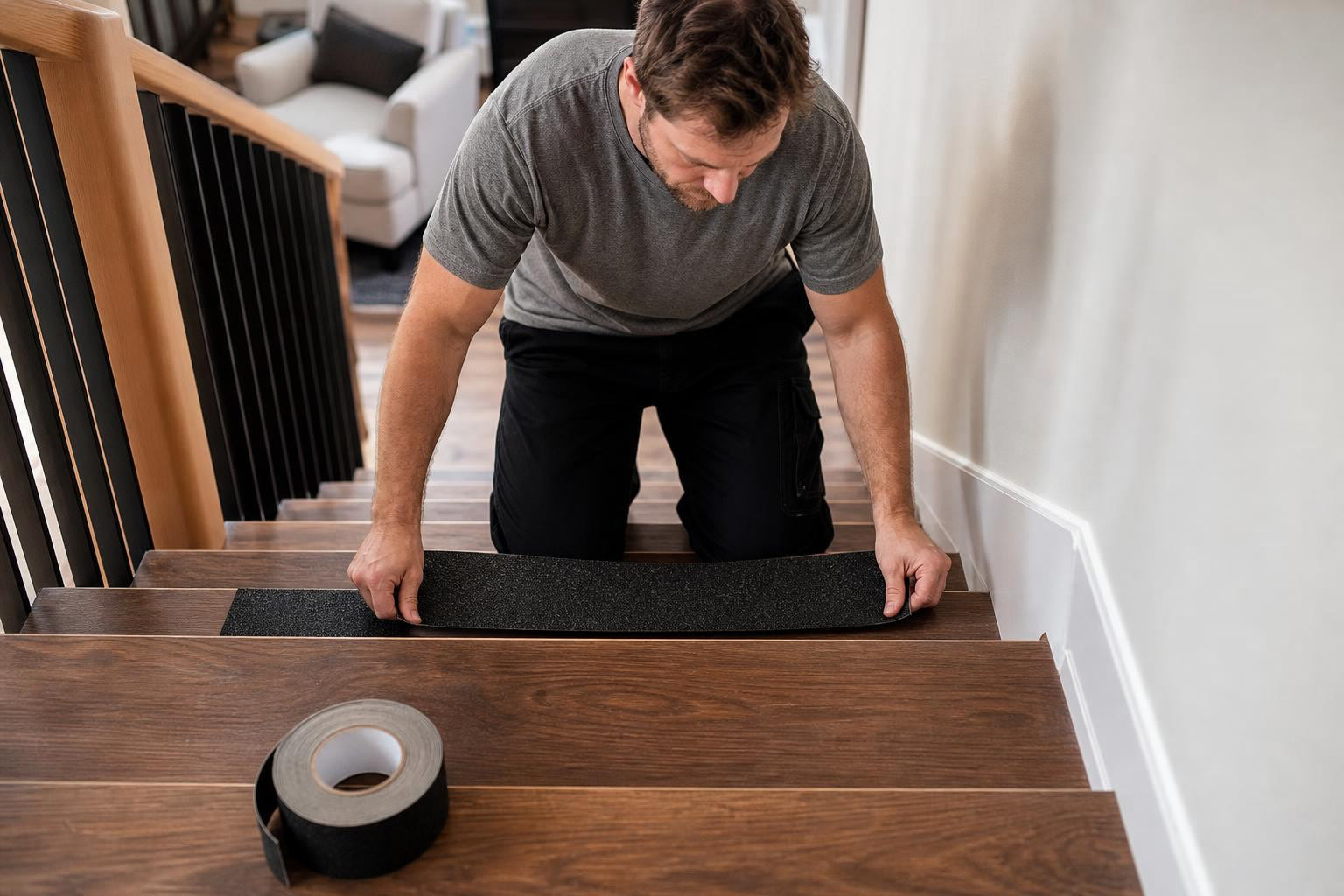
Option 3: Anti-Slip Tape (The Quick Fix)
What it is: Peel-and-stick tape with a sandpaper-like grit surface.
Cost: Typically $10 to $30 per roll. Anti-slip grip tape is available in various widths.
How to install: Clean the step surface thoroughly, peel off the backing, press firmly. Done in minutes.
Best for: Indoor stairs where you need an immediate fix. Light-traffic areas. Renters who can’t make permanent modifications.
The honest truth about tape outdoors: This is where you need to set realistic expectations. Practitioners on the Fine Homebuilding forum report tape peeling up in about 18 months outdoors, with one user noting it was “kind of expensive for what it is” given that lifespan. In Canadian and northern US winters, freeze-thaw cycles break down the adhesive even faster. Many people report tape failing within a single season outdoors.
Bottom line: Tape is great for a quick indoor fix. For outdoor stairs or stairs that see heavy use, plan on replacing it regularly, or spend a bit more on nosings that won’t need replacing.
Option 4: Anti-Slip Deck Strips (For Decks, Ramps, and Walkways)
What they are: Thicker, more durable adhesive strips designed for flat outdoor surfaces.
Cost: Starting at $24.95 CAD for a 1000mm strip, up to $75 CAD for a 2400mm strip.
How to install: Clean the surface, apply the adhesive strip, and optionally add a screw at each end for extra security.
Best for: Wooden decks that get slippery in rain or snow, ramps, and walkways. Available in yellow, black, hazard stripe, and beige to match your deck.
View anti-slip deck strips for pricing and color options.
Option 5: Anti-Slip Coatings and Paints (The Invisible Fix)
What they are: Clear or near-clear liquid coatings you apply with a brush or roller. They add micro-texture to the stair surface without changing its appearance.
Cost: Varies by brand, typically $20 to $50 for enough to do one staircase.
How to install: Clean the stairs thoroughly, apply with a brush or roller like you would a coat of varnish, let dry completely (usually 24 hours).
Best for: Indoor wood stairs where you want to keep the natural look. Tile stairs where you don’t want visible hardware.
The catch: Coatings wear down. Most last one to three years depending on foot traffic. A practitioner on the Fine Homebuilding forum pointed out that adding grit to varnish “would trap dirt too, and look dingy,” which is something marketing materials rarely mention. Plan on reapplying periodically.
Option 6: Carpet Treads and Stair Runners (The Residential Classic)
What they are: Fabric-based treads or a continuous carpet strip running down the center of the staircase.
Cost: $15 to $100+ for a set of treads, depending on material and quality.
How to install: Adhesive-backed treads just press in place. Runners typically use tack strips or double-sided tape.
Best for: Interior residential stairs where comfort and noise reduction matter alongside traction.
Limitations: Carpet treads leave the stair edges exposed (the most dangerous spot). Runners can shift or buckle if not properly secured. Neither option works outdoors.
Quick-Reference Comparison Table
| Solution | Best For | Lifespan | Difficulty | Approx. Cost | Indoor/Outdoor |
|---|---|---|---|---|---|
| FRP Stair Nosing | Long-term fix, outdoor stairs | 10+ years | Moderate (drill + screw) | $55–$210 CAD per nosing | Both |
| Aluminum Stair Nosing | Outdoor concrete/metal stairs | 10+ years | Moderate (drill + screw) | From $79 CAD | Both |
| Stair Tread Cover | Full-step coverage, heavy wear | 10+ years | Moderate | Varies | Both |
| Anti-Slip Tape | Quick indoor fix, renters | 1–3 years indoors; under 18 months outdoors | Easy (peel and stick) | $10–$30 per roll | Mostly indoor |
| Anti-Slip Deck Strip | Decks, ramps, walkways | 5+ years | Easy to moderate | $25–$75 CAD per strip | Outdoor |
| Anti-Slip Coating | Keeping wood stair appearance | 1–3 years | Easy (brush on) | $20–$50 per staircase | Both (better indoors) |
| Carpet Tread/Runner | Interior home stairs | 2–5 years | Easy | $15–$100+ per set | Indoor only |
| Ladder Rung Cover | Workshop/garage ladders | 10+ years | Easy (clamp on) | $55 CAD each | Both |
The big takeaway from this table: Tape and coatings are cheap upfront but need regular replacement. Nosings and tread covers cost more initially but last years longer. Over five to ten years, the “expensive” option usually costs less because you’re not replacing it every year or two.
Glossary: Anti-Slip Terms Explained in Plain Language
When you’re shopping for anti-slip products, you’ll run into some unfamiliar terms. Here’s what they all mean.
Stair Nosing
The textured strip that attaches to the front edge (the “nose”) of each stair step. It protects the step edge from wear and provides grip right where your foot lands first. This is the single most effective way to fix slippery stairs because it targets exactly where falls begin.
Shop stair tread nosings to see available sizes, colors, and glow strip options.
Stair Tread Cover (Step Cover)
A wider panel that covers most or all of the flat part of the step, not just the front edge. Think of it as a nosing’s bigger sibling. Some people install both a nosing on the edge and a tread cover across the step for maximum coverage.
FRP (Fibre-Reinforced Polymer)
A composite material made from fiberglass and resin. In anti-slip products, FRP has gritty particles bonded into the material during manufacturing, not just sprinkled on top. This means the grip doesn’t wear off the way it does with tape or coatings. FRP is also lightweight, rustproof, and easy to cut with basic tools, which makes it a good option for DIY installation.
Pultruded / Pultrusion
A manufacturing method where continuous glass fibers are pulled through resin and shaped in a heated mold. The result is a product that’s consistently strong throughout and won’t peel apart in layers (a problem called delamination, covered below). When shopping for FRP nosings, pultruded products are the more durable option. You can learn more about cutting and fitting them in our on-site fitting guide.
Aluminum Stair Nosing
A nosing made from aluminum alloy instead of FRP. Aluminum nosings are weather-resistant, hold up to heavy foot traffic, and have a clean, professional appearance. They’re a popular choice for fixing slippery outdoor stairs on concrete or metal steps where looks matter. Our aluminum nosing installation guide covers the full process.
Browse aluminum stair nosings starting from $79.00 CAD.
Anti-Slip Tape / Grip Tape
Adhesive-backed tape with a rough, sandpaper-like surface. You peel off the backing and stick it to your stairs. It’s the fastest way to fix slippery stairs, but it has real limitations outdoors. Anti-slip grip tape works well for indoor stairs with moderate foot traffic. Expect to replace it every one to three years indoors, and much sooner outside.
Anti-Slip Deck Strip
A thicker, more rigid version of grip tape designed for outdoor surfaces. Safety Step Canada’s EZ Strips come in 1000mm and 2400mm lengths and work on wood, concrete, brick, stone, and metal. They’re the go-to solution for slippery decks and ramp surfaces where full nosings aren’t needed.
Anti-Slip Coating / Non-Slip Floor Finish
A liquid you brush or roll onto stairs. It dries clear and adds subtle texture without changing how the stairs look. Great for preserving the appearance of wood stairs indoors, but plan on reapplying every one to three years as foot traffic wears it down.
Coefficient of Friction (COF)
A number that measures how much grip a surface provides. Higher number means more grip. You might see this on product spec sheets. The standard safety threshold for level floors is a score of 0.43 or higher. It’s useful for comparing products objectively rather than just trusting marketing claims.
Luminance Contrast
The brightness difference between the nosing and the stair tread. A yellow nosing on dark concrete, for example, has high luminance contrast. This makes the step edge easy to see, which is important in dim lighting and for people with vision impairments. Many building codes now require minimum contrast at stair edges.
Glow-in-the-Dark (Photoluminescent) Nosing
Nosings that absorb light during the day and glow in the dark. They keep step edges visible during power outages, which matters for safety in any multi-story home or building. Glow-in-the-dark stair strips are available for adding visibility without replacing your existing nosings.
Ladder Rung Cover
A cover that snaps or clamps over existing steel ladder rungs to add a gritty, slip-resistant surface. Perfect for workshop ladders, dock ladders, or any fixed ladder exposed to moisture and grime. You get new traction without buying a new ladder. Ladder rung covers are available for both square and round rungs.
Saddle Clamp Assembly
Stainless steel hardware used to attach nosings to metal grating stairs where you can’t drill through the step. If your stairs are open-mesh steel grating (common on industrial platforms, outdoor mezzanines, and some dock stairs), saddle clamp assemblies are how you secure nosings without screws.
Substrate
Just a fancy word for whatever material your stairs are made from: wood, concrete, steel, tile, or something else. Every product listing will ask about your substrate because the attachment method depends on it.
Delamination
When layers of a material separate and peel apart. This happens with lower-quality fiberglass products and with adhesive tapes exposed to weather extremes. A seasoned commenter on DoItYourself.com forums captured this well: “About the only thing that will remain grippy without cleaning is a very aggressive stamped metal.” Products with grit bonded into the material (like pultruded FRP) resist delamination far better than surface-applied solutions.
Retrofit
Adding anti-slip products to stairs that already exist, without tearing them out and rebuilding. Almost every anti-slip product is a retrofit solution. You’re working with the stairs you have, not building new ones.
Traction
The grip between your shoe and the stair surface. This is what every anti-slip product is trying to increase, through texture, material changes, or physical grit that interlocks with your shoe sole.
How to Choose: A Simple Decision Guide
Picking the right fix doesn’t have to be complicated. Ask yourself these questions:
Are your stairs indoors or outdoors?
Indoor stairs are more forgiving. Tape, coatings, and carpet treads all work fine in climate-controlled spaces. Outdoor stairs need mechanical solutions (screw-down nosings or deck strips) because adhesive products break down in weather.
Do your stairs get wet regularly?
Any surface that gets wet, whether from rain, snow, tracked-in water, or mopping, needs aggressive traction. Products with grit bonded into the material (FRP nosings) outperform surface-coated products in wet conditions.
Do you deal with ice and snow?
This is the single biggest factor for anyone in Canada or the northern US. Freeze-thaw cycles destroy adhesive bonds, crack coatings, and peel up tape. Across Reddit, Fine Homebuilding, and DIY forums, the real-world experience is consistent: adhesive-only products fail within one to two seasons outdoors in freezing climates. Screw-fastened FRP and aluminum nosings handle these conditions without issue.
How much foot traffic do your stairs get?
A back porch used by two people is different from a front staircase used by a family of five and all their guests. Higher traffic wears through coatings and tape faster. Nosings and tread covers handle heavy use without degradation.
How important is appearance?
If you want your wood stairs to look exactly the same, a clear coating is your best bet (with the understanding that you’ll reapply it every couple of years). If you’re okay with a visible nosing strip, you get much better long-term performance. Aluminum nosings offer a clean, subtle look. Yellow FRP nosings are highly visible, which is a safety feature in its own right.
What’s your budget?
Be honest about whether you’re comparing purchase price or total cost. A $20 roll of tape replaced three times over five years costs $60 plus your time. A $55 nosing installed once costs $55 for the same period. For most homeowners, the math favors nosings if you can spend a bit more upfront.
How handy are you?
Tape and coatings require zero tools. Nosings require a drill, screws, and the ability to measure and cut. It’s a straightforward DIY project, roughly the same difficulty as hanging a shelf, but it’s not peel-and-stick simple.
Step-by-Step: How to Install Stair Nosings (DIY)
Here’s the basic process for installing screw-down nosings on wood or concrete stairs. Always follow the specific instructions that come with your product, but this gives you a sense of what’s involved.
What you’ll need:
- Stair nosings (measured and cut to your stair width)
- Drill/driver
- Appropriate screws (wood screws for wood stairs, masonry anchors for concrete)
- Tape measure
- Pencil for marking
- Safety glasses
- Hacksaw or circular saw (for cutting nosings to length)
- Construction adhesive (optional, for extra holding power)
Steps:
-
Clean the stairs. Remove all dirt, debris, old tape, and loose paint from the step edges. The nosing needs to sit flat against a clean surface.
-
Measure each step. Stair widths can vary, especially on older houses. Measure each step individually.
-
Cut the nosings to length. FRP nosings cut easily with a hacksaw or circular saw. Wear safety glasses since the material produces fine dust.
-
Dry-fit each nosing. Place it on the step edge before drilling to make sure it sits flush and centered.
-
Mark your drill holes. Most nosings have pre-drilled holes. Use these as a guide to mark the step surface with a pencil.
-
Drill pilot holes. For wood, use a bit slightly smaller than your screws. For concrete, use a masonry bit and insert anchors.
-
Apply adhesive (optional). A bead of construction adhesive along the back of the nosing adds extra bond strength, especially on outdoor stairs.
-
Screw down the nosing. Drive screws snugly but don’t overtighten, which can crack FRP.
-
Repeat for each step. Work from top to bottom so you’re not stepping on freshly installed nosings.
The whole job typically takes one to three hours for a standard staircase. No special skills required.
Important Things to Know
Anti-slip products reduce risk, but they don’t eliminate it completely. A nosing covered in a sheet of ice is still dangerous. Regular maintenance matters: sweep grit surfaces periodically so dirt doesn’t fill in the texture, keep stairs clear of snow and debris, and replace worn products before they lose effectiveness.
If you’re a landlord, property manager, or business owner, local building codes may have specific requirements for stair traction and visibility. Standards vary between provinces and municipalities in Canada (and between states in the US). Products may support code compliance, but it’s worth checking your local requirements.
Winter conditions significantly increase slip-and-fall risk. Over 160,000 fall-related injuries required hospitalization in a single year based on Canadian Institute for Health Information data, with winter conditions a major contributing factor. Anti-slip nosings are one part of the solution; salting, sanding, and snow removal are the other.
Ready to Fix Your Slippery Stairs?
The right solution depends on your stair material, whether they’re indoors or outdoors, and how much traffic they get. For most homeowners dealing with outdoor stairs or high-traffic indoor stairs, FRP or aluminum nosings provide the best combination of durability, safety, and long-term value.
Contact Safety Step Canada if you need help choosing the right product for your specific stairs. For quick answers to common questions, visit our FAQ page.
Frequently Asked Questions
What is the fastest way to fix slippery stairs?
Anti-slip tape is the fastest option. Peel, stick, done in minutes. But speed comes with trade-offs: outdoor tape typically lasts only 6 to 18 months. For a fast fix that also lasts, screw-down FRP nosings can be cut to size and installed in under an hour per staircase with basic tools.
Do anti-slip products work on all stair materials?
Most products work across multiple materials, but the installation method changes. FRP nosings can be screwed into wood, anchored into concrete, or clamped onto metal grating. Adhesive deck strips bond to wood, concrete, brick, stone, and metal. Always confirm the product works with your specific stair material before buying.
How long do anti-slip stair nosings last compared to tape?
FRP and aluminum nosings typically last 10 years or more. Anti-slip tape lasts one to three years indoors and often less than 18 months outdoors. In Canadian or northern US winters, tape frequently fails within a single season. The upfront cost of nosings is higher, but the total cost over five to ten years is almost always lower.
Can I fix slippery stairs without changing how they look?
Yes. Clear anti-slip coatings preserve the appearance of wood stairs while adding micro-texture. They last one to three years before needing reapplication. If coatings aren’t enough, low-profile aluminum nosings in colors that complement your stairs offer a balance between safety and appearance.
What causes anti-slip tape to fail outdoors?
Three things: moisture getting under the adhesive, UV degradation from sun exposure, and freeze-thaw cycles that expand and contract the tape and stair surface at different rates. Surface prep is also a big factor. Practitioners across online forums consistently identify dirty or damp surfaces at the time of application as the number one reason tape peels prematurely.
Are there anti-slip solutions that also help with visibility?
Yes. High-contrast nosings (yellow on dark stairs) and glow-in-the-dark nosings serve double duty. They increase traction and make each step edge visible, even during power outages. This is especially useful in basements, garages, and any stairwell with poor lighting.
What’s the difference between a stair nosing and a stair tread cover?
A nosing covers only the front edge of the step. A tread cover spans the full flat surface. Nosings target the highest-risk zone (the leading edge where slips start). Tread covers protect the entire stepping surface. For stairs in really bad shape, you can install both.
How do I choose between FRP and aluminum stair nosings?
FRP is lighter, chemical-resistant, and rustproof, making it the better choice for coastal locations, pool areas, or anywhere with salt or chemical exposure. Aluminum is stronger under impact and has a more polished look, which works well when appearance matters. Both last 10+ years. Read our stair nosing buyer’s guide for a detailed comparison.
How much does it cost to fix slippery stairs?
It depends on the solution. Anti-slip tape runs $10 to $30 per roll. Deck strips cost $25 to $75 CAD each. FRP nosings range from $55 to $210 CAD depending on width and length. Aluminum nosings start at $79 CAD. For a standard outdoor staircase with five to seven steps, expect to spend roughly $275 to $500 CAD on FRP nosings for a solution that lasts over a decade, or about $50 to $100 on tape that you’ll replace every year or two.