
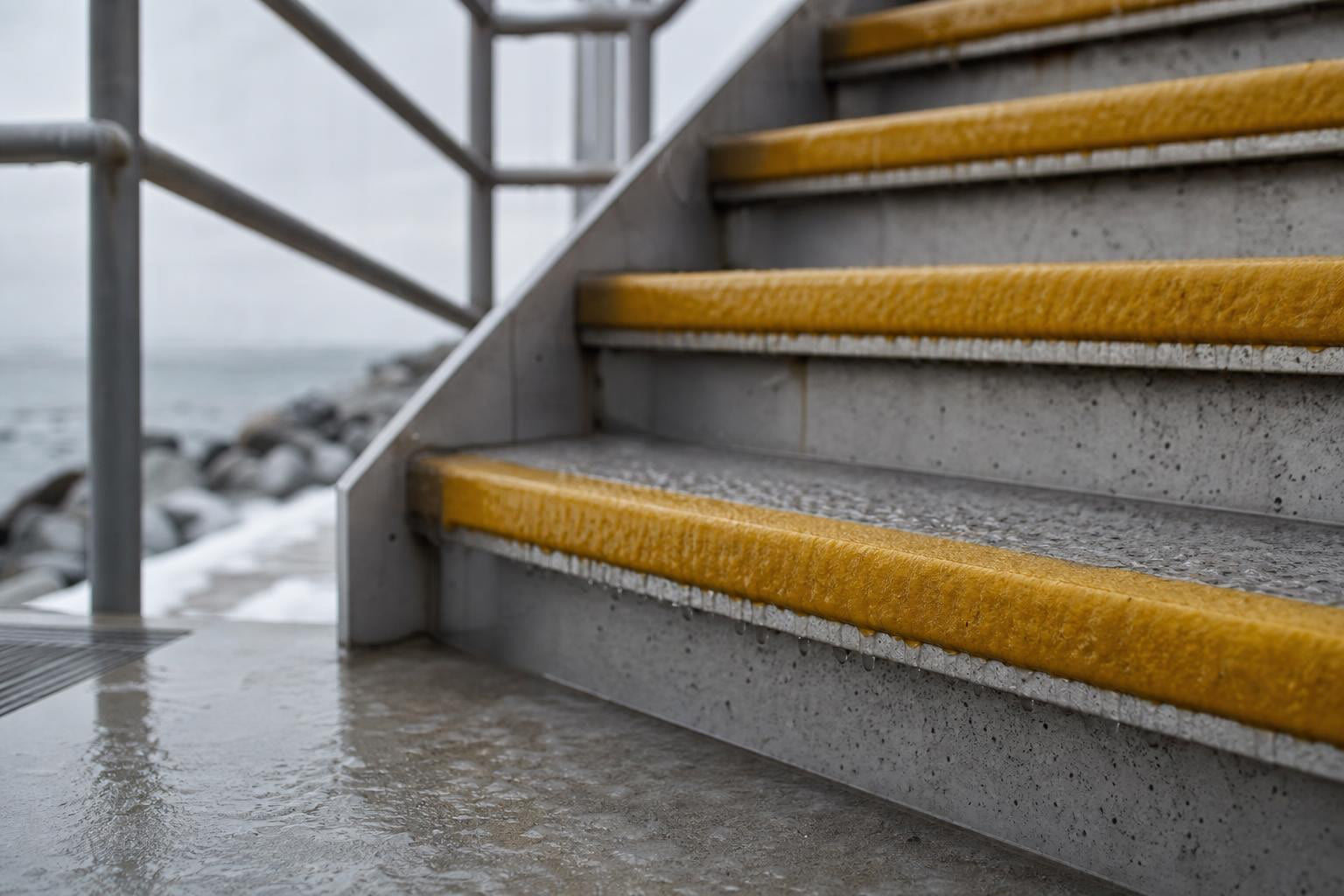
TL;DR
Durability data for FRP pultruded nosings points to a 20 to 30+ year service life based on manufacturer field evidence, with related pultruded FRP products retaining over 80% of structural properties after 40 years in harsh environments. Key test standards include EN 13706, ASTM D7792 (freeze-thaw), ASTM D4329 (UV), and ASTM E84 (fire). Controlled lab data beyond 18 months remains thin across the industry, but real-world performance in corrosive, wet, and freeze-thaw conditions is strong compared to metal and tape alternatives.
This guide is for facility managers, specifiers, contractors, and procurement teams who need hard numbers before committing to FRP pultruded stair nosings. If you’re comparing FRP against aluminum, anti-slip tape, or painted treads and want to know what “durable” actually means in measurable terms, this is the reference you need.
Browse FRP stair tread nosings to see available sizes and colors.
What “Durability Data” Actually Means for FRP Pultruded Nosings
Durability data for FRP pultruded nosings is not a single number. It is a collection of measured performance metrics that describe how the nosing holds up under specific stresses over time: flexural strength retention, corrosion resistance, UV stability, freeze-thaw tolerance, grit retention, and delamination resistance.
This distinction matters because marketing language often substitutes adjectives (“long-lasting,” “heavy-duty”) for actual test results. When you see durability data for FRP pultruded nosings cited properly, it should reference a test method, a measured property, and either a time frame or a cycle count.
The reason buyers search for this data is straightforward. They’re comparing FRP nosings against aluminum stair nosings, anti-slip tape, and paint. Each option degrades differently. Tape peels. Paint wears through. Metal corrodes. FRP resists all three failure modes, but “resists” needs backing with numbers, not just claims.
What “Pultruded” Means for Durability
Pultrusion is a continuous manufacturing process where glass fiber rovings are pulled through a resin bath and then through a heated die. The fibers align in one direction, creating a profile with exceptional longitudinal strength. Unlike hand-layup or spray-up methods, pultrusion produces consistent fiber-to-resin ratios across every inch of the product.
This matters for nosings because the continuous fiber alignment is what makes pultruded FRP resistant to the delamination that plagues metal-backed alternatives. In metal nosings, an anti-slip grit surface is bonded to a metal substrate using adhesive. Over time, foot traffic, moisture cycling, and temperature swings attack that bond line. Practitioners in the anti-slip industry have observed that metal-backed nosings in high-traffic environments can lose their grit surface through delamination within a few years.
Pultruded FRP nosings take a different approach: the anti-slip grit is impregnated directly into the composite matrix during manufacturing. There is no separate adhesive layer to fail. This one-piece construction is the single biggest durability advantage pultruded FRP holds over metal-backed and adhesive-bonded alternatives.
Pultruded vs. Molded FRP
Both pultruded and molded FRP use glass fiber and resin, but they serve different structural roles. Pultruded profiles have continuous unidirectional fibers, giving them higher strength along the length of the nosing. Molded FRP uses chopped or woven fibers for bi-directional strength but at lower absolute values in any single direction.
For stair nosings, pultruded construction excels in heavy-duty applications requiring longer spans and higher load capacity. Applications like industrial and commercial facilities, oil sands plants, and mining operations favor pultruded profiles for exactly this reason. If you need help understanding how to cut and fit pultruded FRP nosings on site, that process is straightforward with standard tools.
Key Durability Properties and What They Measure
Each property in the durability data for FRP pultruded nosings tells you something specific about how the product will perform. Here is what each one means in practical terms.
Flexural Strength and Modulus
Flexural strength measures how much bending force the nosing can absorb before it fails. Flexural modulus measures stiffness, or how much it deflects under load before reaching that failure point. Under the European standard EN 13706, the higher Grade E23 requires a minimum longitudinal flexural strength of 240 MPa and a flexural modulus of 23 GPa. These benchmarks give specifiers a floor for structural performance.
Why it matters for nosings: a nosing that deflects too much under foot traffic feels unstable and can work loose from its fasteners over time. High flexural modulus means the nosing stays rigid across the span between mounting points.
Corrosion Resistance
FRP composites do not rust. Period. They eliminate the corrosion cycle that destroys steel and aluminum nosings in wet, salty, or chemically aggressive environments. This is not a marginal advantage; it fundamentally changes the maintenance equation. Steel nosings on exterior stairs in a Canadian coastal environment will show rust within a few years. FRP nosings in the same location will show no corrosion at all.
The corrosion resistance comes from the resin matrix (typically isophthalic polyester or vinyl ester) that encapsulates the glass fibers and prevents moisture from reaching them. Vinyl ester resins offer better chemical resistance and are preferred for environments with acid, alkali, or solvent exposure.
UV Resistance
UV radiation is the primary environmental threat to FRP composites in outdoor installations. Over time, UV breaks down the resin on the exposed surface, causing a phenomenon called “fiber blooming” where the glass fibers become visible. This leads to poor aesthetics, degraded mechanical properties near the surface, and potentially shortened service life.
The fix is built into the manufacturing process. UV absorber (UVA) additives are incorporated into the resin during pultrusion. Strongwell’s specification for pultruded grating and treads requires that all FRP products exposed to weather contain an ultraviolet inhibitor, with optional UV coating for additional protection. Color in fiberglass nosings is UV-stabilized to resist fading, though some fading may occur over many years of intense sun exposure.
For testing, ASTM D4329 (Cycle A) is the relevant standard. Strongwell uses a 750-hour accelerated UV exposure benchmark in its specifications.
Freeze-Thaw Tolerance
This is where durability data for FRP pultruded nosings becomes especially relevant for Canadian installations. Research on pultruded FRP bridge deck materials found that freeze-thaw cycling between 4.4°C and -17.8°C for up to 625 cycles (1,250 hours) caused “very insignificant or no change” in flexural strength, storage modulus, or loss factor.
The dedicated test standard is ASTM D7792, specifically written for freeze-thaw conditioning of pultruded FRP composites used in structural designs. Canadian research has also confirmed that the bond between carbon FRP strips and concrete is not significantly damaged by up to 300 freeze-thaw cycles.
For anyone specifying nosings in provinces with harsh winters (which is most of Canada), this data is critical. Metal nosings expand and contract with temperature swings, loosening fasteners and breaking adhesive bonds. FRP’s thermal stability means the nosing stays put.
Slip Resistance Retention
The anti-slip grit on FRP nosings wears down under foot traffic. How quickly depends on grit type, traffic volume, and whether the grit is surface-bonded or impregnated into the composite. Impregnated grit, standard on pultruded FRP nosings, wears more slowly because fresh grit particles are exposed as the surface wears.
ASTM F1637, the “Standard Practice for Safe Walking Surfaces,” addresses slip resistance for indoor and outdoor walking surfaces and is the relevant reference for verifying that nosings maintain adequate traction under expected conditions.
Delamination Resistance
As discussed above, pultruded FRP nosings resist delamination because they are manufactured as a single piece with grit embedded in the matrix. Metal nosings with bonded grit surfaces are vulnerable to delamination from moisture ingress, thermal cycling, and impact. Multiple suppliers in the anti-slip industry specifically market FRP nosings as replacements for areas where delamination has occurred with metal stair nosings.
Fire Retardancy
ASTM E84 tests flame spread and smoke development. Fire-retardant grades of pultruded FRP achieve a flame spread rating of 25 or less, meeting the threshold required for many building and industrial applications. The fire performance depends on the resin system; always confirm the specific ASTM E84 rating for the product you are specifying.
Real-World Service Life Data
The strongest piece of durability data for FRP pultruded nosings comes not from a lab but from the field. Strongwell’s landmark durability study examined pultruded FRP grating installed on an offshore platform in 1979. After more than 40 years of daily weather exposure and pedestrian traffic, the grating retained over 80% of its flexural modulus and 80% of its maximum load capability.
While that study covered grating rather than nosings specifically, the material, manufacturing process, and exposure conditions are directly analogous. A pultruded FRP nosing uses the same resin systems, fiber reinforcement, and UV stabilization as pultruded grating.
For stair nosings specifically, manufacturer claims are more conservative but still strong. American Stair Treads cites a service life of 20 to 30 years or more for fiberglass stair treads and nosings, noting they “won’t rust, rot, or deteriorate from moisture or chemical exposure.” Strongwell’s FAQ reports that several customers have documented service life in excess of 30 to 40 years.
Warranty Comparisons
Warranties are not the same as service life, but they signal manufacturer confidence:
- FRP nosing suppliers typically warrant against delamination for 5 years
- Metal stair nosing warranties commonly run 10 years
- Anti-slip tape typically carries no meaningful warranty beyond adhesion for 1 to 2 years
The gap between warranty period and actual service life is large for FRP. A 5-year warranty on a product that commonly lasts 20+ years reflects the conservative nature of warranty programs, not a limitation of the material.
The Honest Data Gap
A comprehensive review published in Composites Part B found that there is still a lack of experimental databases on the durability of FRP composites, particularly for lab tests conducted beyond 18 months. This is an industry-wide limitation, not specific to nosings. The controlled, accelerated-aging studies that would let engineers predict a precise 25-year lifespan from lab data simply have not been conducted at sufficient scale.
What fills this gap is field evidence. The Strongwell 40-year study, two decades of manufacturer warranty tracking, and thousands of in-service installations across industrial and commercial environments collectively provide strong evidence. But anyone reviewing durability data for FRP pultruded nosings should understand that the picture is built primarily from real-world observation rather than controlled laboratory databases.
You can see examples of FRP products in actual field installations on the projects page.
Relevant Test Standards
When evaluating durability data for FRP pultruded nosings, these are the standards that matter:
| Standard | What It Tests | Why It Matters for Nosings |
|---|---|---|
| EN 13706 | Structural grades (E23/E17) for pultruded profiles | Sets minimum flexural strength (240 MPa) and modulus (23 GPa) benchmarks |
| ASTM D7792 | Freeze-thaw conditioning of pultruded FRP | Validates performance through Canadian winter cycles |
| ASTM D4329 (Cycle A) | Accelerated UV exposure | Confirms outdoor color and strength retention |
| ASTM E84 | Flame spread and smoke development | Fire safety compliance (≤25 for fire-retardant grades) |
| ASTM F1637 | Safe walking surface practices | Slip resistance requirements for pedestrian surfaces |
When requesting durability data from a supplier, ask which of these standards the product has been tested against. A supplier who can provide test certificates referencing specific standards is more credible than one offering only general claims.
For more on how FRP compares to other materials for stair applications, the stair nosing buyer’s guide covers material selection and cost comparisons.
Factors That Reduce FRP Nosing Lifespan
FRP pultruded nosings are durable, but they are not indestructible. Several factors can shorten their service life:
Prolonged UV without inhibitors. If a nosing was manufactured without UVA additives and installed outdoors, the resin surface will degrade. Fiber blooming becomes visible, and surface mechanical properties decline. Always confirm UV inhibitors are factory-included for outdoor applications.
Chemical exposure beyond the resin’s rating. Isophthalic polyester resin handles most common chemicals, but concentrated acids, specific solvents, or high-temperature chemical exposure may require vinyl ester resin. Using the wrong resin for the environment will shorten life significantly.
Abrasive cleaning methods. Steel brushes and abrasive cleaners damage the resin surface and accelerate grit wear. FRP nosings need only water and mild detergent for regular cleaning.
Improper installation. A nosing that is not firmly secured will shift under traffic, creating catch points that accelerate wear on both the nosing and the stair edge. Proper fastening hardware, such as stainless steel saddle clamp assemblies, prevents this. For detailed installation steps, see the guide on installing FRP stair nosing on concrete steps.
Impact from heavy equipment. FRP nosings are rated for pedestrian and light cart traffic. Repeated impacts from heavy rolling loads or dropped equipment can crack the resin matrix and expose fibers.
How to Evaluate Durability Claims When Buying
Use this checklist when comparing FRP pultruded nosings from different suppliers:
-
Ask about the resin type. Isophthalic polyester is standard. Vinyl ester is needed for aggressive chemical environments. If the supplier cannot tell you which resin they use, that is a red flag.
-
Confirm UV inhibitors for outdoor use. UV stabilization should be factory-incorporated, not an aftermarket coating. Ask whether the product has been tested to ASTM D4329.
-
Check grit integration method. Grit impregnated into the composite matrix during pultrusion resists delamination far better than grit bonded to the surface after manufacturing.
-
Request test certificates. Any credible supplier should be able to provide documentation referencing EN 13706, ASTM D7792, ASTM E84, or other relevant standards. General claims without test references are not durability data.
-
Compare warranty terms. A longer warranty period with specific coverage (delamination, structural failure) is more meaningful than a short warranty with vague terms.
-
Ask about field history. How long has this specific product been in service at comparable installations? Field evidence from 10+ year installations is more valuable than a 500-hour accelerated lab test.
-
Verify fire rating if required. For interior stairwells or regulated facilities, confirm the ASTM E84 flame spread rating meets your building code requirements.
Important Limitations
FRP pultruded nosings significantly reduce slip risk on stairs, but they do not eliminate all risk. Surfaces still need regular cleaning. Ice, oil, and debris must be managed through maintenance programs, not product selection alone. The anti-slip grit will wear over time in extremely high-traffic environments and should be inspected periodically.
Any code or accessibility claims related to nosing contrast, visibility, or placement should be verified against the specific building code in your province or territory. The Canadian accessibility building code guide provides additional context on nosing requirements.
Choose the Right FRP Nosing for Your Facility
Durability data for FRP pultruded nosings supports a clear conclusion: properly manufactured and installed FRP nosings outlast metal, tape, and paint alternatives by a wide margin, especially in corrosive, wet, or freeze-thaw environments. The material does not rust, resists delamination, tolerates hundreds of freeze-thaw cycles without measurable degradation, and maintains structural integrity for decades.
Shop FRP stair tread nosings with published pricing by size and color.
Need help choosing the right size, color, or grit level for your project? Contact Safety Step Canada for specification assistance.
Frequently Asked Questions
How long do FRP pultruded nosings last?
Manufacturer field evidence supports a service life of 20 to 30 years or more for FRP stair nosings under normal conditions. Related pultruded FRP products have demonstrated over 80% structural retention after 40+ years on offshore platforms. Actual lifespan depends on UV exposure, traffic volume, chemical environment, and installation quality.
What test standards apply to durability data for FRP pultruded nosings?
The most relevant standards are EN 13706 (structural grades for pultruded profiles), ASTM D7792 (freeze-thaw conditioning), ASTM D4329 (UV exposure), ASTM E84 (flame spread), and ASTM F1637 (safe walking surfaces). Ask suppliers which standards their products have been tested against.
Are FRP pultruded nosings better than aluminum for outdoor stairs?
FRP nosings do not corrode, which gives them a significant advantage over aluminum in coastal, chemical, or salt-spray environments. Aluminum is stronger in absolute terms but requires anodizing or coating to resist corrosion, and those coatings can wear through. FRP also weighs roughly one-third to one-half as much as steel, making installation easier.
Do FRP nosings work in Canadian winter conditions?
Yes. Research shows that freeze-thaw cycling up to 625 cycles caused very insignificant or no change in pultruded FRP flexural properties. ASTM D7792 is the specific standard for freeze-thaw conditioning of pultruded FRP. FRP’s thermal stability also means it does not expand and contract as much as metal, so fasteners stay tight through seasonal temperature swings.
Will the grit surface on FRP nosings wear off?
All anti-slip grit surfaces wear under foot traffic. The advantage of pultruded FRP nosings is that grit is impregnated into the composite during manufacturing, so fresh grit particles are exposed as the surface wears. This lasts significantly longer than surface-bonded grit on metal nosings or adhesive-backed anti-slip tape.
What causes FRP nosings to fail prematurely?
The most common causes are UV degradation from missing UV inhibitors, cleaning with steel brushes or abrasive chemicals, exposure to chemicals beyond the rated resin system, and improper installation that allows the nosing to shift under traffic. All of these are preventable with correct product selection and maintenance.
Is there enough long-term lab data on FRP nosing durability?
Honestly, no. Academic reviews note a lack of controlled experimental databases beyond 18 months for FRP composites in general. However, decades of field evidence from industrial, offshore, and commercial installations fill that gap. The Strongwell 40-year study is the strongest single data point, showing that real-world durability data for FRP pultruded nosings and related products far exceeds what limited lab testing might suggest.