
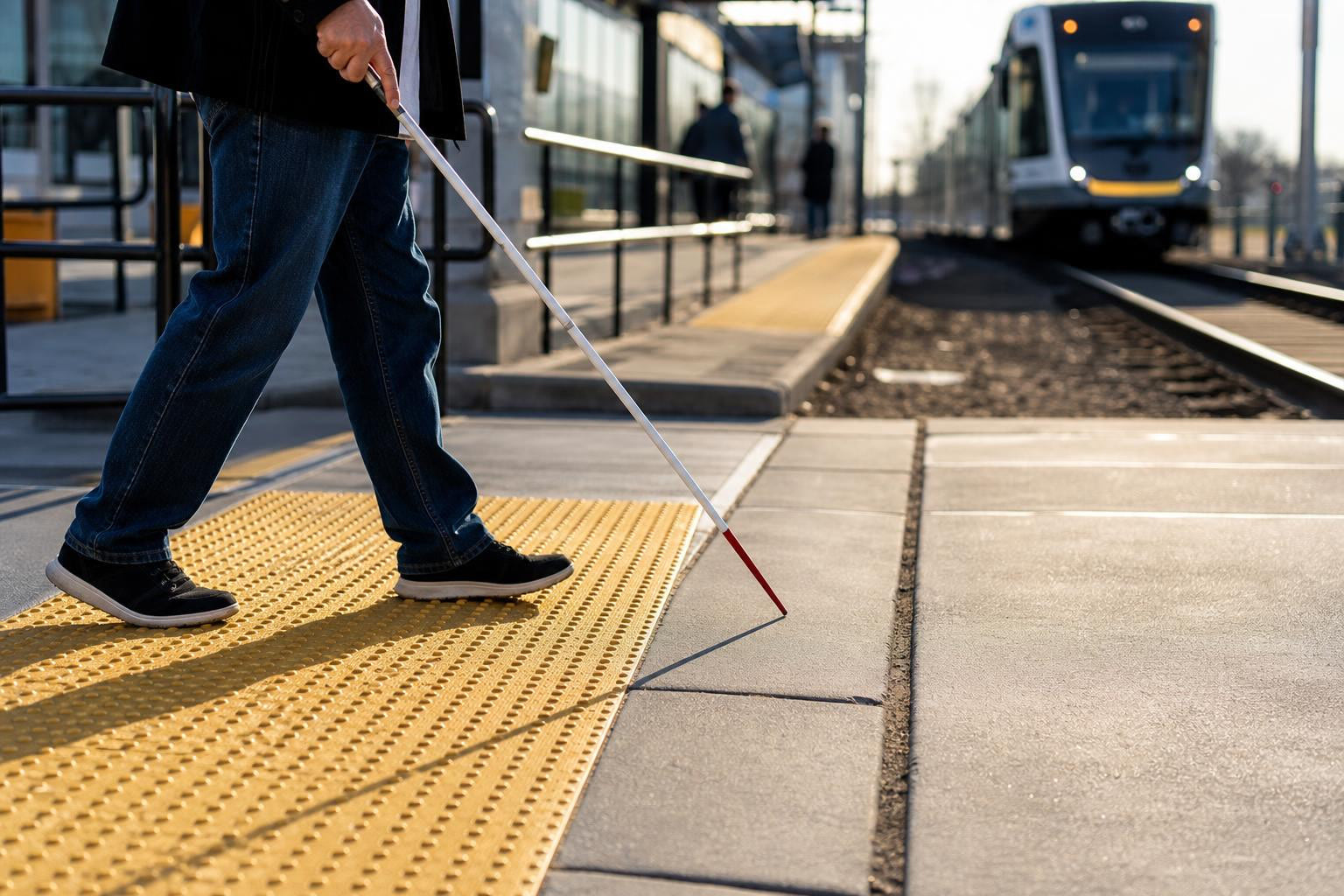
TL;DR: Detectable warnings (truncated dome surfaces) are required at transit platform edges, curb ramps at transit facilities, and pedestrian crossings under various US and Canadian codes. In Canada, these are called Tactile Walking Surface Indicators (TWSIs), governed by CSA B651, the National Building Code, provincial legislation like Ontario’s AODA, and municipal bylaws. In the US, requirements depend on whether a project falls under DOJ or DOT jurisdiction, with the DOT’s recent adoption of PROWAG in January 2025 expanding where detectable warnings are mandated. Requirements vary by jurisdiction, so always verify with your local authority.
This guide is for contractors, architects, facility managers, and property owners who need to determine where detectable warnings are required on their projects. It covers both US and Canadian codes, breaks down the technical specs, flags common installation mistakes, and helps you choose the right product for your specific site.
Browse tactile indicator options for your next accessibility project.
What Are Detectable Warnings?
Detectable warnings are standardized tactile surfaces featuring truncated domes, small raised bumps with flat tops, installed at ground level to alert pedestrians of upcoming hazards. They exist because of a problem that accessibility improvements unintentionally created: when curb ramps replaced raised curbs at intersections, pedestrians with visual impairments lost the physical cue that told them where the sidewalk ended and the roadway began.
The truncated dome pattern solves this. It is detectable both underfoot and with a long white cane, giving a clear tactile signal that means “stop and assess your surroundings before proceeding.”
In Canada, these surfaces are more commonly called Tactile Walking Surface Indicators (TWSIs). CSA B651:23 defines a TWSI as “a standardized surface, detectable underfoot or by a long white cane, to assist people with low vision or blindness by alerting or guiding them.”
There are two distinct types, and confusing them is a common and costly mistake:
- Attention indicators (truncated domes): Signal a need for caution at a change in elevation, a vehicular route, train tracks, or other hazard. These are what most people mean when they say “detectable warnings.”
- Direction indicators (elongated flat-topped bars): Facilitate wayfinding through large open spaces like transit concourses or plazas. These indicate a suggested path of travel.
Each type serves a different purpose. They should be used in combination where appropriate, but never interchangeably. Installing directional bars where attention indicators belong (or vice versa) creates confusion rather than safety.
A Brief History of Detectable Warning Requirements
Understanding the history explains why there is still so much confusion about where detectable warnings are required.
Detectable warning surfaces first appeared in the 1991 Americans with Disabilities Act Accessibility Guidelines (ADAAG), covering hazardous vehicular areas, transit platform edges, and curb ramps. But from 1994 to 2001, the US Access Board suspended most requirements (except at transit platforms) to research whether alternative textures like grooves, striations, and exposed aggregate could serve the same function.
The research was conclusive. Those alternatives were not reliably detectable in sidewalk and roadway environments because they looked and felt too much like ordinary surface defects. Truncated domes remained the only design that could be consistently detected. On July 26, 2001, the suspension expired, and detectable warnings as specified in ADAAG were again required.
In Canada, the evolution has followed a different path, driven by CSA standards and provincial accessibility legislation rather than a single federal mandate. The result is a layered system of national standards, provincial codes, and municipal bylaws that together determine where detectable warnings are required on any given project.
Where Are Detectable Warnings Required Under US Federal Codes?
This is where most guides get it wrong. They treat “ADA requirements” as a single set of rules, but there are actually two separate federal agencies with different standards, and the distinction matters enormously.
The DOJ vs. DOT Split
The Department of Justice (DOJ) and the Department of Transportation (DOT) each issue their own version of the ADA Standards, and they cover different types of facilities:
- DOJ Standards govern buildings and sites like shopping centers, office buildings, restaurants, and hotels. Under these standards, detectable warnings are required only at transit facilities, not at general curb ramps or building entrances.
- DOT Standards govern public transportation facilities. These standards require detectable warnings at curb ramps serving transit stops and along unprotected platform edges.
This means that a curb ramp at a shopping center parking lot does not trigger a federal detectable warning requirement under DOJ’s ADA Standards alone. A curb ramp at a bus stop does, under DOT’s standards.
Specific US Locations Where Detectable Warnings Are Required
Transit platform boarding edges (ADA §810.5.2, §705.2):
Platforms in rail stations without guards or screen barriers must have detectable warnings 24 inches (610 mm) wide running the full length of the platform’s public use area.
Curb ramps at transit facilities (DOT ADA Standards):
Detectable warnings must extend the full width of the curb ramp (excluding flared sides) to a minimum depth of 24 inches or the full depth of the ramp, whichever is less.
FHWA-funded projects:
Projects receiving Federal Highway Administration funding must also comply with DOT’s detectable warning requirements.
PROWAG: The Major 2025 Update
In December 2024, the DOT adopted the Public Right-of-Way Accessibility Guidelines (PROWAG) as its enforceable standard for new construction and alterations in the public right-of-way, effective January 17, 2025. Under PROWAG, detectable warnings are required at:
- Curb ramps
- Blended transitions (where the sidewalk meets the street at the same grade)
- Pedestrian refuge islands
- At-grade rail crossings
This significantly expands where detectable warnings are required on DOT-covered projects. However, the DOJ has not yet adopted PROWAG for non-transit elements in the public right-of-way, like general sidewalks and crosswalks. This gap means that for many municipal projects not tied to transit, the requirement depends on state or local codes rather than federal mandate.
State Codes Often Go Further
Many US states have adopted requirements that exceed the federal minimums. California, for example, requires detectable warnings at seven different location types. The practical takeaway: federal requirements are surprisingly narrow, but your state or municipality may be far more demanding. Always check with the local Authority Having Jurisdiction (AHJ).
| Location | DOJ (Buildings/Sites) | DOT (Transit) | PROWAG (2025, DOT) |
|---|---|---|---|
| Transit platform edges | Required | Required | Required |
| Curb ramps at transit stops | Not required | Required | Required |
| General curb ramps | Not required | Not required | Required |
| Blended transitions | Not required | Not required | Required |
| Pedestrian refuge islands | Not required | Not required | Required |
| At-grade rail crossings | Not required | Not required | Required |
| Building entrances | Not required | Not required | Not addressed |
Where Are Detectable Warnings Required Under Canadian Codes?
This is where Canadian projects face a more complex regulatory environment than their US counterparts, but also a more comprehensive one. Requirements flow from national standards down through provincial codes to municipal bylaws, and each layer can add obligations.
For a deeper breakdown of compliance requirements across Canada, see the full tactile indicators compliance guide.
National Level: CSA B651 and the National Building Code
CAN/CSA B651 is the national standard that defines TWSI specifications, including materials, construction, installation, texture, dimensions, and visual contrast. The National Building Code of Canada references CSA B651 for TWSI technical requirements.
Key Canadian locations where TWSIs are commonly required include:
- Transit platforms
- Pedestrian crossings
- Building entrances
- Top and bottom of stairs
- Ramps
- Escalator approaches
- Parking areas
- Passenger loading zones
Provincial Level: Ontario’s AODA and Building Code
Ontario provides the clearest example of how provincial legislation adds specificity. The Accessibility for Ontarians with Disabilities Act (AODA) mandates TWSIs at all new and redeveloped public spaces. Attention indicators and directional indicators are required at specific locations, including the top and bottom of stairs, transit platforms, and pedestrian crossings.
The Ontario Building Code gets even more specific:
- OBC 3.8.3.17: Tactile indicators are required along platform edges not protected by a guard and higher than 250 mm above the floor or ground, preventing people from unintentionally walking off an elevated platform.
- OBC 3.8.3.18: Tactile attention indicators must be installed where an accessible pedestrian path enters a vehicular route or area where no curb or other element separates pedestrian and vehicle traffic.
Other provinces have their own accessibility legislation and building code provisions. Requirements vary, so verifying with your provincial authority is essential.
Federal Buildings in Canada
The Barrier-Free Design Standards issued by Public Services and Procurement Canada apply to federal buildings like post offices, border crossings, and government offices. These standards align with CSA requirements and mandate tactile warning strips at stairs, pedestrian crossings, platform edges, and other hazard points. Compliance is mandatory for all construction and renovations initiated by Public Services and Procurement Canada.
Projects involving institutional and government facilities carry these additional federal obligations.
Municipal Level
Many Canadian cities layer their own requirements on top of provincial codes. The City of Toronto Accessibility Design Guidelines prescribe detailed TWSI specifications for municipal facilities and public rights-of-way. Calgary’s Access Design Standards regulate the location and technical specifications of TWSIs in city infrastructure. Other municipalities have similar standards. If you are working on a municipal project, the city’s accessibility design guidelines should be your first stop after the provincial building code.
Technical Specifications at a Glance
Getting the specs wrong can mean failing an inspection or, worse, creating a surface that does not actually work for the people who need it. Here is a side-by-side comparison of US and Canadian requirements:
| Specification | US (ADA/ADAAG §705) | Canada (CSA B651 / OBC) |
|---|---|---|
| Dome base diameter | 23 mm (0.9 in) min to 36 mm (1.4 in) max | 12 mm |
| Dome top diameter | 50%–65% of base diameter | Per CSA B651:23 |
| Dome height | 5.1 mm (0.2 in) | 5 mm |
| Centre-to-centre spacing | 41 mm (1.6 in) min to 61 mm (2.4 in) max | 50–60 mm |
| Base-to-base spacing | 17 mm (0.65 in) min | Per CSA B651:23 |
| Depth in direction of travel | 610 mm (24 in) minimum | Per CSA B651:23 |
| Width | Full width of curb ramp (excluding flares) | Full width of hazard zone |
| Visual contrast (LRV difference) | No specific color mandated federally | At least 70% contrast with surrounding surface |
Visual contrast deserves special attention. The recommended standard is a 70% light reflectance value (LRV) difference between the detectable warning surface and the adjacent ground. US federal regulations do not mandate a specific color, though yellow on grey concrete is the most common choice. In Canada, the 70% contrast requirement is more explicitly enforced, and yellow on grey concrete is the standard compliant combination.
Always verify dimensions against the latest edition of the applicable standard for your jurisdiction. Specs can and do change with code updates.
Common Mistakes to Avoid
Practitioners consistently report that detectable warning installations go wrong more often than they go right. As one code professional noted on a building code forum, “I’ve probably seen more installed where they shouldn’t be than installed properly.” Here are the mistakes that cause the most problems.
Over-Installation
Installing detectable warnings everywhere creates what practitioners call a “boy who cried wolf” effect. When truncated domes appear at every minor change in grade, they stop communicating meaningful hazard information. A person with a visual impairment encounters the warning, assesses the situation, finds no actual danger, and eventually learns to ignore the signal. That is the opposite of safety.
Installing in Prohibited Locations
Understanding where detectable warnings should not be placed is just as important as knowing where they are required. Installing detectable warning plates on medians, for example, can be dangerous. The tactile signal could tell a person with a visual impairment that they have reached the far side of a crosswalk when they are actually standing in the middle of traffic.
Confusing Attention Indicators with Direction Indicators
Truncated domes (attention indicators) mean “stop and assess.” Elongated bars (direction indicators) mean “follow this path.” Swapping them sends the wrong message at the wrong time.
Wrong Dimensions or Placement
Common dimensional errors include:
- Not extending the full width of a curb ramp, leaving an unprotected path at the edges
- Installing to the wrong depth (the standard calls for 24 inches minimum, not the full ramp length)
- Misaligning the panel with the direction of travel
- Domes that are too high, too close together, or too far apart, failing to meet spec
For additional guidance on correct stair placement specifically, see this guide on tactile indicators at stairs.
Ignoring Visual Contrast
A detectable warning that matches the color of the surrounding pavement provides no visual cue for people with low vision. The 70% LRV contrast guideline exists for a reason. Grey domes on grey concrete may technically have the right tactile profile, but they fail the population of users who rely on visual contrast rather than (or in addition to) tactile feedback.
For answers to other common product questions, visit the frequently asked questions page.
Choosing the Right Product for Your Project
Once you have determined where detectable warnings are required on your project, the next decision is product type. The right choice depends on whether you are building new or retrofitting, what climate the installation will face, and how much traffic the surface will see.
Cast-in-Place Panels
Best for new construction. These are set into a bed of fresh concrete during the pour, making them a permanent part of the surface. Because they sit flush with the surrounding concrete, they resist displacement and edge lifting. For new builds, cast-in-place surface panels are the most durable long-term option.
Surface-Applied Panels
Best for retrofits where the concrete or surface already exists. These are mechanically fastened or adhesive-bonded onto the existing surface. They are the standard solution for bringing non-compliant sidewalks, ramps, or platforms into compliance without demolishing and repaving.
Cast Iron Plates
Best for cold climates with snow plow exposure. This is a critical consideration for Canadian projects. While most tactile warning panels are constructed sturdily, snow plows are particularly destructive to polymer and composite panels over time. Cast iron plates withstand repeated plow contact and freeze-thaw cycles far better than lighter materials. In locations where plowing is routine, cast-in-place panels can also be recessed slightly to reduce plow damage.
Flexible PU Tiles
Best for temporary installations, small areas, or situations where you need to test placement before committing to a permanent install. These are lightweight and easy to cut to size.
Radius Panels
For curved curb ramps and rounded platform edges, standard rectangular panels leave gaps or require awkward cuts. Radius tactile panels are purpose-built for these geometries.
Durability Expectations
Quality detectable warning installations last 25 years or more. Fiberglass-reinforced polymer (FRP) composites, the most widely used material, offer compressive strength exceeding 30,000 psi and slip resistance ratings of 0.93 (dry) and 0.76 (wet). But durability depends heavily on correct installation, appropriate material selection for the environment, and ongoing maintenance. No product eliminates the need for periodic inspection, cleaning, and, eventually, replacement.
The Cold Climate Factor
Canadian buyers face conditions that most US-focused product guides ignore. Freeze-thaw cycling works at adhesive bonds and panel edges. Ice buildup can temporarily obscure the tactile pattern. And as noted above, snow plows can shear surface-applied panels right off the concrete. When specifying detectable warnings for projects north of the border, material choice is not a minor detail. It is the difference between a 25-year installation and a 5-year failure.
Where Required vs. Where You Should Install Anyway
There is a practical gap between what codes strictly mandate and what responsible building practice suggests. Many facility owners install detectable warnings at locations not technically required by their local code, for two reasons:
- Liability reduction. If someone is injured at a hazard point that lacked a detectable warning, the absence of a widely recognized safety measure can become a factor in litigation, even if the code did not mandate it.
- Codes change. PROWAG’s expansion of requirements in 2025 is a reminder that locations exempt today may be mandated tomorrow. Installing proactively avoids costly retrofits later.
The key is to install strategically, not everywhere. Over-installation defeats the purpose. Focus on genuine hazard points: transitions between pedestrian and vehicular areas, platform edges, the tops and bottoms of stairs, and anywhere a change in elevation could surprise a person with a visual impairment.
For transportation accessibility projects or complex multi-use sites, consulting with an accessibility specialist before specifying locations is worth the investment.
Frequently Asked Questions
Are detectable warnings required at all curb ramps in the US?
Not under federal law alone. DOJ’s ADA Standards only require them at transit facilities. DOT’s standards require them at transit curb ramps, and the newly adopted PROWAG (effective January 2025 for DOT projects) extends the requirement to all curb ramps and blended transitions in the public right-of-way. However, many states have adopted broader requirements. Check your state and local codes.
What is the difference between a detectable warning and a directional bar?
A detectable warning uses truncated domes to signal “stop and assess, there is a hazard ahead.” A directional bar surface uses elongated flat-topped bars to signal “follow this path.” They serve different functions and should never be substituted for one another.
Do Canadian codes require detectable warnings at building entrances?
Yes, in many jurisdictions. CSA B651 covers building entrances as a key TWSI location, and provincial codes like Ontario’s AODA mandate TWSIs at new and redeveloped public spaces. Municipal design guidelines in cities like Toronto and Calgary add further specificity. Check the requirements for your province and municipality.
What color should detectable warning tiles be?
US federal regulations do not mandate a specific color, only that visual contrast be provided. In Canada, the standard is at least 70% LRV contrast with the surrounding surface. Yellow on grey concrete is the most common compliant combination on both sides of the border.
How deep should the detectable warning surface extend?
A minimum of 24 inches (610 mm) in the direction of travel, per both ADA §705 and common Canadian specifications. The surface should also extend the full width of the curb ramp, blended transition, or hazard zone, excluding flared sides.
Can snow plows damage detectable warning surfaces?
Yes. Snow plows are one of the primary causes of detectable warning damage in cold climates. Surface-applied polymer panels are most vulnerable. Cast iron plates and recessed cast-in-place installations offer significantly better resistance to plow contact and freeze-thaw cycling.
Are there places where detectable warnings should NOT be installed?
Yes. Medians, for example, should not have detectable warnings because the signal could indicate to a person with a visual impairment that they have safely reached the far side of a crosswalk. Installing warnings at every minor grade change also diminishes their effectiveness. The goal is to mark genuine hazards, not to cover every surface.
Do I need to comply with both federal and provincial/state codes?
Yes. The more restrictive standard applies. Federal codes set a minimum floor, but provincial, state, and municipal codes frequently add requirements. Confirm with your local Authority Having Jurisdiction (AHJ) or an accessibility consultant for project-specific guidance.
Next Steps
Determining where detectable warnings are required is only the first step. Choosing the right product for your surface, climate, and installation type is what turns code compliance into lasting safety.
Browse tactile indicators from Safety Step Canada, or contact us for help selecting the right detectable warning product for your project.