
TL;DR
Stair nosings reduce slip incidents and related injuries through four mechanisms: increasing traction at the step edge, improving step visibility with contrasting colors, expanding usable foot placement area, and protecting step edges from wear over time. Canadian data shows falls cause over 654,000 emergency department visits annually, with stair descent accounting for 80% of stair falls. Properly installed nosings have been shown to cut stair-related accidents by 60% to 75% in real-world facilities.
This guide is for facility managers, safety officers, property managers, and contractors who need to understand exactly how stair nosings prevent falls. Whether you are building a business case for a capital purchase, evaluating liability exposure, or recommending solutions to a client, the information here covers the biomechanical evidence, injury data, and practical product decisions that matter.
Browse FRP stair tread nosings to see available sizes and configurations.
What Is a Stair Nosing?
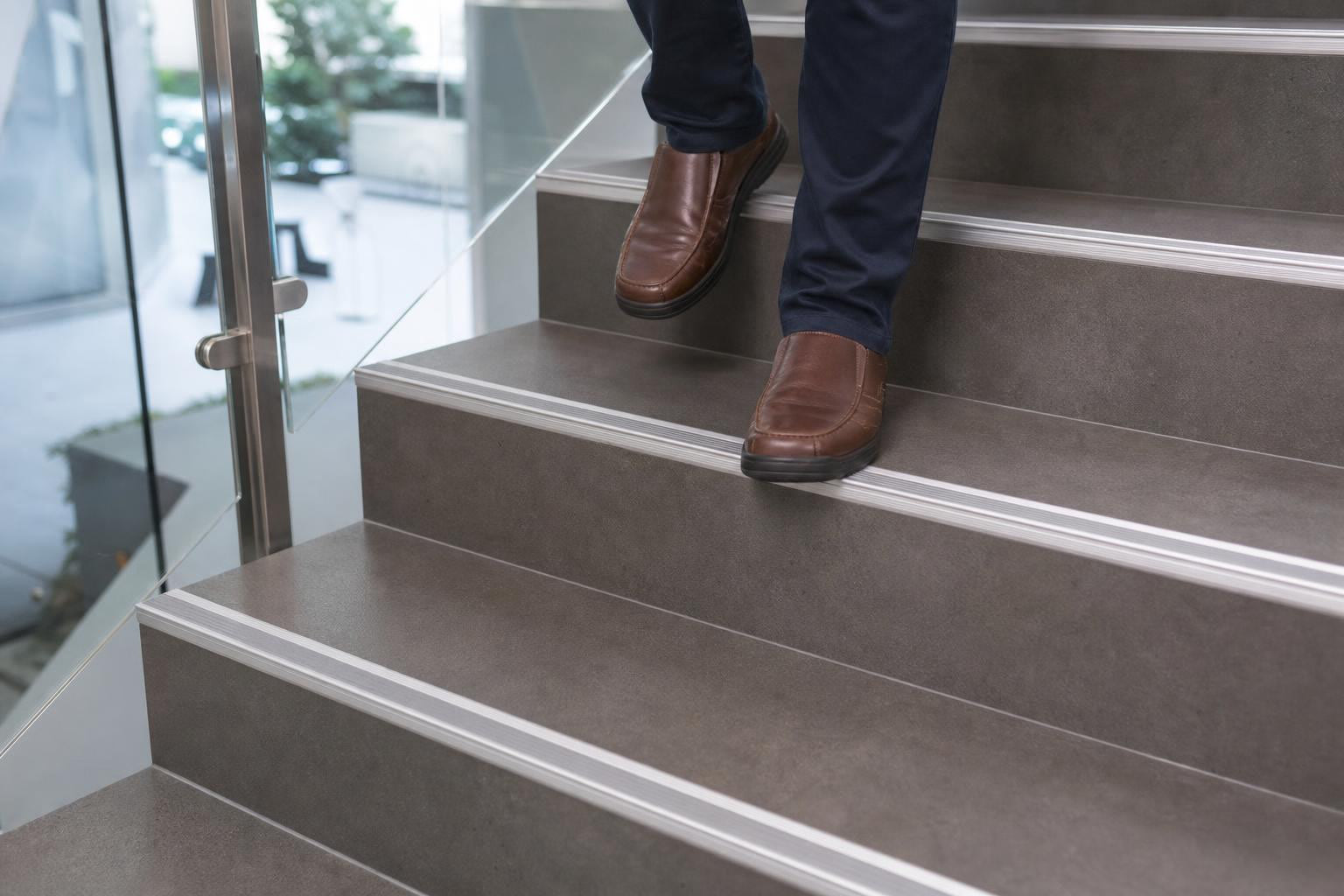
A stair nosing is the front edge of a stair tread, either built into the step or applied as a separate strip. In safety applications, the term usually refers to a retrofitted or purpose-built profile attached to the leading edge of each step. This profile typically features an anti-slip surface (abrasive grit, grooves, or textured coating) and a contrasting color that makes the step edge visible.
Nosings sit at the exact point where the foot meets the step during ascent and descent. That placement is what makes them effective. Every footfall on a staircase loads the front edge of the tread first, and that edge is where slips begin.
Common materials include fiberglass reinforced polymer (FRP), aluminum, rubber, and steel. FRP nosings are lightweight, corrosion-proof, and can be cut on site. Aluminum nosings resist weathering and offer a clean appearance for commercial and institutional settings. The material choice depends on the environment, the substrate, and the traffic the stairs receive.
The Slip Problem: Why Stair Edges Are Dangerous
Stair falls are not a minor safety concern. They are one of the most common and costly injury categories in Canada and globally.
The Canadian picture
More than 40,000 Canadian workers are injured annually due to fall accidents, representing a significant share of lost-time injuries accepted by workers’ compensation boards. Statistics Canada data shows that as many as 1.7 million falls occur each year for people aged 12 and older, accounting for roughly 40% of all injuries.
In 2016–2017, nearly 654,000 of Canada’s two-million-plus injury-related emergency department visits were caused by accidental falls. Those falls led to about 152,500 hospital admissions, with an average stay of 14.3 days, nearly double the 7.5-day average for other medical reasons.
The financial burden is staggering. Fall-related injuries account for roughly 35% of the total $29.4 billion economic burden of preventable injuries in Canada. Direct costs (emergency visits, hospital stays, surgery, rehabilitation) total $9.1 billion. Indirect costs from lost productivity and long-term disability add another $1.2 billion.
Specific hazard conditions
Multiple surface conditions create the slip risk that nosings address:
- Wet surfaces from rain, cleaning, or spills reduce friction below safe levels
- Icy surfaces, a distinctly Canadian problem, cause nearly 8,800 fall injuries per year across the country
- Oily or greasy surfaces in industrial kitchens, manufacturing floors, and maintenance areas
- Worn stair edges where foot traffic has polished the surface smooth
- Smooth metal or concrete stairs without any applied traction
- Poor visibility in stairwells with dim lighting or uniform-color steps
- High foot traffic that accelerates edge degradation and increases exposure
These conditions affect every surface type: concrete, metal, wood, tile, and fiberglass. The stair edge is the common failure point across all of them.
What injuries look like
The most common injuries from stair falls are sprains and strains (32.3%), followed by soft tissue injuries (23.8%) and fractures (19.3%). The body regions most frequently affected are legs, ankles, and feet (42%) and head and neck (22%). Traumatic brain injury is the most serious outcome, with the CDC reporting over 69,000 TBI-related deaths in a single year.
Understanding how stair nosings reduce slip incidents and related injuries starts with recognizing that the step edge is ground zero for these numbers.
Four Ways Stair Nosings Reduce Slip Incidents and Related Injuries
Research and field evidence point to four distinct mechanisms. Most competitor resources cover one or two of these. All four work together, and understanding each one helps you specify the right product.
1. Increased Traction at the Step Edge
The fundamental job of a stair nosing is to create friction exactly where slips start: the front edge of the tread. Stair nosing strips secure staircases at this critical zone because the friction surface must cover the “nose” to be effective.
Anti-slip nosings achieve traction through two main approaches. Abrasive coatings use hard particles, commonly silicon carbide granules, embedded into the nosing surface during manufacturing. The particles are bonded to a depth of at least 1/16 inch for durability and consistent grip over years of use. Grooved or ribbed surfaces create channels approximately 1/16 inch deep that provide mechanical interlocking with shoe soles while also channeling water and debris away from the contact area.
How much friction is enough? Standards provide benchmarks. ANSI A137.1 requires a minimum wet dynamic coefficient of friction (DCOF) of 0.42 for surfaces in wet conditions. Australian standard AS HB 198:2014 recommends a Pendulum Test Value (PTV) of at least 35 for dry stair treads and 45 for wet conditions. The ADA recommends a COF of 0.60 or above for walkways and 0.80 for ramps. While no single code quantifies slip resistance for stairs specifically, these figures establish the performance floor that quality nosings exceed.
FRP nosings with embedded grit surfaces consistently outperform painted or taped solutions because the abrasive is part of the material rather than a surface layer that can peel or wear through. For outdoor stairs that face rain, snow, and freeze-thaw cycles, outdoor aluminum stair nosings provide weather-resistant traction that holds up across seasons.
2. Visual Contrast Makes Steps Visible
A person descending a staircase does not look at every step. Research has shown that during stairway use, pedestrians view only the first and last three steps, navigating the rest without looking down. This finding, from the Cohen stair safety research cited in EHS Today, explains why uniform-color staircases are dangerous. If the step edge blends into the tread, a descending person has no visual reference for foot placement on the majority of steps.
Stair nosings in a contrasting color solve this problem by defining each step edge in the user’s peripheral vision. Yellow nosings on grey concrete, black nosings on light tile, or high-visibility strips on metal stairs all create the contrast needed for the brain to register step location without conscious attention.
This matters even more for people with reduced vision. California’s Title 24 building code requires slip-resistant treads or nosings of contrasting color specifically to increase step discernibility for visually impaired users. Canadian accessible-ready housing standards specify that nosings accept a horizontal contrasting strip 50 ± 10 mm deep.
For emergency egress, where stairwell lighting may fail, glow-in-the-dark stair strips provide visibility when power is out. This is not a niche concern. Building codes increasingly require photoluminescent markings in high-rise egress stairs.
3. Greater Foot Accommodation and Reduced Overhang
This is the mechanism most safety pages ignore, and it may be the most important one.
Stair descent is where 80% of stair falls happen. Over half of those falls are estimated to occur because the person misjudged their foot placement on the step. The biomechanics are straightforward: when descending, the foot lands on the front portion of the tread. If the tread is too shallow or the edge is poorly defined, a significant portion of the foot overhangs the step.
Research from Roys and Wright established a critical threshold. If more than 30% of the foot overhangs the step edge on a habitual basis, slip risk increases significantly. People who routinely step with greater overhang are more likely to experience a fall than those with more of their foot on the tread.
A stair nosing addresses this directly. By projecting slightly beyond the riser, it increases the usable surface area of each tread. A biomechanical literature review published through NRC Publications Canada found that stairs with a nosing, compared to stairs without one, led to reduced foot overhang during descent. The nosing gives the foot more surface to land on, keeping it below that 30% danger threshold.
This connects to broader stair design research. When the 2015 National Building Code of Canada increased the minimum stair run dimension to 254 mm (10 inches) from 210 mm (8.25 inches), the supporting research showed that the larger tread dimension could reduce falls by up to 64%. The principle is the same: more usable tread surface means better foot placement and greater stability.
For existing staircases that cannot be rebuilt to modern dimensions, adding a nosing is the most practical way to increase effective tread depth.
4. Edge Protection Maintains Safety Over Time
Safety degrades when surfaces wear. Most people plant their feet at the front of the stair tread, which means the step edge receives the greatest abuse from foot traffic. Over time, continuous use causes stair edges to smooth out, reducing grip and making it harder to place feet securely.
This creates a feedback loop. A new concrete stair may have adequate texture on its edge. After a few years of heavy traffic, that edge has been polished smooth by thousands of footfalls. The stair becomes more dangerous the longer it is used, often so gradually that nobody notices until someone falls.
Stair nosings break this cycle. They absorb the impact and abrasion at the highest-traffic zone, shielding the underlying step material from wear. When a nosing eventually reaches the end of its service life, you replace the nosing, not the staircase. For guidance on how long different nosing materials last, read more about FRP pultruded nosing durability.
This edge protection function is particularly valuable for industrial and commercial facilities where stairs see hundreds or thousands of daily users.
What the Evidence Shows: Real-World Reduction Numbers
Theory matters, but facility managers need results. Several documented cases show how stair nosings reduce slip incidents and related injuries in practice.
A manufacturing facility that experienced frequent slips on metal stairs reported a 75% reduction in stair-related accidents within six months after installing anti-slip stair treads and nosing. The safety upgrade reduced both worker injuries and the downtime and liability costs that came with them.
A major logistics company in Toronto achieved a 60% reduction in stairway accidents in one year after implementing a stair safety protocol that included slip-resistant coatings, bi-weekly inspections, and mandatory handrail use during shift changes.
At the building code level, the research underpinning the NBC 2015 changes demonstrated that improving stair tread dimensions could save an estimated 27 lives and avoid 13,000 serious accidents in the first five years of adoption.
Public health experts argue that 90% of fall “accidents” are predictable and preventable. Stair nosings are one of the simplest interventions that address multiple causes at once.
Choosing the Right Product Type
Stair nosings are not the only anti-slip product, and not every stair problem calls for the same solution. Here is how common product types compare for stair applications:
| Product Type | Best For | Limitations |
|---|---|---|
| Stair nosing (FRP or aluminum) | Step edge traction, visibility, foot accommodation | Must be properly fitted to step profile |
| Full stair tread cover | Severely worn or damaged treads needing complete resurfacing | Higher cost per step, more material |
| Anti-slip tape | Quick, low-cost fix for low-traffic areas | Wears through faster, edges can peel and create trip hazard |
| Deck strips | Flat surfaces, ramps, landings adjacent to stairs | Not shaped for step edges |
| Ladder rung covers | Fixed ladder rungs in wet or oily environments | Stair-specific only if adapted |
| Tactile panels | Accessibility compliance at stair landings and transitions | Not a traction solution for the steps themselves |
For stairs specifically, nosings deliver the best combination of traction, visibility, and foot accommodation per dollar spent. Full aluminum stair tread covers make sense when the entire tread surface is compromised, not just the edge.
Selection Factors: Matching the Nosing to the Environment
Indoor vs. outdoor
Indoor nosings can use a wider range of materials and adhesives. Outdoor nosings must withstand UV exposure, temperature cycling, rain, and (in Canada) ice and snow. FRP and aluminum both perform well outdoors. Rubber degrades faster in UV and freeze-thaw conditions.
Wet vs. dry conditions
Any staircase that might get wet, whether from rain, cleaning, tracked-in snow, or process liquids, needs a nosing rated for wet performance. Target a PTV of 45 or higher in wet conditions, or a DCOF of 0.42 minimum. Grooved profiles help channel water away from the contact surface.
Ice and snow exposure
Canada’s winter conditions demand special attention. With almost 8,800 fall injuries from ice slipping annually, outdoor stair nosings must maintain grip when covered in snow, slush, or black ice. Aggressive grit surfaces outperform smooth profiles in these conditions. Practitioners on Reddit and building forums frequently note that anti-slip tape fails in freeze-thaw cycles because moisture gets under the adhesive and peels it off, while mechanically fastened nosings hold up through multiple winters.
Chemical exposure
Industrial stairs exposed to oils, solvents, or cleaning chemicals need corrosion-resistant nosings. FRP is inherently chemical-resistant. Aluminum may need anodizing or coating in harsh chemical environments.
Foot traffic volume
Light residential traffic and heavy industrial shift traffic place very different demands on a nosing. High-traffic stairs need thicker abrasive coatings and more durable substrates. The edge protection mechanism described earlier becomes more important as traffic increases.
Installation method
Nosings attach via adhesive, mechanical fasteners (screws or bolts), or both. Adhesive-only works for light-duty applications on clean, smooth substrates. Mechanical fastening is essential for outdoor, industrial, or high-traffic use. For installation guidance, the aluminum nosing installation guide covers the process step by step.
Visibility requirements
High-visibility yellow nosings are standard for industrial and commercial stairs. Black nosings suit architectural settings where aesthetics matter. Glow-in-the-dark options are needed for egress stairs in buildings where power loss is a realistic scenario.
Common Mistakes That Undermine Nosing Effectiveness
Stair nosings only work if they are installed correctly. A poorly installed nosing can create a new hazard worse than the one it was meant to fix.
Loose installation. If a stair nosing is not adhered or fastened properly, it becomes a trip hazard itself. Someone catching a toe on a lifted nosing edge can fall just as badly as someone slipping on a bare step.
Wrong profile for the environment. Practitioners note that facility managers sometimes select a nosing that looks good in dry conditions but have not considered that people enter the building with water or snow on their feet at certain times of year. Even a well-installed nosing can create a slip hazard if its surface profile cannot handle wet footwear.
Poor alignment. Nosings should sit flush with the stair edge without gaps or raised sections. Misalignment causes footwear to catch on the nosing edge, increasing trip risk. This is a common issue when nosings are installed over irregular or damaged step edges without proper preparation.
Excessive projection. Building codes and best practices specify that nosings should not protrude more than 1.5 inches (38 mm) beyond the riser, and the underside should be beveled to reduce trip potential. An over-projecting nosing can catch a toe during ascent.
Ignoring adjacent surfaces. Stair landings, the flat areas at the top and bottom of a flight, also need traction treatment. A person can slip on a wet landing and tumble down the stairs even if every step has perfect nosings. Anti-slip deck strips address flat surfaces near stairs.
For answers to common installation questions, see the frequently asked questions page.
Important Limits to Understand
Anti-slip stair nosings significantly reduce risk, but they do not eliminate all slip risk. Several realities apply:
- Surfaces still need regular cleaning and maintenance. Grit, oil, and debris accumulation can reduce the effectiveness of any anti-slip surface over time.
- Ice, snow, and standing water still need to be managed through shoveling, salting, drainage, and building maintenance protocols. Nosings improve grip in wet and icy conditions but do not melt ice or prevent puddle formation.
- Building code requirements vary by province in Canada. The National Building Code is a model code that provinces adopt, modify, and enforce at their discretion. Any specific compliance claim should be verified against the code in force at the project location.
- OSHA standard 1910.24(f) requires that “all treads shall be reasonably slip-resistant and the nosings shall be of non-slip finish,” but this is a U.S. standard and does not directly apply to Canadian workplaces.
The strongest safety outcomes come from combining good nosings with handrails, adequate lighting, regular inspections, and housekeeping protocols. The Toronto logistics company that achieved its 60% reduction used nosings as part of a broader stair safety program, not as a standalone fix.
Frequently Asked Questions
How much do stair nosings actually reduce slip accidents?
Documented cases show reductions between 60% and 75% in stair-related accidents after installing anti-slip nosings and treads. A manufacturing facility reported 75% fewer stair incidents within six months. A Toronto logistics company achieved 60% fewer stairway accidents in one year using nosings as part of a broader safety protocol. Individual results depend on the existing condition of the stairs, the nosing quality, and whether other safety measures (handrails, lighting, maintenance) are also in place.
What is the 30% foot overhang rule?
Biomechanical research established that when more than 30% of the foot extends past the step edge during descent, slip risk increases significantly. People who habitually step with this much overhang are more likely to fall. Stair nosings reduce overhang by extending the usable tread surface, helping keep the foot within safe limits.
Do stair nosings work on all stair materials?
Yes, but the attachment method differs. FRP and aluminum nosings can be installed on concrete, metal, wood, and tile stairs. Concrete and metal stairs typically accept mechanical fasteners. Wood stairs can use screws and adhesive. Tile stairs may need adhesive-only application or drilling through the tile. The key is matching the nosing material and mounting method to the substrate.
Can a stair nosing create a trip hazard?
It can if installed incorrectly. Nosings that are loose, misaligned, or projecting more than 1.5 inches beyond the riser can catch footwear and cause trips. Proper installation, including flush alignment, adequate fastening, and beveled undersides, prevents this. This is one reason to use quality products and follow manufacturer installation instructions rather than improvising.
Are stair nosings required by Canadian building code?
The National Building Code of Canada addresses stair dimensions and nosing profiles but is a model code with no legal force on its own. Provinces adopt and enforce their own versions. Canadian accessible-ready housing standards do specify nosing geometry requirements, including a slope angle greater than 60 degrees and leading edge radius not more than 13 mm. Check your provincial code for the specific requirements that apply to your project.
How long do anti-slip stair nosings last?
Lifespan varies by material and traffic volume. FRP pultruded nosings are designed for years of heavy industrial use without delamination, thanks to the manufacturing process that embeds grit throughout the surface rather than applying it as a topcoat. Aluminum nosings resist corrosion and maintain structural integrity for many years in outdoor conditions. Anti-slip tape, by comparison, typically needs replacement every 6 to 18 months in high-traffic areas.
Ready to reduce slip incidents on your facility’s stairs?
Shop aluminum stair nosings or contact Safety Step Canada for help choosing the right product for your stairs, surface, and environment.