
TL;DR
Outdoor aluminum stair nosing installation requires substrate-specific preparation, corrosion-resistant fasteners (stainless steel only), and polyurethane adhesive rated for temperature extremes. The combination method (adhesive plus screws) is the most reliable approach for exterior stairs. Surface prep accounts for roughly 80% of nosing failures, so clean, level, and patch before you fasten anything. Freeze-thaw cycles, de-icing chemicals, and UV exposure make outdoor installation fundamentally different from indoor work.
This guide is for contractors, facility managers, and property owners who need to install aluminum stair nosing on outdoor concrete, wood, or metal stairs. It covers substrate identification, tool selection, surface preparation, fastener requirements, and the installation methods that hold up through Canadian winters. By the end, you’ll know which installation approach fits your project, what mistakes to avoid, and when a nosing alone won’t solve the problem.
Browse outdoor aluminum stair nosings to see sizing, pricing, and finish options before starting your project.
What Is Aluminum Stair Nosing?
A stair nosing is the projecting front edge of a stair tread, the part that extends past the riser below. It’s where feet land during descent and where most wear concentrates. An aluminum stair nosing is a manufactured strip that attaches to this edge to protect it, improve traction, and make the step edge visible.
For outdoor use, aluminum is the preferred material. It resists corrosion, UV degradation, and heavy wear without softening in heat or becoming brittle in cold. High-quality aluminum nosings can last 20+ years with minimal maintenance, according to manufacturer data from Ghonor Trims. When anodized or powder-coated, the material handles rain, snow, and temperature swings far better than rubber, vinyl, PVC, or chrome alternatives.
Two main types exist:
- Extruded aluminum nosings, typically made from 6063 T5 exterior-grade heat-treated aluminum. These are filled with mineral abrasive grit and epoxy to create a durable anti-slip surface. Most retrofit installations use extruded profiles.
- Cast aluminum nosings, which feature a cross-hatch design and sand-cast surface for maximum traction on slippery concrete steps. These are common in new construction and institutional settings, and when embedded in wet concrete, they can last the lifetime of the building.
The best combination for outdoor environments is an extruded aluminum profile paired with a carborundum (grit) insert, offering maximum rust resistance and the highest coefficient of friction on wet surfaces.
Why Outdoor Stairs Are Different
Every competing installation guide treats outdoor stairs as a footnote. That’s a mistake. Exterior stairs face conditions that indoor stairs never encounter, and those conditions change what products, fasteners, and adhesives you can use.
The Slip Problem
Outdoor stairs become dangerous through several overlapping hazards:
- Wet surfaces from rain, snowmelt, or irrigation runoff
- Icy surfaces, including black ice (water that freezes into a thin, invisible layer)
- Snow compaction, where foot traffic presses snow into a slick surface
- Worn stair edges where the original tread material has eroded
- Smooth concrete or metal that was never textured for traction
- Poor visibility at dawn, dusk, or under inadequate lighting
- High foot traffic that accelerates surface wear
Slips, trips, and falls remain the number one cause of workplace injuries, according to National Grating, and outdoor stairs with degraded edges are among the highest-risk surfaces.
Canadian Winter Context
Freeze-thaw cycles are the silent destroyer of outdoor stair installations. Water seeps into micro-gaps between the nosing and substrate, freezes, expands, and breaks the bond. This cycle repeats dozens of times per winter in most Canadian provinces. De-icing salts and calcium chloride accelerate corrosion on non-stainless fasteners and degrade certain adhesives. Melting during the day and refreezing at night creates repeated ice buildup that tests every component of the installation.
These conditions mean that installation methods adequate for indoor stairs (adhesive-only, non-stainless screws, standard construction glue) will fail outdoors. Period.
For a broader look at making exterior stairs safer through Canadian winters, the guide on how to fix slippery stairs covers additional approaches beyond nosing installation.
Why Aluminum Beats Other Materials Outdoors
- vs. Rubber/Vinyl: Rubber softens in high heat and hardens in cold temperatures, becoming stiff and losing flexibility. It also degrades under UV exposure.
- vs. PVC: Sunlight causes PVC nosing to fade and yellow, quickly producing an old, worn appearance. Avoid PVC for exterior stairs.
- vs. Chrome: Chrome finishes scratch off under heavy traffic. Chrome profiles are designed for indoor applications only.
Aluminum holds its shape and structural integrity across temperature extremes. It won’t crack at -30°C or warp at +35°C.
Identify Your Substrate
The surface material of your stairs dictates every other decision: fastener type, adhesive choice, drill bits, and prep method. Measure your project against this table before purchasing materials.
| Substrate | Fastener Type | Adhesive | Drill Required | Key Prep Step |
|---|---|---|---|---|
| Concrete | Stainless steel Tapcon anchors | Polyurethane construction adhesive or silicone caulk | Hammer drill with masonry bit | Patch cracks, remove loose aggregate, clean dust |
| Wood | Stainless steel wood screws | Polyurethane construction adhesive | Standard drill | Fill cracks with wood filler, check for rot, pre-drill pilot holes |
| Metal | Stainless steel self-tapping screws or bolts | Polyurethane adhesive (metal-bonding) | Standard drill with metal bit | Remove rust, clean, and smooth surface |
Each substrate has failure modes. Concrete crumbles. Wood rots and splits. Metal rusts and warps. Addressing these before installation prevents callbacks and safety hazards.
Tools and Materials Checklist
Gather everything before you start. Missing one item mid-installation leads to shortcuts, and shortcuts lead to failures.
Tools (All Substrates)
- Tape measure
- Pencil or marking tool
- Circular saw with carbide-tipped blade (or miter saw/hacksaw)
- Metal file (for deburring cut edges)
- Caulking gun
- Level
- Safety glasses
- Work gloves
- Hearing protection (when cutting)
Substrate-Specific Tools
- Concrete: Hammer drill, 3/16" masonry drill bit
- Wood: Standard drill, drill bits sized for pilot holes
- Metal: Standard drill, metal drill bits
Materials
- Aluminum stair nosing profiles (measured to each step)
- Polyurethane construction adhesive (for outdoor use, rated for temperature range of your climate)
- For exterior installations where adhesive alone is used, clear silicone caulk (such as GE Silicone) can substitute for glue, per Amstep Products recommendations
- Concrete: Tapcon 1/4" x 1-3/4" 410 stainless steel Phillips flat head concrete anchors
- Wood: Stainless steel wood screws
- Metal: Stainless steel self-tapping screws
- Leveling compound (concrete) or wood filler (wood) for patching
- Cleaning solution and stiff brush
- Rags or cloth for wiping
For projects that also require mounting hardware or saddle clamp assemblies, include those in your materials order.
A note on fasteners: Never use standard zinc-plated or galvanized screws outdoors. They corrode within a single winter when exposed to de-icing chemicals. 410 stainless steel is the minimum standard for exterior stair nosing fasteners.
Surface Preparation: The Most Important Step
A stair nosing is only as strong as the surface it attaches to. According to practitioner data cited by Niuyuan Trims, 80% of stair nosing failures trace back to a dirty or uneven surface. This single step determines whether your nosing stays put for two decades or comes loose in two seasons.
Concrete Stairs
- Remove loose debris, old adhesive, paint, or sealant from the stair edge.
- Check for cracks and crumbling aggregate. If the edge is heavily chipped, rebuild it with a high-quality leveling compound to restore a solid, 90-degree base.
- Sweep thoroughly, then clean with a stiff brush and cleaning solution.
- Remove all dust. Blow out with compressed air if available.
- Allow the surface to dry completely before proceeding.
Wood Stairs
- Inspect for rot, woodworm, or soft spots. If the tread shows evidence of rot, replace the tread before installing nosing.
- Clean the surface, removing dirt, mildew, and old finish.
- Fill cracks with a strong wood filler. Allow it to dry and harden completely.
- Sand the filled areas smooth.
- Ensure the surface is dry.
Metal Stairs
- Remove all rust using a wire brush, sandpaper, or rust remover.
- Remove debris, grease, and oil.
- Smooth any rough weld spots or burrs at the stair edge.
- Wipe clean with a solvent and allow to dry.
When Nosing Isn’t Enough
If more than 30% of a stair edge is crumbled, rotted, or missing, a nosing strip won’t sit properly. In these cases, a full aluminum tread cover provides better coverage and structural reinforcement over the damaged area. Alternatively, aluminum safety renovation treads can completely resurface badly degraded steps.
Installation Methods Compared
Four methods exist for attaching aluminum stair nosing. Each has a specific use case, and selecting the wrong one for your conditions is the second most common cause of failure (after poor surface prep).
Method 1: Adhesive Only
Best for smooth, solid substrates where a clean, screw-free look is desired. Acceptable indoors on marble, tile, or well-maintained wood.
Outdoor limitation: Adhesive-only installations are risky outside. Freeze-thaw cycles, moisture intrusion, and temperature swings stress adhesive bonds beyond what most products are rated for. If you must go adhesive-only outdoors, use clear GE Silicone caulk rather than standard construction glue. Standard wood glue will fail.
Method 2: Mechanical Fastening (Screws Only)
The strongest method, highly recommended for concrete stairs and high-traffic commercial areas. Screws provide a permanent mechanical bond that doesn’t degrade with temperature changes.
Drawback: Using only screws on hard surfaces like concrete causes a clicking or rattling sound. The aluminum bends slightly under body weight, and without adhesive as a cushion, metal contacts the substrate with each footstep. This is a common complaint in commercial installations.
Method 3: Combination (Adhesive + Screws), the Best Method for Outdoor Stairs
This is the recommended approach for any exterior installation. The screws provide structural hold through freeze-thaw. The adhesive creates a continuous bond, prevents water from seeping beneath the nosing, and acts as a sound-deadening cushion that stops clicking.
When commercial clients ask for the safest outdoor solution, the answer is always both glue and screws.
Method 4: Embedded in Wet Concrete (New Construction Only)
For new construction projects where concrete staircases are being poured, embedding cast aluminum nosing directly in the wet concrete produces the most permanent result. An embedded nosing should last the lifetime of the building on commercial properties. This method obviously isn’t available for retrofit projects.
Quick Comparison
| Method | Best For | Outdoor Rating | Difficulty |
|---|---|---|---|
| Adhesive only | Indoor smooth surfaces | Poor | Easy |
| Screws only | High-traffic concrete | Good | Moderate |
| Combination | All outdoor installations | Excellent | Moderate |
| Embedded | New concrete construction | Excellent | Requires coordination with pour |
For more detail on general nosing installation principles, the step-by-step guide for aluminum stair nosings covers additional indoor and outdoor considerations. If your project involves concrete specifically, the guide on installing FRP stair nosing on concrete walks through similar substrate preparation.
Step-by-Step Installation (Combination Method)
This walkthrough covers the combination method on outdoor stairs, the approach recommended for virtually all exterior projects regardless of substrate.
Step 1: Measure Each Step Individually
Measure the width of every single step tightly. Do not assume all steps are identical. Minor architectural variances are common, and even 3mm of gap creates a trip hazard and allows water penetration. Record each measurement.
Step 2: Cut the Nosing to Length
Using a circular saw with a carbide-tipped blade (or a miter saw or hacksaw), cut each nosing piece to its measured length.
Critical safety step: Aluminum stair nosing is easy to cut, but the new edges will be very sharp. Always use a metal file to remove burrs and sharp edges before handling or installing. This protects both the installer and anyone who might touch the nosing edge after installation.
Protective film: Do not remove the factory protective film until the installation is finished and the site is clean. The film prevents scratches during handling and fastening.
Step 3: Dry Fit Every Piece
Place each cut nosing on its corresponding step without adhesive or fasteners. Check for:
- Proper alignment with the stair edge
- Consistent overhang (if any)
- No gaps between the nosing and the substrate
- Level sitting, no rocking
Skipping the dry fit is a common mistake. Misalignment discovered after adhesive is applied means wasted material and a compromised bond.
Step 4: Mark Fastener Locations
With the nosing dry-fitted, mark screw hole locations through the pre-drilled holes in the nosing (or at evenly spaced intervals if marking your own holes).
For concrete: Mark the substrate through the nosing holes, then remove the nosing and drill pilot holes with a hammer drill fitted with a 3/16" masonry bit. Drill 1/2" deeper than the anchor length. Insert concrete anchors (Tapcon 1/4" x 1-3/4" 410 stainless steel).
For wood: Pre-drill pilot holes to prevent the wood from splitting. Size the pilot bit slightly smaller than the screw shank.
For metal: Use a metal drill bit to create pilot holes at marked locations.
Step 5: Apply Adhesive
Run a continuous bead of polyurethane construction adhesive along the back of the nosing, covering the full contact area. For outdoor installations, ensure the adhesive is rated for your regional temperature range (check the product label for minimum application and service temperatures).
The adhesive serves three purposes outdoors: bonding, waterproofing the gap between nosing and substrate, and sound dampening.
Step 6: Position and Fasten
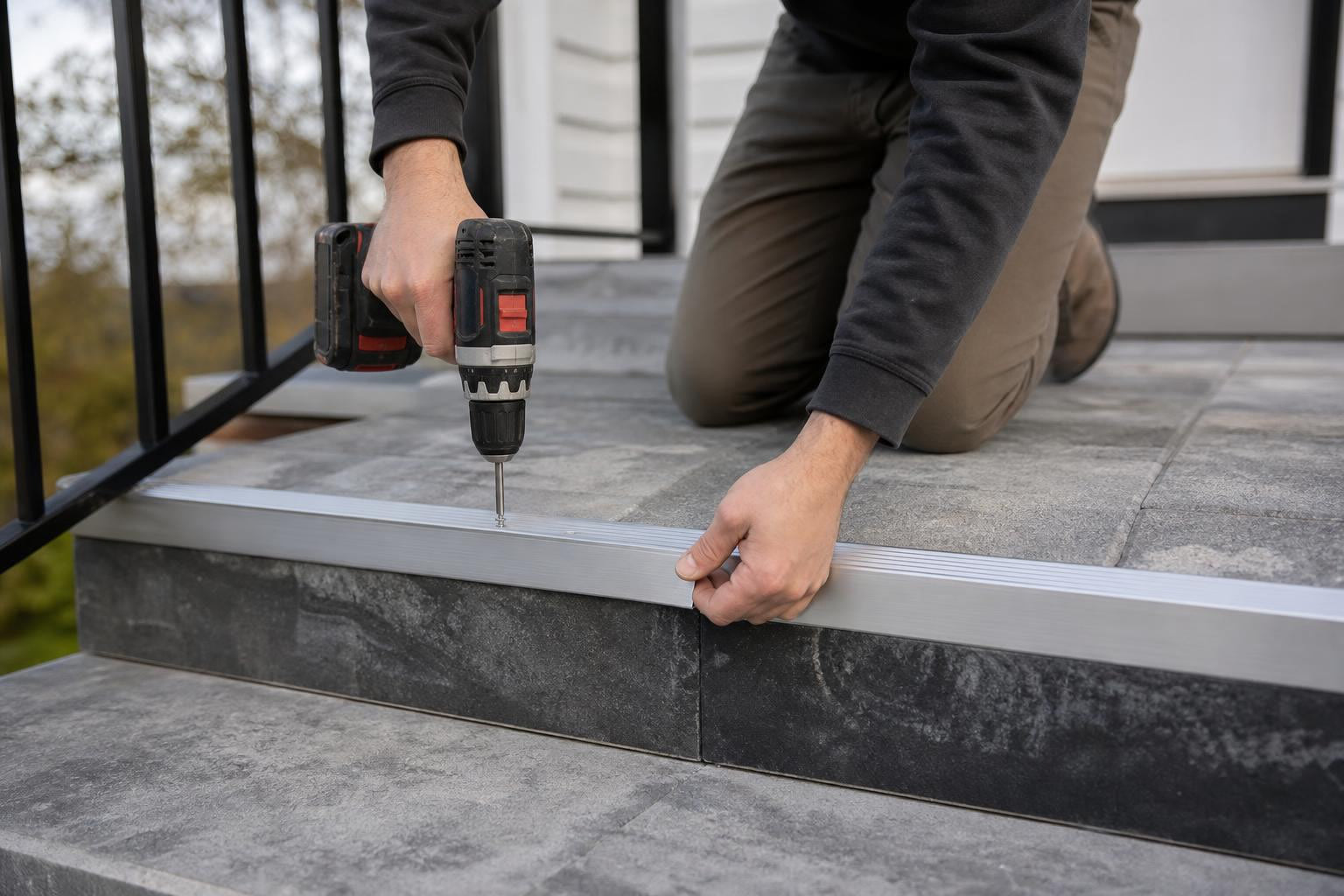
Press the nosing firmly into position on the stair edge, aligning it with your dry-fit marks. Drive stainless steel screws through the pre-drilled holes and tighten until the nosing sits snug against the substrate. Do not over-torque, which can warp the aluminum profile.
On concrete, thread the Tapcon anchors in carefully. On wood, drive screws until the head sits flush. On metal, use self-tapping screws or bolts appropriate for the metal thickness.
Step 7: Clean Up and Cure
Wipe away any adhesive squeeze-out immediately with a rag. Check each nosing for alignment one final time. Allow the adhesive to cure fully before allowing foot traffic. Most polyurethane adhesives need 24 hours at moderate temperatures. In cold weather, curing takes longer, so check the adhesive manufacturer’s guidelines and plan accordingly.
Remove the protective film only after curing is complete and the work area is clean.
Common Mistakes to Avoid
These are the failures that practitioners and manufacturers report most frequently. Every one of them is preventable.
| Mistake | What Happens |
|---|---|
| Dirty or uneven surface | Adhesive fails, nosing loosens within months |
| Wrong adhesive type (standard wood glue, non-rated products) | Bond failure, especially in freeze-thaw conditions |
| Screws only on concrete, no adhesive | Clicking and rattling under foot traffic |
| Measuring one step and cutting all nosings to match | Gaps, poor fit, trip hazards |
| Skipping the dry fit | Misalignment discovered too late, adhesive wasted |
| Not filing cut edges | Sharp exposed aluminum creates injury risk |
| Installing over crumbling substrate | Nosing pulls away along with damaged material |
| Using zinc-plated or non-stainless fasteners outdoors | Corrosion and fastener failure within one winter |
| Not checking traffic rating of the profile | Premature wear, finish damage |
Once a nosing starts loosening, every footstep and piece of rolling equipment makes it worse. A nosing that sticks up or shifts becomes a trip hazard itself, the exact problem it was supposed to prevent.
For additional guidance on avoiding installation pitfalls, the secure stair tread installation guide covers overlapping best practices.
Post-Installation Care
Aluminum stair nosings are low-maintenance, but “low” does not mean “no.” Outdoor installations need periodic attention.
- Regular cleaning: Sweep or wipe the nosing with a damp cloth to remove grit, dirt, and salt residue. For cast aluminum nosings, a general-purpose industrial floor cleaner with a stiff bristle brush works well. Pressure washing up to 1,000 psi is safe for most cast profiles.
- Fastener checks: In busy commercial zones, inspect screws and adhesive bonds every 6 months. Tighten any screws that have loosened. Outdoor installations should get an extra check after the first hard freeze of winter.
- Winter maintenance: Nosings improve traction, but they do not melt ice. Continue snow removal, salting, and sanding routines. Clear packed snow from nosing edges so the grit surface remains exposed and effective.
- Grit inspection: Over years of heavy traffic, the abrasive grit insert on extruded nosings can wear down. If the surface feels noticeably smoother than when installed, it may be time to replace the nosing.
Visibility and Building Code Considerations
Aluminum stair nosings serve a visibility function that building codes take seriously. The nosing must visually contrast with the surrounding stair tread to help visually impaired individuals identify step edges. Codes typically require a minimum 30% difference in Light Reflectance Value (LRV) between the nosing and the tread, with a contrasting strip at least 2 inches (51mm) wide along the leading edge.
Choose a nosing color that contrasts with your stair material. On dark concrete, a bright aluminum or yellow-nosed profile works. On light surfaces, a matte black or dark bronze finish creates the required contrast.
For egress stairs in commercial buildings, glow-in-the-dark strip options provide additional visibility during power outages.
Building code requirements vary by province, territory, and municipality. Any specific compliance claims should always be verified against your local jurisdiction before specifying products.
Aluminum vs. FRP: Which Is Right for Your Outdoor Stairs?
Both aluminum and FRP (fiberglass-reinforced polymer) nosings work outdoors, but they serve different environments. This comparison is worth understanding if you’re deciding between the two.
| Factor | Aluminum | FRP (Fiberglass) |
|---|---|---|
| Weight | Heavier | Lighter, easier to handle |
| Corrosion resistance | Good (anodized/powder-coated) | Excellent, immune to rust |
| Chemical resistance | Moderate | Superior |
| UV resistance | Good | Good |
| Cutting on site | Easy (carbide blade + file) | Easy (standard tools) |
| Appearance | Clean, modern, commercial | Utilitarian, high-visibility |
| Best for | Commercial entrances, parking garages, public buildings | Industrial, marine, chemical plants, harsh environments |
Aluminum is the better choice for commercial, institutional, and public-facing stairs where appearance matters alongside safety. FRP is the better choice for industrial environments with chemical exposure, marine applications, or anywhere extreme corrosion resistance is needed.
FRP nosings are highly resistant to corrosion, do not rust, and can be retrofitted to virtually any surface base including steel checker plates, steel grating, concrete, and wood. They’re lighter than aluminum, which simplifies handling on large-scale projects.
Safety Step Canada carries both product lines. Browse FRP stair tread nosings for industrial and harsh-environment projects. For a deeper comparison of FRP against other tread materials, the FRP vs. rubber stair tread guide covers durability and use-case differences.
Product Selection Factors
Choosing the right aluminum stair nosing means matching the product to your specific conditions. Run through these factors before ordering:
- Indoor vs. outdoor: Outdoor installations require anodized or powder-coated aluminum, stainless steel fasteners, and weather-rated adhesive. Indoor installations have more flexibility.
- Wet vs. dry: Wet environments demand a grit-insert nosing (carborundum/abrasive surface), not a smooth aluminum profile.
- Ice and snow exposure: In Canadian climates, combination installation (adhesive + screws) is non-negotiable. Adhesive-only bonds will fail.
- Chemical exposure: If the stairs are near loading docks, pools, or industrial areas where chemicals are used, consider FRP instead of aluminum.
- Foot traffic volume: High-traffic commercial stairs need a heavier-duty profile with a higher traffic rating. Light-duty residential profiles will wear prematurely in a parking garage or transit station.
- Cart or equipment traffic: Rolling loads stress nosings differently than foot traffic. Ensure the profile is rated for rolling loads if applicable.
- Installation method preference: If you cannot drill into the substrate (heritage building, rental property), adhesive-only with silicone caulk is possible but carries higher risk outdoors.
- Visibility requirements: Match nosing color to code-required LRV contrast. When in doubt, choose a nosing with a contrasting nose strip.
- Maintenance commitment: All outdoor nosings need periodic cleaning and inspection. Budget for that.
For flat surfaces, ramps, and decking where nosings aren’t the right product type, anti-slip deck strips provide a simpler alternative that adheres directly to the walking surface.
Important Limits
Anti-slip stair nosings significantly reduce slip risk on outdoor stairs. They do not eliminate all slip risk. Surfaces still need regular cleaning, snow and ice removal, and maintenance even after nosing installation. Ice, oil, and debris still need to be managed through standard facility maintenance practices.
Any code or accessibility claims referenced in this guide should be verified against the specific building code of your province, territory, or municipality. Requirements vary by jurisdiction, and local code authorities have final say on compliance.
Frequently Asked Questions
Can I install aluminum stair nosing in freezing temperatures?
You can install the screws in freezing weather, but most polyurethane adhesives perform poorly below 5°C. Check your adhesive’s minimum application temperature on the product label. If you must install in cold weather, use the mechanical fastening method alone and return to apply adhesive when temperatures rise. The screws will hold in the interim.
How do I know if my stair edge is too damaged for nosing?
If the front edge of the tread is crumbled, chipped, or missing material across more than a third of its width, a nosing strip won’t sit flat or bond properly. In that case, either rebuild the edge with leveling compound (concrete) or wood filler (wood), or choose a full tread cover that spans the entire step surface.
Do I need to seal around the nosing edges after installation?
In most outdoor installations using the combination method, the adhesive squeezed beneath the nosing creates a seal. However, in high-moisture environments or on stairs directly exposed to driving rain, running a bead of silicone caulk along the top edge where the nosing meets the tread can prevent water from working underneath and causing freeze-thaw damage.
How often should I inspect outdoor stair nosings?
Twice a year minimum: once in spring after freeze-thaw season, and once in fall before winter. Check for loose screws, adhesive separation (visible gaps between nosing and substrate), worn grit surfaces, and any nosing movement when you apply pressure with your foot. High-traffic commercial locations should be checked quarterly.
What’s the difference between extruded and cast aluminum nosing?
Extruded nosings are made by pushing heated aluminum through a die, producing a consistent cross-section. They’re filled with abrasive grit and are the standard choice for retrofit projects. Cast nosings are poured into molds, creating a textured surface pattern. They’re heavier, offer maximum traction, and are often used in new construction where they can be embedded in wet concrete.
Can aluminum nosing be installed on stairs with existing paint or sealant?
The paint or sealant must be removed from the bonding area first. Adhesive bonds to the coating, not the substrate, and coatings peel. Scrape, sand, or strip the stair edge where the nosing will sit, then proceed with standard prep.
Next Steps
If you’re ready to install aluminum stair nosing on outdoor stairs, start by identifying your substrate and choosing the combination installation method. Measure every step individually, order stainless steel fasteners, and allow a full day for installation and curing.
Shop aluminum stair nosings to find the right profile for your outdoor project, or contact Safety Step Canada for help selecting the right product and installation approach for your specific conditions.