
TL;DR
Tactile walking surface indicators (TWSIs) in Canada must meet requirements from multiple overlapping standards. The primary national standard is CSA/ASC B651:23, which covers design, dimensions, contrast, and placement. ISO 23599:2019 provides international product specifications and is directly referenced by the Ontario Building Code. Material testing falls under various ASTM standards depending on whether the product is cast iron, stainless steel, or composite. Provincial building codes, the Accessible Canada Act, and municipal guidelines add further requirements, and non-compliance penalties can reach $250,000 per violation at the federal level.
Who This Guide Is For
If you are a contractor bidding on a transit or municipal project, an architect specifying accessibility features, a facility manager responsible for a public building, or a procurement officer at a government institution, this is the reference page you need. Understanding what testing standards apply to tactile walking surface indicators in Canada determines whether your project passes inspection, whether a supplier’s compliance claims hold up, and whether your organization avoids significant fines.
Browse tactile indicator products to see options that meet Canadian standards.
What Is a Tactile Walking Surface Indicator?
CSA/ASC B651:23 defines a tactile walking surface indicator as “a standardized surface, detectable underfoot or by a long white cane, to assist people with low vision or blindness by alerting or guiding them.” There are two distinct types, and the standards treat them differently.
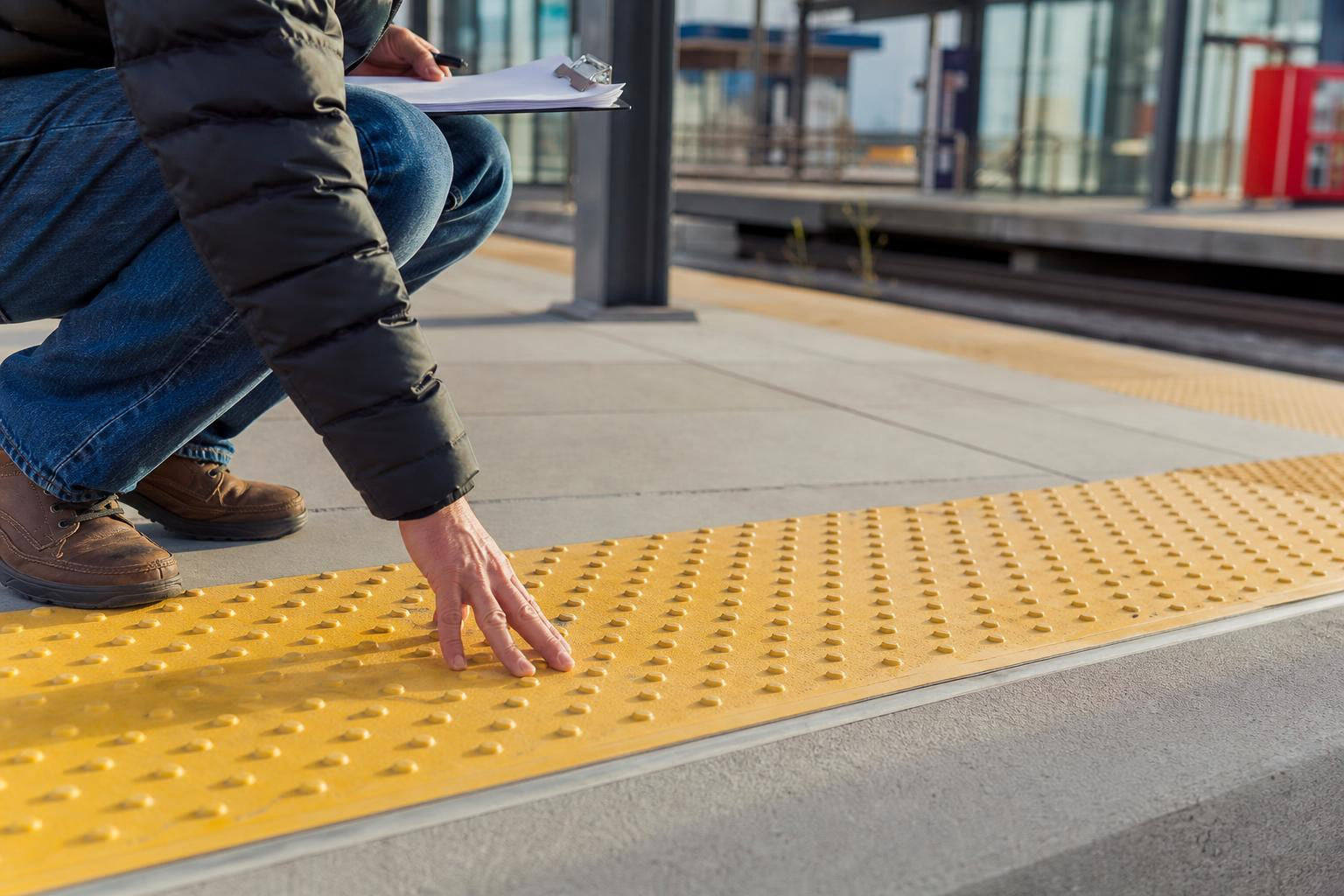
Attention indicators use truncated domes to signal a hazard or a need for caution. You find these at curb ramps, stair landings, transit platform edges, and building entries where pedestrian paths meet vehicular routes.
Direction indicators use flat-topped elongated bars to help people navigate open areas like transit concourses or large public plazas. One commonly missed requirement from CSA B651:23: direction indicators shall not be yellow. This catches many specifiers off guard because yellow is the default colour people associate with tactile surfaces.
Knowing which type your project requires is the first step. The standards that apply to each type overlap significantly but differ in key dimensional and contrast specifications.
For a broader overview of where these products are required, see our guide on TWSI requirements for public buildings.
CSA/ASC B651:23: The Primary Canadian Standard
This is the standard that matters most. Published on January 27, 2023, CSA/ASC B651:23 (Accessible design for the built environment) is now in its sixth edition, superseding the 2018, 2012, and 2004 editions. It is the most frequently referenced standard when asking what testing standards apply to tactile walking surface indicators in Canada.
What It Covers
CSA B651:23 sets out technical specifications for TWSI design and placement. It addresses materials, construction methods, installation requirements, texture profiles, dimensions, and visual contrast. For anyone specifying TWSIs, this document is the starting point.
Key specifications include:
- Dome and bar height: 4 to 5 mm above the surrounding surface
- Bar spacing: 12 to 61 mm
- Bar top width: 17 to 30 mm for direction indicators
- Visual contrast: Detailed guidance on luminance (colour) contrast between TWSIs and adjacent surfaces
- Bevelled edges between tiles and ground to prevent tripping hazards
What Changed in the 2023 Edition
The 2023 update brought several meaningful revisions. These include a more detailed explanation of luminance contrast measurement, revised accessibility guidance for applying that contrast, and revised guidance for tactile direction indicator positioning. The relevant technical subcommittee, a third of whose members live with a disability, developed these updates.
One practical detail worth knowing: the full CSA/ASC B651:23 standard is available for free download from the CSA Group website. There is no reason to specify products without reading the current edition.
Its Relationship to the National Building Code
The National Building Code of Canada directly references CSA B651 as an acceptable solution for meeting the accessibility requirements in Section 3.8.3 of Division B. This makes CSA B651:23 the backbone of TWSI compliance across the country.
ISO 23599:2019: The International Product Specification
ISO 23599:2019 (Edition 2) provides product specifications for tactile walking surface indicators and recommendations for their installation. It was last reviewed and confirmed in 2025, so it remains current. This standard specifies two TWSI types, attention patterns and guiding patterns, similar to the CSA framework but with its own set of technical requirements.
Luminance Contrast Requirements
This is where ISO 23599:2019 gets specific in ways that matter for product selection. Luminance contrast between TWSIs and the surrounding surface must exceed 30% (using the Michelson Contrast formula) where TWSIs are integrated into paving modules of uniform colour. Where discrete elements are used, the contrast threshold jumps to 50%.
That distinction between integrated and discrete installations is critical. A product that passes at 35% contrast in an integrated paving module would fail if installed as a standalone surface-mounted panel.
Why It Allows Wide Variation
The original ISO 23599 was published in 2012 after roughly 15 years of development. Because the process took so long, participating countries had each implemented somewhat different systems by the time it was completed. The result is a standard with technical specifications that allow for wide variation. This flexibility is both a feature and a source of confusion for Canadian specifiers, since Canadian provincial codes may layer additional constraints on top of ISO requirements.
Direct Reference in the Ontario Building Code
The Ontario Building Code, Section 3.8.3.18, specifically requires that tactile attention indicators conform to Clauses 4.1.1 and 4.1.2 of ISO 23599. This is a direct, clause-level cross-reference, not a general nod to the standard. Contractors working in Ontario need to verify that their products satisfy these specific ISO clauses, not just the broader CSA B651 requirements.
This creates one of the most confusing aspects of understanding what testing standards apply to tactile walking surface indicators in Canada: the NBC references CSA B651, while the OBC directly cites ISO 23599 clause numbers. Both apply in Ontario, and they don’t always align perfectly.
National Building Code of Canada (NBC 2020)
The NBC 2020 sets out technical requirements for the design and construction of new buildings, as well as the alteration, change of use, and demolition of existing buildings. Certain parts of the design requirements from CSA B651 are permitted as an acceptable solution to comply with Section 3.8.3 of Division B.
There is an important caveat. As a model code, the NBC has no legal status until a province or territory adopts it. It sets the baseline. Provinces adopt it and sometimes add requirements, modify thresholds, or reference additional standards. The NBC tells you what Canada expects at minimum. Your provincial code tells you what is legally enforceable.
Provincial and Municipal Standards
This is where the testing standards question gets layered. Provincial building codes adopt the NBC (in whole or with modifications) and often add province-specific accessibility legislation on top.
Ontario: AODA and the OBC
Ontario has the most developed framework. Effective January 2016, the AODA (Accessibility for Ontarians with Disabilities Act), under Part IV.1 of Reg 191/11, made TWSIs mandatory on all new and repaired depressed curb sidewalks. The Ontario Building Code Section 3.8.3.18 references ISO 23599 for TWSI specifications, requiring truncated domes at hazards and wayfinding bars for guidance.
Penalties are steep. A person or unincorporated business can be fined up to $50,000 per day. Corporations face daily fines of up to $100,000 for major offences.
Manitoba
The Manitoba Accessibility Act requires municipalities to implement accessibility plans that include installing TWSIs where needed. The specific technical requirements generally follow CSA B651, but local enforcement varies.
Municipal Layers
Cities often publish their own accessibility design guidelines that go further than provincial codes. The City of Toronto Accessibility Design Guidelines prescribe detailed TWSI requirements for municipal facilities. Calgary Access Design Standards regulate both the location and technical specifications of TWSIs in city infrastructure.
A 2022 memo from the City of Mississauga illustrates the real-world complexity. The memo notes that Mississauga uses the CSA B651-18 reference but acknowledges that “CSA B651-18 conflicts with other standards.” No ranking page on this topic addresses this standards conflict head-on, but it is exactly the kind of problem contractors encounter on the ground.
The message here: always check your local jurisdiction’s specific requirements. National and international standards are the floor, not the ceiling.
For more on how codes affect tactile indicator placement, see our tactile indicators compliance guide.
The Accessible Canada Act (Federal)
The Accessible Canada Act (S.C. 2019, c. 10) is federal legislation enacted to achieve a barrier-free Canada by January 1, 2040. It applies to federally regulated organizations, including transportation providers, banks, telecommunications companies, and the federal government itself.
Maximum penalty: $250,000 per violation. Serious violations carry penalties ranging from $2,500 to $150,000. Very serious violations result in fines between $6,250 and $250,000. Each day of continued non-compliance can constitute a separate violation.
For transportation specifically, service providers must meet CSA/ASC B651:23 requirements for new purchases, leases, modifications, and renovations. The earlier CAN/CSA B651-18 continues to apply to existing infrastructure. This dual-standard situation means transportation sector buyers need to know which edition applies to their specific project scope.
Material and Performance Testing Standards (ASTM)
Understanding what testing standards apply to tactile walking surface indicators in Canada requires looking beyond design codes to material-specific testing. The product itself must pass physical performance tests before the design and placement standards even come into play.
Cast Iron
Cast iron TWSI plates are manufactured in accordance with ASTM A-48, Class 35B Grey Cast Iron. This standard governs the tensile strength, hardness, and structural integrity of grey cast iron. It matters for longevity because, as the City of Toronto found during its pilot projects, cast iron indicators initially develop a rusty red colour that may stain the surrounding sidewalk in the first year. The stain eventually disappears as the cast iron develops a natural patina, which actually provides greater tonal contrast over time.
View cast iron tactile plates for specifications on available sizes.
Stainless Steel
Stainless steel TWSI products are tested against a range of ASTM specifications: A182, A193, A276, A313, A314, A320, A479, A493, and A580. Each covers different aspects of stainless steel composition, mechanical properties, and corrosion resistance. When evaluating supplier claims about stainless steel products, ask which specific ASTM standards have been satisfied.
Slip Resistance
One of the critical requirements is that TWSIs meet slip resistance thresholds. ASTM C1028 is a standard test method for determining the static coefficient of friction of surfaces. A product that meets all dimensional requirements but fails slip resistance testing is non-compliant and dangerous.
Wear and Abrasion
Average wear depth shall not exceed 1 mm of abrasion cycles when measured on the top surface of domes or bars. This threshold matters for long-term compliance. A TWSI that was compliant at installation but wears below the minimum dome height within a few years is no longer providing the tactile feedback that visually impaired pedestrians depend on.
With proper installation and maintenance, quality-compliant tactile indicators can last 10 to 15 years outdoors and 20+ years indoors.
Key Technical Requirements at a Glance
This table consolidates the dimensions and thresholds from CSA B651:23 and ISO 23599:2019 that matter most for product specification and verification.
| Requirement | Specification | Source |
|---|---|---|
| Dome/bar height above surface | 4–5 mm | CSA B651:23 |
| Bar spacing | 12–61 mm | CSA B651:23 |
| Direction indicator bar top width | 17–30 mm | CSA B651:23 |
| Luminance contrast (integrated) | Greater than 30% | ISO 23599:2019 |
| Luminance contrast (discrete) | Greater than 50% | ISO 23599:2019 |
| Surface-mounted panel base height | Maximum 3 mm above existing surface | CSA B651:23 |
| Direction indicator colour restriction | Shall not be yellow | CSA B651:23 |
| Maximum wear depth (domes/bars) | 1 mm | ASTM test standards |
For direction indicator products that meet these specifications, see directional bar tiles.
How the Standards Relate to Each Other
One of the biggest sources of confusion when researching what testing standards apply to tactile walking surface indicators in Canada is understanding how the various standards fit together. Here is the hierarchy:
Level 1: Federal Legislation
The Accessible Canada Act sets the broadest policy framework and penalty structure for federally regulated entities.
Level 2: National Model Code
The NBC 2020 establishes baseline accessibility requirements for buildings and references CSA B651 as an acceptable solution for Section 3.8.3.
Level 3: National and International Standards
CSA/ASC B651:23 provides the detailed Canadian technical specifications. ISO 23599:2019 provides the international product specification. Both apply, but in different ways depending on jurisdiction.
Level 4: Provincial Building Codes
Provinces adopt the NBC (with modifications) and may reference ISO 23599 directly (as Ontario does) or rely on CSA B651 alone.
Level 5: Municipal Guidelines
Cities like Toronto, Calgary, and Mississauga publish their own accessibility design standards that may exceed provincial requirements.
The practical takeaway: a product must satisfy CSA B651:23 dimensions and contrast requirements, pass the relevant ASTM material and performance tests, and also meet any additional ISO or provincial requirements specific to the project location.
For a deeper look at how these codes affect construction and architectural projects, Safety Step Canada works with firms across the country.
Real-World Testing and Standards Conflicts
Toronto’s Pilot Project
The City of Toronto conducted a pilot project at Shuter Street and Victoria Street from November 2012 to July 2013, evaluating four different TWSI products in real-world conditions. This kind of field testing goes beyond laboratory standards compliance. It examines how products perform under freeze-thaw cycles, street salt, snow plows, and heavy pedestrian traffic. Products that meet every ASTM and CSA specification in a lab can still fail in Canadian winters.
The Mississauga Standards Conflict
As noted earlier, the City of Mississauga flagged conflicts between CSA B651-18 and other referenced standards. This is not an academic concern. When a municipal authority identifies contradictions between the standards it is obligated to enforce, contractors and architects are caught in the middle. The 2023 update to CSA B651 addressed some of these issues, but anyone working on a project governed by multiple jurisdictions (for example, a transit station that falls under both provincial building code and federal Accessible Canada Act requirements) should verify compliance with each applicable standard independently.
These real-world complications reinforce why understanding what testing standards apply to tactile walking surface indicators in Canada is not as simple as citing a single document.
Frequently Asked Questions
What is the main testing standard for TWSIs in Canada?
CSA/ASC B651:23 is the primary Canadian standard. Published in January 2023, it covers dimensions, materials, contrast, and placement for both attention indicators (truncated domes) and direction indicators (flat-topped bars). The National Building Code references it directly.
Does ISO 23599 apply in Canada?
Yes. ISO 23599:2019 applies in Canada, particularly in Ontario, where the Ontario Building Code Section 3.8.3.18 specifically references Clauses 4.1.1 and 4.1.2 of ISO 23599 for tactile attention indicator specifications.
What are the penalties for non-compliant TWSIs?
Penalties vary by jurisdiction. Under the Accessible Canada Act, the maximum penalty is $250,000 per violation. In Ontario under the AODA, corporations face fines up to $100,000 per day for major offences. Each day of continued non-compliance can count as a separate violation.
Can direction indicators be yellow?
No. CSA B651:23 states that tactile direction indicators shall not be yellow. This requirement is frequently overlooked, and specifying yellow direction indicators will result in a non-compliant installation.
What ASTM standards apply to cast iron TWSIs?
Cast iron TWSI plates must meet ASTM A-48, Class 35B Grey Cast Iron. This covers tensile strength and material composition. Separate slip resistance testing (ASTM C1028) and wear/abrasion limits also apply.
How long do compliant TWSIs last?
With proper installation and maintenance, quality TWSI products typically last 10 to 15 years in outdoor applications and 20+ years indoors. Cast iron products develop a natural patina that can improve visual contrast over time.
Where can I download CSA B651:23?
The full standard is available for free download from the CSA Group website. There is no cost barrier to reviewing the current edition before specifying products.
Are standards the same across all Canadian provinces?
No. The NBC is a model code with no legal status until adopted by a province. Provinces can modify requirements, and municipalities can add further layers. Always confirm the specific standards enforced in your project’s jurisdiction.
Get Help Choosing Compliant Products
Sorting through the layers of Canadian TWSI standards takes time. If you are specifying products for a project and need to confirm which standards apply to your jurisdiction, Safety Step Canada can help.
Browse all tactile indicator products or contact Safety Step Canada for help choosing code-compliant TWSI products for your next project.
See examples of completed installations on our projects page, including work for the City of Toronto and City of Richmond, BC.