
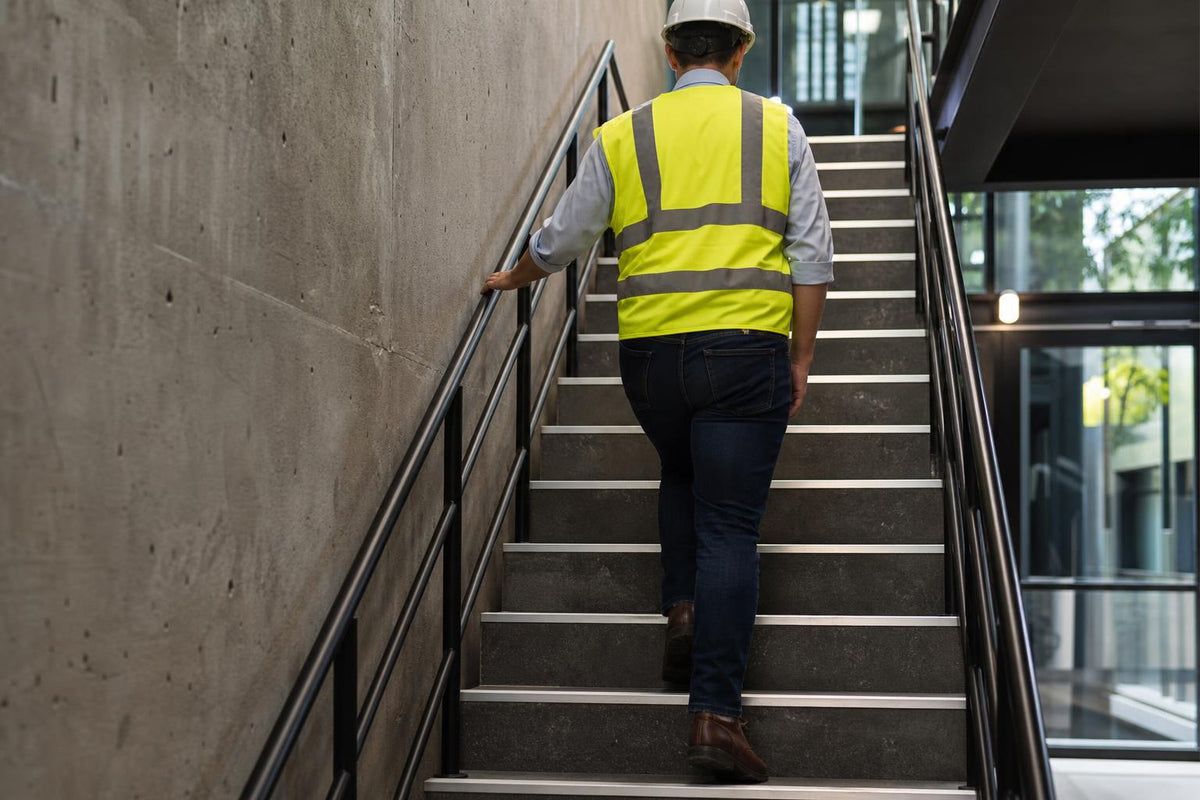
This guide is for architects, contractors, facility managers, and code officials who need to know exactly which standards govern color contrast on egress stairs, what the minimum thresholds are, and how to meet them. Visual contrast on stair nosings is recommended by ADA but required by IBC for commercial buildings. Canada’s standards layer additional requirements through the National Building Code, AODA, and CNIB guidelines. The upcoming ANSI A117.1 edition will introduce a measurable 65% LRV contrast minimum, significantly higher than the commonly cited 30%.
What Color Contrast Requirements for Egress Stairs Actually Mean
Color contrast requirements for egress stairs mandate that the leading edge of each stair tread be visually distinct from the rest of the tread surface. The goal is simple: every step should be identifiable, especially when descending. Without contrast, stairs can blend together into what looks like a ramp, creating a dangerous illusion that causes missteps.
The metric behind these requirements is Light Reflectance Value (LRV), a scale from 0 (pure black) to 100 (pure white) that measures how much light a surface reflects. Contrast is the measured difference between the nosing surface and the tread surface. A yellow nosing on dark concrete, for example, creates a high LRV difference that makes each step obvious.
An egress stair is any stairway designated as part of a building’s emergency exit path. These stairs carry the strictest contrast and marking requirements because they must remain navigable during emergencies, including conditions of reduced lighting or smoke.
If you’re specifying nosings for a commercial or institutional project, FRP stair nosings are available in high-contrast color options including yellow, black with yellow nose, and glow-strip variants.
Why Contrast on Egress Stairs Matters
This is not an aesthetic choice. Data from the National Electronic Injury Surveillance System (NEISS) indicates that from 1990 to 2012, an estimated 24.76 million individuals were treated in U.S. emergency departments for stair-related injuries, roughly one million patients per year.
Grey or dark stairs that lack visual contrast are difficult for the human eye to differentiate. The problem gets worse under three conditions: low ambient lighting, vision impairment, and emergency situations where stress narrows attention.
Research published in Applied Ergonomics tested older adults under varying contrast, vision, and lighting conditions. The study found that a minimum contrast level of 50% is recommended to achieve a balance of task performance and safety. Blurred vision was a greater factor influencing fall risk than low ambient lighting, and higher-contrast highlighters improved safety measures even more during simulated vision impairment.
The U.S. Access Board’s own research identifies safety yellow as the “most visually detectable” color for stair markings. This is why yellow nosings on dark treads remain the default specification for high-traffic commercial and industrial stairs.
For a broader look at how nosings reduce slip incidents, see our guide on how stair nosings reduce injuries.
Code-by-Code Requirements for Stair Nosing Contrast
The single biggest confusion point in this space: the ADA does not require color contrast on stair nosings. The IBC does. These are different standards with different enforcement mechanisms, and conflating them leads to failed inspections and costly rework.
IBC Section 504.6 (The Mandate)
IBC Section 504.6, titled “Stair Treads and Risers,” is the primary enforceable standard for stair nosing contrast in commercial buildings across North America. It requires a visual contrast marking on the leading 1 to 2 inches (25 to 51 mm) of the tread or landing, measured horizontally from the nosing. The marking must extend the full width of the step, use either light-on-dark or dark-on-light color schemes, and be made of a material that is long-lasting and at least as slip-resistant as the surrounding tread.
Here is the critical detail: IBC does not specify a numeric contrast value. The code says “visually contrast” without defining a percentage or LRV difference. In practice, the industry generally expects a minimum 30% luminance contrast to meet best practices and align with accessibility guidelines. But “contrasting” ultimately means a clearly visible visual difference sufficient to make the tread edge apparent, as reasonably determined by the building official.
Practitioners on the Building Code Forum note that this subjectivity can create enforcement inconsistencies. One building official might accept a moderate contrast while another rejects it. Specifying the LRV values on your nosing schedule removes that ambiguity.
For assembly occupancies (theaters, stadiums, arenas), IBC Section 1029.14.2.3 adds a separate, explicit requirement: “A contrasting marking stripe shall be provided on each tread at the nosing or leading edge such that the location of each tread is readily apparent when viewed in descent. Such stripe shall not be less than 1 inch and not more than 2 inches wide.”
ADA / ADASAD (Recommendation Only)
The U.S. Access Board states clearly: “Visual contrast on stair nosings or the leading edges of treads is helpful for people with low vision, but it is not required by the Standards except at escalators in rail and fixed guideway stations.”
The ADA advisory recommends providing light-on-dark or dark-on-light contrast approximately 2 inches wide on the top and bottom steps. But this is guidance, not a mandate. Buildings seeking ADA compliance for stair contrast are really meeting IBC or state code requirements, not ADA requirements.
Upcoming ANSI A117.1 (The 65% Threshold)
The next edition of ANSI A117.1 will fundamentally change color contrast requirements for egress stairs by introducing a specific, measurable minimum. Discussions shared on the Building Code Forum reveal the pending language: the percentage of visual contrast between the marking and its background shall be 65% minimum, calculated using the formula:
Contrast = [(B1 − B2) / B1] × 100
Where B1 is the LRV of the lighter surface and B2 is the LRV of the darker surface.
This 65% threshold is substantially higher than the commonly cited 30% industry guideline. Once adopted into IBC by reference, it will force many existing nosing specifications to be revisited. Architects and specifiers writing stair schedules now should consider this coming change.
California Title 24
California’s requirements exceed the federal ADA. Interior stairs must have the upper approach and lower tread marked with a contrasting stripe. Exterior stairs must have the upper approach and all treads marked. The stripe must be within one inch of the front of the nose, creating a more precisely located marking than what IBC requires. For projects involving outdoor stairs in California, consider aluminum stair nosings rated for weather exposure.
Canadian Codes: NBC, AODA, and CNIB
Canada’s contrast requirements are layered across federal, provincial, and guideline frameworks.
Accessibility Standards Canada (for accessible/ready housing) specifies that stair nosings must accept a horizontal strip 50 ± 10 mm deep that is luminance contrasted with the tread and riser, is slip resistant, and extends the full width of the tread.
CNIB “Clearing Our Path” guidelines, widely referenced across Canadian practice, require a colour/brightness-contrasted strip 40 to 60 mm deep on the leading edge. The contrast between the strip and the tread surface must be at least 50%. The strip should not extend down the front face of the riser by more than 10 mm. For tactile walking surface indicators (TWSIs), CNIB recommends a contrast of at least 70%.
Ontario AODA (Section 80.25) requires that stairs connecting to exterior paths of travel have treads with a slip-resistant finish and high tonal contrast markings extending the full width of the leading edge. The BC Building Code addresses nosing projection, visibility through contrast requirements, and slip resistance in Section 9.8.
A key takeaway: Canadian standards are generally stricter than U.S. requirements. The CNIB’s 50% nosing contrast and 70% TWSI contrast are more demanding than the commonly cited 30% guideline. For more on Canadian accessibility compliance, see our AODA tactile requirements guide and the guide to detectable warning surface colour requirements.
NFPA 101: Photoluminescent Egress Path Markings
Beyond normal color contrast, high-rise buildings face additional requirements for photoluminescent (glow-in-the-dark) markings in emergency exit stairwells. Requirements for luminous egress path markings were first added to the 2009 editions of the IBC, International Fire Code, and NFPA 101.
The 2009 and 2012 International Fire Code require that existing nonresidential buildings over 75 feet high install photoluminescent markings in all enclosed emergency exit stairwells. Products must be UL 1994-listed. Notably, NFPA 101 precludes the use of adhesive-backed tapes on stair nosings due to potential trip hazards; path markers for stair nosings must be marked “Suitable for Stair Nosings” or equivalent.
For buildings that need photoluminescent compliance, glow-in-the-dark stair strips provide egress visibility when power fails.
Quick Reference: Contrast Requirements by Code
| Standard / Code | Minimum Contrast | Strip Width | Scope |
|---|---|---|---|
| IBC 504.6 | “Visually contrast” (no number) | 1–2 in (25–51 mm), full width | Most commercial stairs |
| ADA (ADASAD) | Recommendation only | ~2 in | Advisory for egress stairs |
| ANSI A117.1 (next edition) | 65% LRV formula | 1–2 in (25–51 mm) | Accessible stairways |
| Industry best practice | 30% luminance contrast | 1–2 in | General guideline |
| CNIB Clearing Our Path | 50% nosing; 70% TWSIs | 40–60 mm | Canadian guidance |
| AODA (Ontario) | “High tonal contrast” | Full tread width | Exterior path stairs |
| Canada (ASC housing std) | Luminance contrasted | 50 ± 10 mm | New housing |
| California Title 24 | Clear visual contrast | 2–4 in, within 1 in of nose | Interior/exterior stairs |
| UK BS 8300 | 30 LRV points | Per nosing | Commercial/public |
| Australia AS 1428.1 | 30% luminance | Per nosing | Accessible stairs |
| NFPA 101 (photoluminescent) | Glow-in-dark visibility | Per UL 1994 | High-rise exit stairs |
How LRV Contrast Is Calculated
The formula from the upcoming ANSI A117.1 standard (and already used in practice by specifiers and nosing manufacturers):
Contrast = [(B1 − B2) / B1] × 100
Where:
- B1 = LRV of the lighter surface
- B2 = LRV of the darker surface
Worked example: A vinyl nosing with an LRV of 75 installed on vinyl tile with an LRV of 15 yields: Contrast = [(75 − 15) / 75] × 100 = 80%. This comfortably exceeds both the 30% industry guideline and the upcoming 65% ANSI threshold.
Practical rule of thumb: If the flooring has an LRV of 50, then the stair nosing should have an LRV of either 0 to 20 (dark nosing on medium tread) or 80 to 100 (light nosing on medium tread). Staying at least 30 LRV points apart is the minimum for current compliance; aiming for 65% formula contrast future-proofs the specification.
Color Difference Does Not Equal LRV Contrast
This is the most common misconception about color contrast requirements for egress stairs. Two visually different colors (red and green, for example) can have nearly identical LRV values, resulting in virtually no useful contrast for someone with low vision. The eye perceives hue differences, but LRV measures lightness. A red nosing on a green tread might look contrasting to someone with full color vision yet be invisible to someone with color deficiency or low vision.
Always check the LRV numbers. Never assume that “different colors” equals “sufficient contrast.”
Common Mistakes That Fail Inspections
Placing the contrast strip away from the step edge. Stripes should be placed directly on the leading edge and extend the full width of the step. Stripes placed even slightly back from the edge mislead those who rely on them, creating a false sense of where the drop occurs.
Using two parallel color stripes. Where colored nosings indicate a stair edge, they should be a single, solid color. Two parallel stripes of different colors give a false impression of the step edge location and confuse depth perception.
Dark strips on light treads. CNIB guidance notes that light-colored strips on dark treads are preferable to dark strips on light treads. People with vision loss don’t easily notice dark strips on nosings. If your tread is light-colored, choose an even lighter or brighter nosing rather than defaulting to black.
Omitting the LRV specification from the nosing schedule. When the spec sheet just says “contrasting nosing” without calling out actual LRV values, the installer picks whatever is available. This regularly leads to failed accessibility inspections because the building official measures the installed contrast and finds it insufficient.
Assuming local codes match the national model code. The National Building Code of Canada is a model code. Provinces adopt and amend it differently. Ontario’s AODA requirements differ from BC’s Building Code provisions. Always check with your local Authority Having Jurisdiction (AHJ) before finalizing a specification.
For guidance on writing complete nosing specifications, see our post on specifying stair nosings in architectural drawings.
How to Meet Stair Nosing Contrast Requirements
Choose single-color, high-LRV-difference nosings. Yellow on dark grey or black concrete is the most straightforward combination. Safety yellow is the most visually detectable color according to U.S. Access Board research. A yellow FRP nosing (LRV around 70 to 75) on dark concrete (LRV around 10 to 15) easily exceeds even the upcoming 65% threshold.
Specify LRV values explicitly. Write the nosing LRV and the expected tread LRV into your specification. Calculate the contrast percentage using the formula above. This protects against subjective enforcement and gives the installer a clear target.
Consider glow-in-the-dark options for high-rise egress. If your building is over 75 feet and falls under IBC/IFC photoluminescent requirements, you need UL 1994-listed products marked as suitable for stair nosings. Adhesive-backed tapes are prohibited by NFPA 101 on stair nosings due to trip risk.
Use materials that maintain contrast over time. The IBC requires markings to be “long-lasting.” Painted stripes wear off. Adhesive tapes peel. Pultruded FRP nosings with integral color (the pigment runs through the entire material, not just the surface) maintain their LRV values for years without repainting. For help choosing between adhesive and mechanical fastening, see our guide on adhesive vs. mechanical fixation for nosings.
Verify slip resistance alongside contrast. IBC requires the nosing material to be at least as slip-resistant as the surrounding tread. A glossy, high-contrast nosing that creates a new slip hazard defeats the purpose. Look for grit-surface or textured nosings that satisfy both requirements simultaneously.
Check accessibility requirements for TWSIs at stair approaches. In Canadian buildings, tactile walking surface indicators at the top of stairs have their own contrast requirements (CNIB recommends 70%). These are separate from nosing contrast and may require different products. Browse tactile indicator options for stair approach compliance.
Frequently Asked Questions
Does the ADA require color contrast on stair nosings?
No. The ADA recommends visual contrast on stair nosings as helpful for people with low vision, but it is not a requirement under the ADA Standards except at escalators in rail and fixed guideway stations. The enforceable mandate for commercial buildings comes from the IBC, not the ADA.
What is the minimum LRV contrast for stair nosings?
Currently, the IBC does not specify a number, only requiring “visual contrast.” The industry standard is a minimum 30% luminance contrast. The upcoming edition of ANSI A117.1 will set the minimum at 65% calculated using the formula Contrast = [(B1 − B2) / B1] × 100. In Canada, CNIB recommends a minimum of 50% for nosings.
Do photoluminescent markings replace color contrast nosings?
No. Photoluminescent egress path markings are an additional requirement for high-rise buildings (typically over 75 feet) under IBC, IFC, and NFPA 101. They provide visibility when power fails. Standard color contrast requirements for egress stairs still apply during normal conditions. Buildings that trigger photoluminescent requirements need both.
Can I use any two different colors for nosing contrast?
Not reliably. Color difference does not equal LRV contrast. A red nosing on a green tread may look different to someone with full color vision but can have nearly identical LRV values, making it useless for someone with low vision. Always verify the actual LRV numbers and calculate the percentage contrast.
Are Canadian stair nosing contrast requirements stricter than U.S. requirements?
Generally, yes. CNIB Clearing Our Path recommends 50% contrast for nosings and 70% for TWSIs, both higher than the U.S. industry standard of 30%. Ontario’s AODA adds its own requirements for exterior stairs. Provinces adopt and amend the National Building Code differently, so requirements vary by jurisdiction.
How wide should the contrast strip be on a stair nosing?
Most codes specify 1 to 2 inches (25 to 51 mm). California Title 24 allows up to 4 inches but requires placement within 1 inch of the nose. Canadian standards call for 50 ± 10 mm (approximately 40 to 60 mm). The strip must extend the full width of the tread in all jurisdictions.
Get the Right Nosing for Your Project
Meeting stair nosing color contrast requirements for egress stairs starts with choosing the right product. If you need help selecting a nosing that meets your local code’s contrast and slip-resistance requirements, contact Safety Step Canada or browse our FAQ page for product and compliance questions.