
How to Choose Between Adhesive and Mechanical Fixation for Nosings
TL;DR: The right fixation method for stair nosings depends on five factors: traffic level, indoor or outdoor location, substrate type, installation temperature, and whether drilling is allowed. Adhesive alone works for light-traffic indoor stairs on smooth substrates. Mechanical screws suit outdoor and high-traffic environments. The dual-bond method (adhesive plus screws together) is the industry standard for commercial and industrial installations. In Canadian conditions, cold weather below 5°C can prevent adhesive from curing, making mechanical fixation the safer primary hold.
This guide is for contractors, facility managers, and property managers who have already selected stair nosings and need to decide how to attach them. It covers when adhesive alone is enough, when screws are essential, and why combining both methods is the default recommendation for most commercial projects.
Choosing between adhesive and mechanical fixation for nosings is not a preference call. It is a technical decision driven by the conditions on your job site. Get it wrong, and a loose nosing becomes a trip hazard worse than having no nosing at all.
Browse FRP stair nosings to see the profiles and sizes available for dual-bond installation.
What “Adhesive Fixation” Means
Adhesive fixation bonds the nosing to the step edge using construction adhesive (polyurethane, MS polymer, or mastic) applied from a cartridge or tube. There is also a simpler version: self-adhesive peel-and-stick nosing strips that come with a pre-applied backing.
Adhesive-only installation works best on smooth indoor substrates like tile, stone, vinyl, or waterproofed surfaces where drilling would cause damage. It produces a clean appearance with no visible fastener heads, and it requires no power tools.
The limitations are real. Adhesive needs a clean, dry, flat surface. It requires 24 to 48 hours to cure, during which foot traffic must be prevented. Most construction adhesives will not cure properly below 5°C, which matters for any outdoor project in Canada from roughly October through April. And on average, peel-and-stick treads last only about a year outdoors before they peel up and become a trip hazard.
Practitioners on Reddit have posted about nosings “sliding off” after adhesive-only installation, reinforcing what manufacturers already warn: self-adhesive products suit quick residential upgrades, not permanent commercial installations.
For examples of adhesive-applied products, see anti-slip deck strips, which use adhesive backing designed for wood, concrete, and metal surfaces in lighter-duty applications.
What “Mechanical Fixation” Means
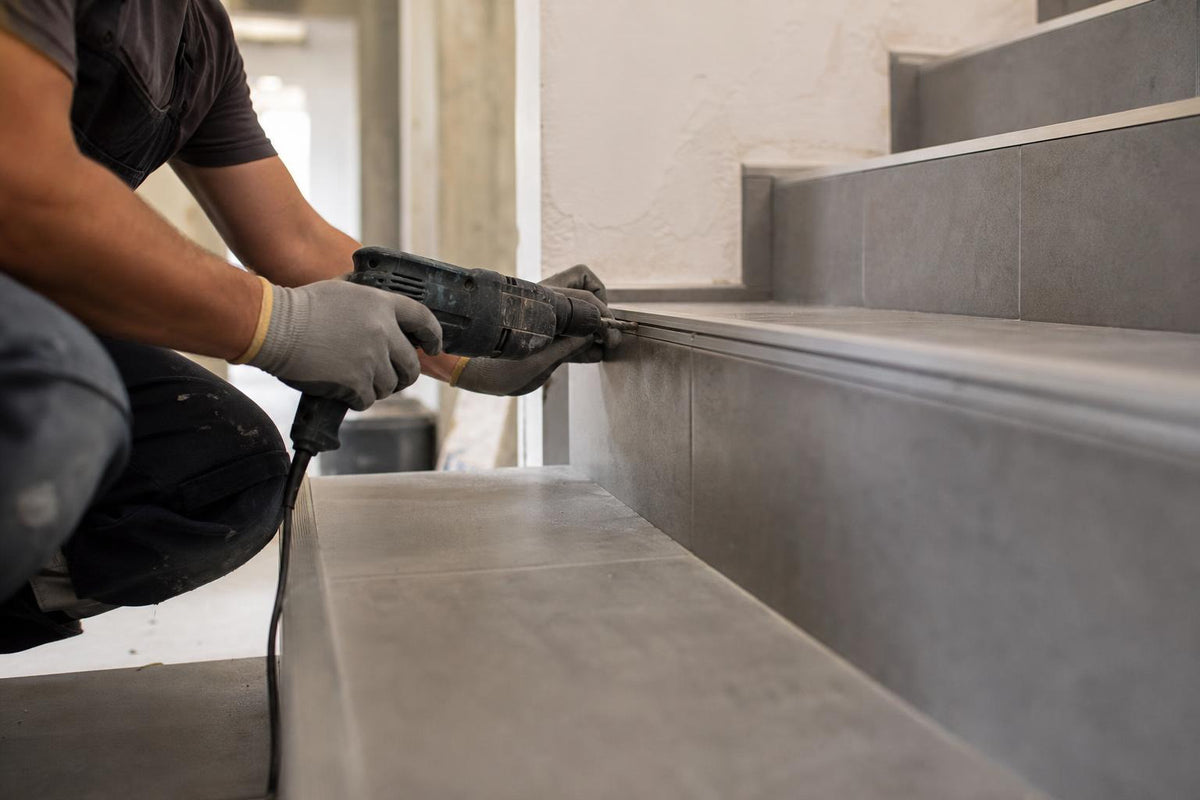
Mechanical fixation uses screws, anchors, bolts, or rivets driven through pre-drilled holes in the nosing and into the substrate. This is the most reliable method for commercial, high-traffic, and outdoor applications.
The key advantages are immediate hold (no cure time), full effectiveness in any temperature, and immunity to substrate moisture. A screw does not care if the concrete is damp.
Screw Specifications by Substrate (FRP Nosings)
| Substrate | Screw Type | Size |
|---|---|---|
| Timber | No. 8 zinc-plated or stainless steel | 30 mm |
| Steel plate | No. 8 self-tapping pan-head stainless steel | 20 mm |
| Concrete | No. 8 zinc-plated or stainless steel impact anchors | 30 mm |
Space screws approximately 600 mm (2 feet) apart along the length of the nosing.
The simple rule: if the stair is public, external, or takes wheeled traffic (carts, trolleys, dollies), screw it down. For outdoor aluminum installations, the guide on installing aluminum stair nosing on outdoor stairs walks through the full mechanical process.
What “Dual-Bond” (Combination) Fixation Means
The dual-bond method uses both adhesive and mechanical fasteners on the same nosing. Unless the manufacturer specifically says not to use screws, this combination is the standard for commercial and industrial work. Adhesive handles shear forces (the sideways pull of foot traffic). Screws prevent peeling and uplift.
Multiple manufacturer data sheets recommend this double fixing method. One experienced installer summarized the consensus well: “Unless the manufacturer specifically says to not use screws or you’re using a special adhesive recommended by the manufacturer, I would recommend both screwing and gluing the profile to the step.”
GRP/FRP nosing manufacturers specifically recommend combining screw fixings with adhesive for the most secure installation.
The Correct Sequence
- Apply adhesive to the substrate in a continuous bead.
- Press the nosing firmly into position so the adhesive spreads evenly.
- Drive screws through the pre-drilled holes.
- Wipe away any adhesive squeeze-out immediately. Polyurethane adhesive is nearly impossible to remove once cured, and dried residue on the tread surface collects dirt.
- Prevent foot traffic for at least 24 hours.
The Hidden Benefit: Noise Reduction
Mechanical fasteners hold nosings in position, but they do not eliminate micro-movement at the contact surface. Over time, that movement causes a “drumming” noise, the hollow thud you hear on metal stairs when nosings vibrate against the substrate. Adhesive fills the gap and creates a continuous bond that eliminates the friction points where noise originates. Even when screws are doing all the structural work, adhesive acts as an acoustic dampener.
For projects in industrial and commercial settings, dual-bond is not optional. It is the baseline expectation.
The Five-Factor Decision Framework
How to choose between adhesive and mechanical fixation for nosings comes down to five variables. No single factor decides the method. The combination of all five does.
| Factor | Adhesive Only | Screws Only | Dual-Bond |
|---|---|---|---|
| Low-traffic indoor | Good | Acceptable | Best |
| High-traffic commercial | Not recommended | Good | Essential |
| Outdoor / weather-exposed | Risky | Good | Essential |
| Concrete substrate | Risky (moisture) | Good (impact anchors) | Best |
| Tile / waterproofed surface | Only option | Not recommended (cracks tile) | Use adhesive only |
| Wood substrate | Acceptable | Good | Best |
| Metal substrate | Acceptable (if clean) | Good (self-tapping screws) | Best |
| Temperature below 5°C | Fails to cure | Works | Screws as primary; adhesive as supplement |
| Open-grate / bar grating | Cannot be used | Saddle clamps | Not applicable |
When deciding how to choose between adhesive and mechanical fixation for nosings on a specific job, locate your project conditions in each row. If any single row points to “screws only” or “essential,” that overrides the rows where adhesive alone would be acceptable.
For help comparing nosing materials and their ideal fixation approaches, see the FRP vs. aluminum stair nosing comparison.
Cold-Weather Considerations for Canadian Installations
This is the factor most general fixation guides ignore, and it is the one that matters most for Canadian projects.
Most construction adhesives have an application temperature range of 5°C to 35°C. Below 5°C, the adhesive will not cure properly. In colder conditions, manufacturers recommend extending cure time to a full 48 hours, but even that assumes temperatures stay above the minimum threshold. A November night in Halifax or Edmonton can easily drop below freezing and halt the curing process entirely.
Temperature swings cause additional problems. Colder temperatures contract the adhesive while warmer temperatures expand it. This expansion and contraction cycle weakens the bond over a single season, which is why peel-and-stick nosing products rarely survive a full Canadian winter outdoors.
For exterior stair projects during fall, winter, or early spring:
- Check the adhesive manufacturer’s temperature specifications before you start.
- If temperatures will dip below 5°C during the 24 to 48 hour cure window, use mechanical fasteners as the primary hold and treat adhesive as a supplement (applied on a warmer day if needed).
- Consider cold-weather-rated adhesives, but verify their stated cure range rather than trusting marketing claims.
- For a long-lasting outdoor solution, aluminum stair nosings with mechanical fixation provide weather-resistant performance without relying on adhesive cure.
The bottom line: in Canadian conditions, screws are the reliable constant. Adhesive is the variable.
Surface Preparation: The Step That Makes or Breaks Either Method
One product engineer with a decade of experience in the nosing industry claimed that 80% of stair nosing failures happen because the surface was dirty or uneven. That number aligns with what practitioners report on flooring forums: the nosing, adhesive, and screws are rarely the problem. The substrate is.
A nosing bonded to a crumbling, dusty, or uneven surface will fail regardless of how good your adhesive is. And screws driven into weak or hollow substrate will pull out under load.
Surface Prep Checklist
- Clean. Remove dust, dirt, grease, paint flakes, and loose material. Sweep, then wipe with a solvent if needed.
- Flat. Fill low spots and grind down high spots. The nosing must sit flush. An uneven surface creates rocking, which accelerates failure.
- Dry. Concrete and screed should read below approximately 4% moisture content before adhesive bonding. If you cannot test moisture, use mechanical fixings instead.
- Scuffed. For adhesive bonding, lightly abrade smooth surfaces (polished concrete, sealed timber) to give the adhesive something to grip.
- Primed (if required). Some adhesives require a primer coat on porous substrates. Check the adhesive data sheet.
For a deeper walkthrough, the guide on preparing surfaces for anti-slip strips covers the same principles and applies equally to nosing installation.
Saddle Clamp Assemblies: When Neither Adhesive Nor Screws Work
Open-grate and bar-grating stairs present a unique problem. There is no solid substrate behind the grating, so adhesive has nothing to bond to and standard screws have nothing to bite into.
Saddle clamp assemblies solve this. They are purpose-built stainless steel brackets that grip the grating bars directly, providing a mechanical fixing point for the nosing without requiring a solid backing surface. They bolt through the nosing and clamp around individual grating bars.
This is the third fixation option that most guides overlook. If your project involves industrial grated stairs (common in plants, refineries, and marine environments), saddle clamps are not optional. They are the only reliable method.
View stainless steel saddle clamp assemblies for specifications and sizing.
Common Fixation Mistakes
Understanding how to choose between adhesive and mechanical fixation for nosings also means knowing what goes wrong. These are the failures installers and facility managers encounter most often:
Using self-adhesive products in commercial or outdoor settings. Peel-and-stick nosings are designed for light residential use. On a busy commercial stairwell or an exterior staircase exposed to rain, snow, and temperature swings, they will peel within months. A loose nosing is a more dangerous trip hazard than a bare step.
Applying adhesive to dusty, wet, or cold surfaces. Moisture is the biggest hidden cause of adhesive failure. Cold prevents curing. Dust prevents bonding. If any of these conditions exist and cannot be corrected, default to mechanical fasteners.
Skipping pilot holes. Driving screws directly into concrete or tile without pre-drilling cracks the substrate and bends the screws. On FRP nosings, pilot holes prevent the composite from splitting. Always pre-drill.
Over-torquing screws. On FRP nosings, too much torque cracks the pultruded profile. On aluminum, it dishes the metal and creates a depression that collects water. Tighten until snug, then stop.
Walking on nosings before adhesive cures. The minimum cure time is 24 hours at room temperature. In cooler conditions, extend to 48 hours. Foot traffic during curing shifts the nosing and breaks the developing bond.
Assuming one method fits all stairs in a building. A single facility can have concrete interior stairs (dual-bond), tiled lobby stairs (adhesive only), exterior metal stairs (screws), and grated platform stairs (saddle clamps). Assess each staircase individually.
For a broader look at installation planning, the procurement checklist for stair nosings covers fixation method alongside sizing, material, and code considerations.
Important Limitations
Anti-slip nosings reduce slip risk, but they do not eliminate it. Surfaces still need regular cleaning and maintenance. Ice, oil, standing water, and debris still need to be managed. The fixation method keeps the nosing attached, but the nosing itself only works when its grit surface is clean and intact.
Code and accessibility requirements vary by province and municipality. Any compliance claims should be verified against the specific building code applicable to your project location.
Frequently Asked Questions
Can I use adhesive alone on outdoor stairs?
It is not recommended. Outdoor stairs face rain, snow, freeze-thaw cycles, and temperature swings that weaken adhesive bonds. Self-adhesive nosings typically last about a year outdoors before peeling. For exterior stairs, use mechanical fixation or the dual-bond method.
What adhesive should I use for stair nosings?
Polyurethane or MS polymer construction adhesive applied from a cartridge is the standard. Avoid general-purpose silicone, which lacks the shear strength needed for foot traffic. Always check the nosing manufacturer’s recommended adhesive, as some products require specific formulations.
How long does adhesive take to cure on stair nosings?
Standard cure time is 24 to 48 hours depending on temperature and humidity. Below 5°C, curing slows dramatically or stops entirely. Foot traffic must be prevented for the full cure period.
Do I need both screws and adhesive?
For commercial, industrial, public, and outdoor installations, yes. The dual-bond method is the industry standard. Screws prevent peeling and provide immediate hold. Adhesive handles shear forces and eliminates drumming noise. The only exception is tile or waterproofed surfaces where drilling would cause damage, in which case adhesive alone is used.
What if I cannot drill into the substrate?
On tile, glass, or waterproofed surfaces, adhesive-only fixation is the accepted method. Choose a high-strength polyurethane adhesive, ensure the surface is clean and dry, and allow the full cure time. Understand that this installation will be less durable than a dual-bond approach and should be inspected regularly.
How do I fix nosings to open-grate stairs?
Standard adhesive and screws will not work on bar grating because there is no solid substrate. Use saddle clamp assemblies that grip the grating bars directly.
Does the nosing material (FRP vs. aluminum) change the fixation method?
The method (adhesive, screws, or dual-bond) depends on the environment and substrate, not the nosing material. However, the screw type and torque limits differ. FRP nosings require pilot holes to prevent splitting. Aluminum nosings can dish if over-torqued. Both materials work well with the dual-bond approach.
For project-specific fixation advice, including screw specifications, adhesive compatibility, and cold-weather installation planning, contact Safety Step Canada directly.