
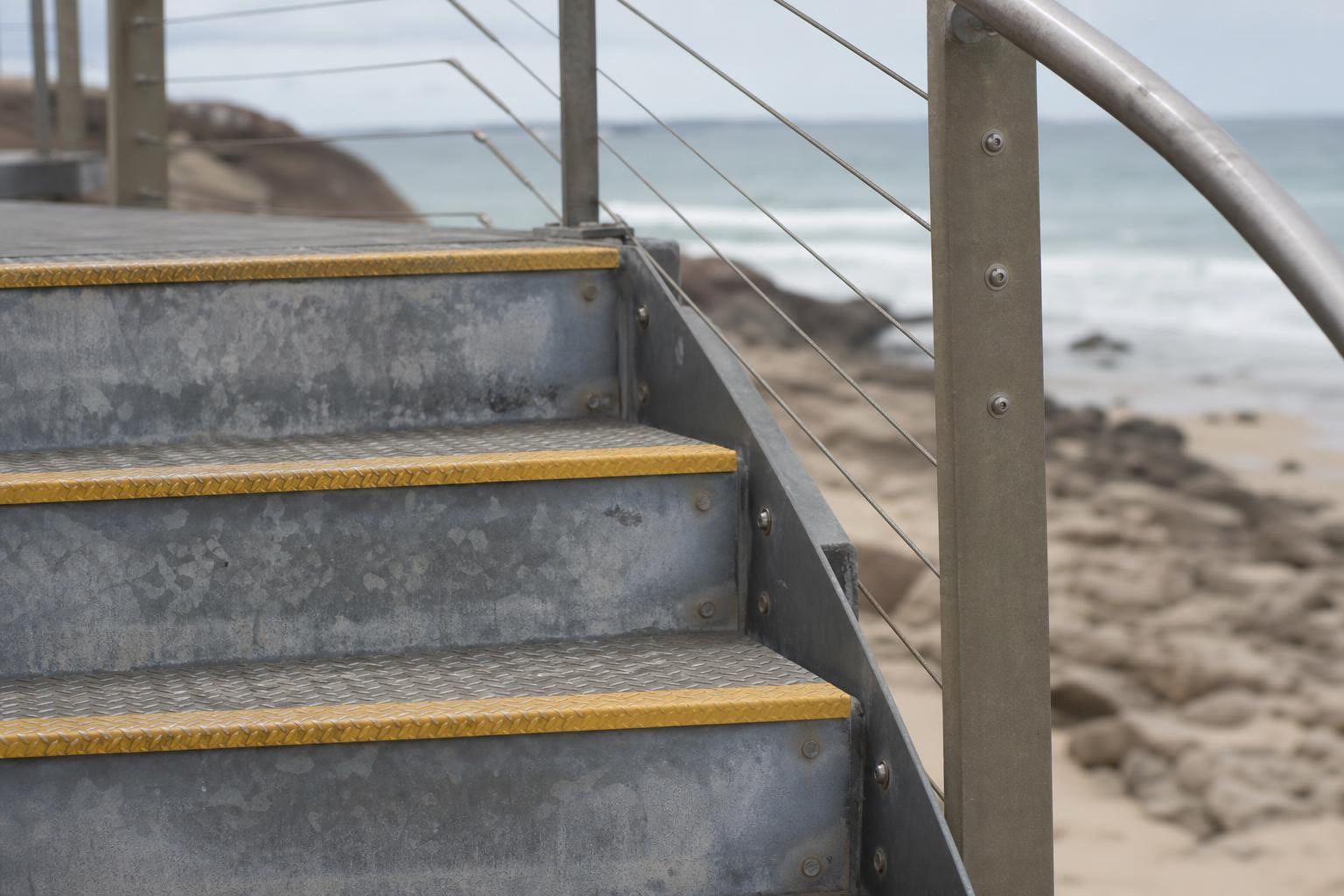
TL;DR
FRP stair nosing is immune to salt corrosion and eliminates galvanic corrosion risk at fastener points, making it the lower-maintenance choice for harsh coastal exposure. Aluminum stair nosing works well near the coast too, but only when the right alloy, finish (powder coating over anodizing for salt air), and fastener isolation are specified correctly. Most aluminum failures in coastal zones are specification errors, not material failures. This guide walks through the corrosion mechanisms, finish options, and practical trade-offs so you can pick the right material for your site.
This guide is for facility managers, contractors, property owners, and specifiers who need stair nosing for a building, boardwalk, dock, or platform exposed to salt air. The decision it helps you make: should you install FRP or aluminum nosing, and what finish and fastener details matter for a coastal installation that lasts?
Both materials can perform in salt environments. The question is which one fits your specific combination of exposure severity, foot traffic, budget, and maintenance capacity. If you are evaluating FRP stair tread nosings or aluminum stair nosings, the sections below cover everything you need to compare them properly.
What Makes Coastal Environments Different for Stair Nosing
“Coastal environment” sounds straightforward, but the corrosion-relevant zone extends much further than most people assume. According to research from Linetec, significant airborne chloride deposits from ocean spray have been measured more than 50 miles inland. Various building standards define “coastal” as anywhere from 1,500 feet to 1.5 miles from the shore, but the chemistry doesn’t respect those neat boundaries.
Three corrosion mechanisms matter when choosing between FRP and aluminum stair nosing for coastal environments:
Chloride attack. Airborne salt deposits land on metal surfaces. Chloride ions penetrate protective oxide layers and initiate pitting, which is localized corrosion that eats into the metal at specific points rather than eroding the surface evenly.
Galvanic corrosion. When two dissimilar metals are in contact and an electrolyte (salt water, humid salt air) is present, the less noble metal corrodes faster. This is a real problem at fastener locations where stainless steel screws meet aluminum nosing.
Coating failure. If a protective finish is scratched, improperly applied, or too thin, the exposed metal underneath corrodes rapidly. In coastal zones, coating failures accelerate because salt deposits concentrate in scratches and crevices.
For readers also dealing with slip risks on adjacent surfaces like decks, ramps, or walkways, anti-slip deck strips and anti-slip sheets for platforms address those broader coastal safety needs.
FRP Stair Nosing: Definition and Coastal Performance
What FRP Is
FRP stands for fibre-reinforced polymer (sometimes called fibre-reinforced plastic). It is a composite material made from glass fibres embedded in a resin matrix, typically polyester or vinyl ester. Quality FRP stair nosings are manufactured through pultrusion, a continuous process that pulls glass fibres through a resin bath and then through a heated die. The result is a uniform cross-section profile with consistent mechanical properties along its full length.
Why FRP Resists Coastal Corrosion
FRP does not corrode. Period. There is no oxide layer to pit, no metal to sacrifice in a galvanic cell, and no coating that needs to remain intact to prevent rust. Saltwater immersion causes no degradation to glass fibre or properly formulated resin systems, which is why FRP has been a standard material on offshore platforms, marine construction, and chemical plants for decades.
Field data backs this up. Pultruded FRP profiles with ECR-glass fibre and vinyl ester resin have shown no measurable structural degradation after more than 10 years of continuous seawater exposure. Installations in offshore and chemical environments have remained in service for over 20 years with zero corrosion-related maintenance. The design service life for pultruded FRP structures is commonly specified at 50+ years.
Anti-Slip Grit Integration
In quality FRP nosings, the anti-slip surface is not a coating glued on top. Silicon carbide or quartz grit is bonded directly into the resin matrix during manufacturing. This means the traction surface is inseparable from the nosing itself, which matters in coastal environments where adhesive-bonded surfaces are more likely to delaminate from salt, moisture cycling, and UV exposure.
The UV Nuance You Need to Know
Here is where honest disclosure matters. FRP is not completely maintenance-free outdoors.
Unprotected FRP resin surfaces degrade under sustained UV exposure. Without UV stabilization, you can see surface chalking, erosion, and eventually exposed fibres within 2 to 5 years of outdoor service. This sounds alarming, but it is a specification issue, not a material flaw. Most pultruded FRP profiles intended for outdoor use are manufactured with UV-stabilized resins. With proper UV stabilization and a protective gel coat, FRP retains over 85% of its mechanical properties at simulated 25 years of service. Planning for a gel coat reapplication at 15 to 20 year intervals maintains surface condition indefinitely.
The takeaway: always confirm that any FRP nosing you specify for an outdoor coastal installation uses UV-stabilized resin. Cheap, unprotected FRP is a different product category.
FRP’s Key Weakness: Impact Resistance
Aluminum tolerates mechanical damage from dropped tools, equipment contact, and heavy boot traffic better than FRP. FRP can crack or delaminate at impact points. If your stair nosing will be subject to regular impacts (loading docks, industrial stairways where tools and equipment are moved frequently), this is a factor. FRP works best on stairs with high foot traffic but low mechanical impact risk.
Bonus Properties
FRP is non-conductive, non-sparking, and lighter than steel or aluminum. These properties matter for marine fuel docks, petrochemical coastal installations, and any location where electrical hazards or flammable vapours are present. For related coastal applications, FRP grating offers the same corrosion resistance on platforms and walkways.
Cutting Safety Note
Practitioners on Reddit and trade forums report that cutting FRP on site generates dust containing fine glass fibres that can cause skin rashes, eye irritation, and respiratory symptoms. A National Library of Medicine report confirms that inhaling FRP dust irritates the respiratory system. If you are cutting FRP nosings to length on site, proper PPE is non-negotiable: P100 respirator, safety glasses, gloves, and long sleeves. For more detail, see cutting FRP stair nosing on site.
Aluminum Stair Nosing: Definition and Coastal Performance
The Alloy Matters
Not all aluminum is created equal for coastal use. The standard extrusion alloy for stair nosings is 6063 aluminum, which forms a thin, self-healing aluminum oxide (Al₂O₃) film on its surface. In non-coastal settings, this natural oxide layer provides good atmospheric corrosion resistance. The problem is that 6063 is sensitive to pitting when chloride concentrations exceed 500 ppm, which is a threshold easily met in coastal air.
Unfinished, bare aluminum reacts strongly with chloride ions. Within weeks of coastal exposure, the chemistry overwhelms the protective oxide layer and visible pitting begins.
For coastal installations, the 5000-series alloys (5052, 5083) and 6000-series alloys (6063, 6005A) are the appropriate starting points, but alloy selection alone is not enough. The finish is what determines whether aluminum survives or fails near the ocean.
Anodized vs. Powder-Coated: Which Finish for Coastal Aluminum?
This is the most consequential specification decision for aluminum stair nosing in coastal environments.
Anodizing is an electrochemical process that converts the aluminum surface into a thicker layer of aluminum oxide. Type II anodizing produces a 5 to 25 μm oxide layer. Type III (hard-coat) anodizing produces 25 to 60 μm. Anodized finishes are wear-resistant, meaning they hold up well against foot traffic and physical abrasion. In salt spray testing per ASTM B117, anodized panels typically achieve 336 to 1,000 hours depending on oxide thickness and sealing quality.
Powder coating is a dry finish applied electrostatically and cured under heat, creating a thicker barrier film than anodizing. In the same ASTM B117 salt spray testing, properly pretreated and powder-coated aluminum panels routinely achieve 1,000 to 3,000 hours of resistance.
From a pure corrosion standpoint, powder coating offers significantly better salt spray performance than anodizing. According to industry finishing specialists, powder-coated aluminum is a better bet in salt air environments. However, anodized coatings are more wear-resistant against scratching and abrasion. If your nosings are in a public area where deliberate scratching or heavy scuffing is likely, that changes the calculation because a scratch through powder coating exposes bare aluminum, while a scratch on an anodized surface encounters more oxide underneath.
The best option for maximum coastal protection: anodize first, then powder coat over the anodized surface. This dual-layer approach gives you the wear resistance of anodizing plus the barrier protection of powder coating.
Lifespan Benchmarks
Anodized aluminum finishes often last over 25 years outdoors with minimal maintenance. Powder-coated finishes typically last 15 to 20 years if kept clean and inspected for damage. These numbers assume correct specification and application, which brings up a critical point.
Most Coastal Aluminum Failures Are Specification Errors
Practitioners in finishing industry forums and trade discussions report a recurring pattern: people who had aluminum products powder-coated for a coastal environment and later regretted it. In nearly every case, the root cause was incorrect surface preparation or the wrong type of powder, not a fundamental limitation of aluminum as a material. When you choose aluminum stair nosing for coastal environments, the finish specification is where the project succeeds or fails.
For guidance on installing aluminum nosings properly, see how to install aluminum stair nosing on outdoor stairs.
Galvanic Corrosion: The Fastener Factor Most Guides Miss
This is the single most underappreciated risk when choosing between FRP and aluminum stair nosing for coastal environments. Almost no competitor guides cover it, but it can determine whether your installation lasts 20 years or develops hidden failure points in two seasons.
What Galvanic Corrosion Is
When two dissimilar metals are in electrical contact and an electrolyte (salt water, humid coastal air) is present, an electrochemical reaction occurs. The less noble metal acts as the anode and corrodes preferentially. In the case of stainless steel fasteners installed into aluminum nosing, the aluminum is the anode. It corrodes.
A stainless steel screw or bolt in an aluminum plate that looks perfect on day one can become a hidden failure point within a few seasons in a harsh coastal climate. The aluminum loss concentrates around the fastener holes and crevices where moisture lingers, exactly where structural integrity matters most.
Why FRP Eliminates This Risk Entirely
FRP is non-metallic. There is no galvanic cell possible between an FRP nosing and a stainless steel fastener. No dissimilar metal pairing, no electrochemical reaction, no hidden corrosion at fastener points. This is a genuine, practical differentiator that goes beyond the general “corrosion resistance” comparison.
For FRP installations requiring saddle clamp assemblies, the stainless steel clamp contacts only the FRP, so galvanic corrosion simply does not apply.
How to Mitigate Galvanic Risk With Aluminum
If aluminum is the right choice for your project (and it can be, for reasons covered below), galvanic corrosion at fastener points needs to be addressed:
- Isolating gaskets. Place a thin plate of non-absorbent material (rubber, plastic, or a specialized insulating gasket) between the stainless steel fastener and the aluminum surface.
- Nylon washers. Plastic or rubber washers under fastener heads prevent direct metal-to-metal contact.
- Avoid the reverse combination. Stainless steel fasteners in aluminum plates are considered acceptable (with isolation). Aluminum fasteners holding stainless steel parts is an unwise combination.
The construction specifier community recognizes this issue, but it is rarely mentioned in stair nosing product guides. If you are specifying aluminum nosings for a coastal site, write the fastener isolation requirement directly into your specification. For help with specification language, see specifications for aluminum stair nosings in architectural plans.
Head-to-Head Comparison: FRP vs. Aluminum Stair Nosing for Coastal Use
| Factor | FRP Stair Nosing | Aluminum Stair Nosing |
|---|---|---|
| Corrosion resistance | Immune to salt, chemicals, moisture. No finish required. | Requires proper finish (anodized + powder coat ideal). Bare aluminum pits within weeks. |
| Salt spray performance | Not applicable (no corrosion mechanism) | 336–1,000 hrs anodized; 1,000–3,000 hrs powder coated (ASTM B117) |
| Galvanic corrosion risk | None (non-metallic) | Real risk at fastener points; requires isolation gaskets |
| Impact resistance | Lower. Can crack or delaminate under mechanical blows. | Higher. Tolerates dropped tools and equipment contact. |
| UV performance | Requires UV-stabilized resin; unprotected FRP degrades in 2–5 years | Finish may chalk or fade; underlying metal unaffected by UV |
| Weight | Lighter than aluminum | Heavier than FRP, lighter than steel |
| Aesthetics | Industrial appearance; limited colour range | Wider colour/finish options; cleaner architectural look |
| Finish maintenance | Gel coat reapplication at 15–20 year intervals for UV protection | Inspect and touch up scratches; recoat at 15–25 year intervals |
| Non-conductive | Yes | No |
| Non-sparking | Yes | Yes (aluminum is generally non-sparking in most conditions) |
| Anti-slip grit | Bonded into resin matrix (inseparable) | Typically applied via insert strips or adhesive grit |
| Typical coastal service life | 20–50+ years (UV-stabilized) | 15–25+ years (properly finished) |
| Relative cost | Generally lower material cost | Generally higher, plus finish specification costs |
Decision Framework: When to Choose FRP, When to Choose Aluminum
Choose FRP Stair Nosing When:
- The installation is directly exposed to salt spray, splash zones, or saltwater immersion (docks, piers, boardwalks, waterfront stairs)
- You need zero corrosion maintenance over the installation’s life
- Galvanic corrosion risk must be eliminated (especially where fastener inspection is difficult or expensive)
- The environment involves chemicals, fuels, or electrical hazards (non-conductive, non-sparking)
- Budget is a primary constraint and you want lower material cost with minimal ongoing maintenance spend
- Impact risk from equipment or tools is low to moderate
Browse FRP stair nosing options to compare sizes and colours for your project.
Choose Aluminum Stair Nosing When:
- Architectural appearance matters and you need a wider range of finishes and colours
- The stairs are subject to regular mechanical impacts (industrial loading, equipment movement)
- You can specify and verify the correct alloy, finish system, and fastener isolation for coastal exposure
- The installation is in the broader coastal zone (1 to 50+ miles from shore) but not in direct splash or immersion
- Long-term maintenance inspections are part of your facility management plan
View aluminum stair nosing options for outdoor applications.
Consider Using Both Materials When:
Real-world marine applications often combine both materials. Great Northern Docks, for example, uses marine-grade aluminum frames with anti-slip fiberglass reinforced treads. This approach uses aluminum’s structural rigidity and impact resistance for the frame while putting FRP’s corrosion immunity and integrated grit where foot contact and salt exposure are highest.
If your coastal project involves both structural framing and tread surfaces, a hybrid approach may be the strongest choice. For broader maritime anti-slip needs, Safety Step Canada also offers an anti-slip coating service for maritime applications.
Key Terms Glossary
6063 Aluminum Alloy. The standard extrusion alloy used for stair nosings. Good atmospheric corrosion resistance in non-coastal settings. Sensitive to pitting when chloride concentrations exceed 500 ppm, requiring finish protection in salt environments.
Anodizing. An electrochemical process that converts the aluminum surface into aluminum oxide (Al₂O₃). Type II produces a 5–25 μm layer suitable for general outdoor use. Type III (hard-coat) produces 25–60 μm for higher abrasion and corrosion resistance.
ASTM B117. The industry standard salt spray fog test for evaluating corrosion resistance. Samples are exposed to a 4–6% sodium chloride mist in a chamber at 35°C (95°F). Testing durations range from 24 hours to over 1,000 hours. MIL-A-8625 specifications reference ASTM B117 at 336 hours.
Chloride Attack. The mechanism where chloride ions penetrate a metal’s protective oxide layer and initiate pitting corrosion. This is the primary corrosion threat in coastal environments.
Delamination. Separation of bonded layers. In stair nosings, this refers to anti-slip grit or surface layers separating from the base material due to moisture cycling, UV damage, or adhesive failure.
FRP (Fibre-Reinforced Polymer). A composite material made from glass fibre and resin (polyester or vinyl ester). When manufactured via pultrusion for stair nosings, FRP is corrosion-proof, lightweight, and non-conductive.
Galvanic Corrosion. An electrochemical reaction between dissimilar metals in the presence of an electrolyte (salt water or moisture). When aluminum contacts stainless steel in a salty environment, the aluminum acts as the anode and corrodes preferentially.
Impact Resistance. The ability of a material to absorb mechanical blows without cracking. Aluminum outperforms FRP on this metric.
Powder Coating. A dry finish applied electrostatically and cured under heat. Creates a thicker barrier film than anodizing. Provides superior salt spray resistance (1,000–3,000 hours ASTM B117) but is more susceptible to through-scratches than anodized surfaces.
Pultrusion. A continuous manufacturing process that pulls glass fibres through a resin bath and heated die, producing uniform cross-section profiles. This is the standard production method for structural FRP nosings.
Salt Spray Zone / Coastal Environment. An area subject to airborne chloride deposition from ocean spray. Corrosion-relevant exposure can extend 50+ miles inland depending on prevailing winds and terrain.
UV Stabilization. Additives or surface treatments (gel coat, surface veil, stabilized resin systems) in FRP that prevent resin degradation from sunlight exposure. Without UV stabilization, outdoor FRP degrades visibly in 2–5 years.
Frequently Asked Questions
Does FRP stair nosing need any maintenance in coastal environments?
FRP is immune to salt corrosion, so there is no corrosion-related maintenance. The only maintenance consideration is UV protection. If the FRP uses UV-stabilized resin (which it should for any outdoor installation), plan for a gel coat reapplication at 15 to 20 year intervals to maintain surface condition. Clean the nosing periodically to remove debris that could reduce traction.
Can aluminum stair nosing last in a coastal environment?
Yes, but the finish specification is critical. Properly powder-coated aluminum on a 6063 or 5000-series alloy can achieve 1,000 to 3,000 hours of salt spray resistance in ASTM B117 testing and last 15 to 20+ years outdoors. Most aluminum failures in coastal zones trace back to incorrect surface preparation, wrong powder type, or inadequate oxide thickness rather than to aluminum itself being a poor choice.
What is the biggest hidden risk with aluminum nosing near the ocean?
Galvanic corrosion at fastener points. When stainless steel screws are installed directly into aluminum in the presence of salt moisture, the aluminum corrodes around the fastener. This is hidden under the screw head and can progress significantly before anyone notices. Isolating gaskets and nylon washers between the fastener and aluminum surface prevent this.
How far from the coast do I need to worry about salt corrosion on stair nosing?
Further than you think. Measurable airborne chloride deposition has been detected more than 50 miles from the coastline. If you can see the ocean, you are definitely in the corrosion zone. Even 10 to 20 miles inland, salt exposure can be significant enough to degrade unprotected metal surfaces.
Is FRP or aluminum cheaper for coastal stair nosing?
FRP generally has a lower upfront material cost. It also has lower lifetime cost because it requires no corrosion-related finish maintenance and no fastener isolation measures. Aluminum has a higher initial cost, plus the additional expense of proper finish specification (anodizing, powder coating, or both) and galvanic isolation at fasteners. However, aluminum may be worth the premium for projects where aesthetics or impact resistance are priorities.
Can I use both FRP and aluminum on the same coastal stairway?
Yes. Marine dock builders commonly use aluminum frames for structural support and FRP treads or nosings for the walking surface. This combination takes advantage of aluminum’s impact resistance and structural rigidity while putting FRP’s corrosion immunity and integrated anti-slip grit where it matters most, under foot.
What PPE do I need when cutting FRP nosings on site?
FRP cutting generates glass fibre dust that can irritate skin, eyes, and lungs. Use a P100 respirator, safety glasses or goggles, work gloves, and long sleeves. Cut in a well-ventilated area or outdoors. For a full walkthrough, see the guide on tools needed for FRP installation.
Need help choosing the right stair nosing for a specific coastal site? Contact Safety Step Canada with your project details and exposure conditions for a recommendation.