
TL;DR
Standard residential stair tread sizes are 11-1/2 inches deep, 36 inches wide, and 1 inch thick. Code minimums vary: Canada’s NBC requires at least 255 mm (10 inches) tread run, the US IRC requires 10 inches with nosing, and commercial IBC stairs need 11 inches minimum. When selecting anti-slip covers or nosings for existing stairs, measure your tread depth from the nosing edge to the riser face, then match that measurement to product sizing. This guide covers all the dimensions, codes, and product sizes you need.
This guide is for facility managers, contractors, property managers, and buyers who need to understand stair tread sizes, whether for new construction, code compliance, or selecting anti-slip tread covers and nosings for existing stairs. It covers every critical dimension, compares Canadian and US building codes in one place, and connects structural stair measurements to practical product sizing.
Falls remain the leading cause of injury-related hospitalizations in Canada, with as many as 1.7 million falls occurring annually for people aged 12 and older. Getting stair tread sizes right is not a detail. It is a safety requirement.
Browse FRP stair tread nosings to see how standard product sizes align with the dimensions covered below.
What Is a Stair Tread?
A stair tread is the horizontal surface you step on when using a staircase. It sits on top of the stringers (the diagonal structural members that support the staircase) and connects to the riser (the vertical face between steps). The nosing is the front edge of the tread that projects slightly beyond the riser below.
The term “stair tread” has two meanings in practice. In construction, it refers to the structural stepping surface built into the staircase. In the safety products world, it also refers to after-market covers, overlays, and nosing strips that attach to an existing step to restore traction or meet safety requirements.
This dual meaning matters when you are shopping. A search for stair tread sizes might return lumber dimensions for new-build treads or product dimensions for anti-slip covers. This guide addresses both.
Stair Tread Size Dimensions Explained
Five measurements define a stair tread’s size. Confusing any one of them leads to ordering errors, code violations, or tripping hazards.
Tread Depth
Tread depth is the distance from the front nosing edge to the face of the riser behind it. This is the usable stepping surface, the part your foot actually lands on. In residential construction, a standard tread depth is 11-1/2 inches, though code minimums are lower (more on that below).
Run
Run is the horizontal distance measured from the nosing of one step to the nosing of the next step. This is what building codes actually regulate when they say “minimum tread depth,” which creates confusion. Practitioners on Building Code Forum threads have pointed out that the IRC and IBC frequently misuse “tread depth” when they actually mean “run.” The distinction is small but real: run includes the effect of the nosing overhang, while tread depth is purely the surface measurement from nose to riser.
For practical purposes, if you are measuring an existing stair for a cover product, measure the actual tread depth (nosing to riser). If you are checking code compliance, measure the run (nosing to nosing, horizontally).
Tread Width
Tread width is the side-to-side dimension, essentially the width of the stairway opening. Residential stairs are typically 36 inches wide. Commercial stairs run 44 to 60 inches. Industrial OSHA stairs can be as narrow as 22 inches.
Tread Thickness
Tread thickness is the vertical measurement of the tread material itself, and it is the dimension most often overlooked in stair size guides.
Two thicknesses dominate:
1-inch thickness is the residential building standard for new construction. A solid 1-inch tread installs directly onto bare stringers and provides the full structural step.
3/4-inch retrofit thickness is designed to install over an existing structural step. The thinner profile prevents the finished step height from exceeding the original dimension. Retrofit treads typically include a built-in dropped bullnose nosing that covers the original step nose. Practitioners on woodworking forums note that the 3/4-inch retrofit is the go-to choice when refinishing an existing staircase without rebuilding it.
For more on retrofit approaches, see this guide on how to retrofit stairs without rebuilding them.
Nosing Overhang
The nosing overhang is how far the front edge of the tread projects beyond the riser face below. Standard overhang ranges from 3/4 inch to 1-1/4 inches (roughly 19 mm to 32 mm) under the IRC. Canada’s NBC specifies a rounded or beveled nosing edge extending 6 mm to 14 mm horizontally from the front face.
Builders on Fine Homebuilding forums report that many use “the thickness of the tread for the overhang” as a rule of thumb, then check it against code limits. The exact overhang often depends on what tread blank fits without needing to be ripped on a table saw.
Code Minimums by Stair Type
No single page in the top search results compares Canadian and US stair tread code dimensions side by side. The table below fixes that. All values represent code minimums or maximums, not recommendations. Real-world stairs are often built larger than these floors.
| Dimension | Canada NBC (Residential) | Canada NBC (Public) | US IRC (Residential) | US IBC (Commercial) | OSHA (Industrial) |
|---|---|---|---|---|---|
| Min tread depth/run | 255 mm (10″) | 255 mm (10″) | 10″ with nosing / 11″ without | 11″ (280 mm) | 9.5″ (241 mm) |
| Max riser height | 200 mm (7-7/8″) | 200 mm (7-7/8″) | 7-3/4″ (197 mm) | 7″ (178 mm) | 9.5″ (241 mm) |
| Min stair width | 860 mm (34″) | 900 mm (36″) | 36″ (914 mm) | 44″ (1118 mm) | 22″ (559 mm) |
| Nosing overhang | 6–14 mm | 6–14 mm | 3/4″–1-1/4″ | Per IBC 1011.5.5 | N/A |
| Max variation between treads | ~5–6 mm | ~5–6 mm | 3/8″ (9.5 mm) | 3/8″ (9.5 mm) | 3/8″ |
Important: Provincial and municipal codes may differ from the National Building Code of Canada. Always confirm requirements with your local authority having jurisdiction. The same applies in the US, where state amendments to the IRC and IBC are common.
The 3/8-Inch Rule
Every code in this table caps the maximum variation between any two treads in a single flight at approximately 3/8 inch (about 10 mm). A 3/8-inch error that nobody would notice in a wall frame becomes a genuine tripping hazard on a staircase. The Canadian Centre for Occupational Health and Safety specifies that tread run within a staircase must not vary more than 5 to 10 mm.
This is why stair tread sizing is not approximate work.
Common Stair Tread Sizes in Practice
Codes set minimums. Actual stair tread sizes in the field tend to be larger.
Residential Stairs
The most common milled stair tread blank sold at lumber yards is 11-1/2 inches deep, 36 inches wide, and 1 inch thick. The 11-1/2 inch depth is not arbitrary. The extra 1-1/2 inches beyond the 10-inch code minimum accounts for the nosing overhang and provides a usable walking surface that fully clears the riser below. Deck stairs typically use 2×12 lumber, which yields an actual depth of about 11.25 inches.
Commercial Stairs
Commercial stair treads sizes start at 11 inches deep (the IBC minimum) and run 44 to 60 inches wide. Concrete stairs in commercial buildings are poured to the specified run dimension and often feature a steel pan or precast construction.
Industrial/OSHA Stairs
OSHA stairs have a steeper pitch and smaller footprint: 9 to 9.5 inches deep and as narrow as 22 inches wide. These stairs serve utility access, not public traffic, so the dimensions reflect a trade-off between space efficiency and usability.
Anti-Slip Cover and Nosing Product Sizes
This is where structural stair dimensions connect to product selection. If your stairs are already built and you need to add traction, you need to match your existing tread measurements to the right cover or nosing size.
Stair Nosing Covers
Stair nosings cover only the front edge of the step, the area where most slips originate. They are the right choice when the tread surface itself is in decent condition but the leading edge is worn, smooth, or lacks visibility.
Typical nosing product dimensions:
- Depth into the step: 2 to 4 inches (50 mm to 100 mm) for standard nosings
- Lengths: commonly available in 24-inch, 30-inch, 36-inch, and 48-inch options
- FRP nosings from Safety Step Canada: available in 70 mm and 150 mm depth options, with standard lengths from 900 mm to 1800 mm
For help choosing the right depth, see how to size stair nosings for retrofit applications.
Full Tread Covers
Full tread covers span the entire stepping surface. Use these when the whole tread is worn, slippery, or damaged beyond what an edge nosing can fix.
- FRP tread covers: common depths of 6, 8, and 10 inches in lengths up to 10 feet, with thicknesses from 3 mm to 5 mm
- Aluminum tread covers: multiple profiles available, from thin strips to full aluminum renovation treads
Aluminum Stair Nosings and Strips
Aluminum nosings come in several profiles suited to different stair tread sizes. They are particularly effective outdoors, where weather resistance matters. Standard lengths of 2, 3, and 4 feet are common across the industry, with custom cutting available.
Explore aluminum stair nosings to see available profiles and sizing.
How to Match Product Size to Your Stair
The decision tree is straightforward:
- If only the front edge needs traction or visibility, choose a nosing (70 mm or 150 mm depth)
- If the entire surface is worn or slippery, choose a full tread cover (6 to 10 inches deep)
- If you need a thin, low-profile solution for a lightly worn surface, an anti-slip stair strip may be sufficient
How to Measure Your Stairs for Product Sizing
Getting accurate measurements takes five minutes and prevents costly returns. Here is the process:
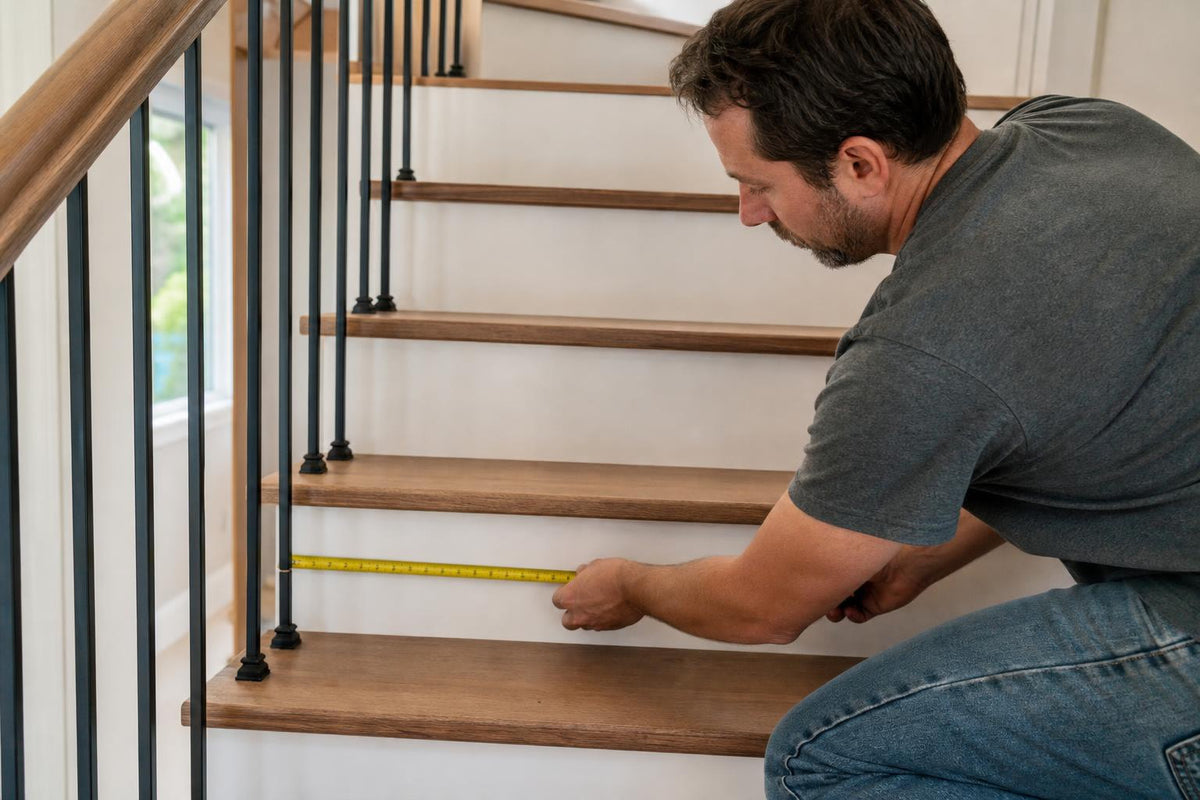
Step 1: Measure tread depth. Place your tape measure at the front nosing edge and extend it straight back to the riser face. This is your tread depth, the dimension you will match to nosing or cover product depth.
Step 2: Measure stair width. Measure across the full opening from wall to wall, or from stringer to stringer if the stairs are open on one or both sides.
Step 3: Check nosing overhang. Measure how far the existing nosing projects beyond the riser below. This affects how a new nosing cover will sit.
Step 4: Order slightly shorter than full width. Most installers order product 25 to 50 mm (1 to 2 inches) shorter than the stair width to clear walls, balusters, or other obstructions.
Step 5: Note your substrate. Concrete, metal, wood, tile, and grating each require different fastening methods. Concrete needs mechanical anchors or adhesive. Metal stairs may need saddle clamp assemblies for grated surfaces. Wood accepts screws directly.
For a more detailed walkthrough, read how to measure a stair for correct nosing size.
Selection Factors Beyond Size
Getting the right stair tread sizes is necessary but not sufficient. Consider these factors before ordering:
Indoor vs. outdoor: Outdoor stairs face rain, snow, ice, UV exposure, and temperature swings. FRP (fiberglass-reinforced polymer) and aluminum products handle these conditions better than adhesive tapes or rubber overlays. For a comparison of materials in harsh conditions, see FRP vs. aluminum stair nosing in coastal environments.
Wet vs. dry environments: Wet surfaces need aggressive grit textures. Smooth or lightly textured products that work fine indoors become inadequate when water, oil, or ice are present.
Foot traffic volume: High-traffic commercial and institutional stairs wear down faster. Pultruded FRP nosings resist this better than surface-applied coatings, which degrade under repeated foot traffic.
Visibility: High-contrast nosings (yellow, hazard stripe, or glow-in-the-dark options) help people see the step edge, especially in low-light stairwells. Falls on stairs account for 13 percent of hospital visits among Canadian seniors, and poor step-edge visibility is a contributing factor.
Maintenance: Anti-slip products reduce slip risk but do not eliminate it. Surfaces still need regular cleaning. Ice, oil, and debris must be managed. No product substitutes for ongoing maintenance.
Limits of Anti-Slip Products
Anti-slip stair covers and nosings significantly reduce slip risk, but they are not a complete solution on their own. A few realities to keep in mind:
- Surfaces still require cleaning and upkeep even after installation
- Ice, snow, oil, and debris accumulation must be addressed separately
- Code compliance depends on your specific project location; provincial and municipal requirements vary
- Anti-slip products work best as part of a broader slip-prevention approach that includes lighting, handrails, drainage, and housekeeping
Frequently Asked Questions
What is the standard stair tread size for residential stairs?
The most common residential stair tread size is 11-1/2 inches deep, 36 inches wide, and 1 inch thick. This exceeds the 10-inch minimum tread depth required by both the Canadian NBC and the US IRC, with the extra width accommodating the nosing overhang.
What is the difference between tread depth and run?
Tread depth is measured from the front nosing edge to the riser face. Run is measured horizontally from the nosing of one step to the nosing of the next step. Building codes regulate run, but the terms are often used interchangeably, which causes confusion even among professionals.
What stair tread sizes does Canada’s National Building Code require?
The NBC requires a minimum tread run of 255 mm (about 10 inches), a maximum riser height of 200 mm (7-7/8 inches), and a minimum stair width of 860 mm (34 inches) for residential stairs. Public stairs require a minimum 900 mm width. Provincial codes may modify these values.
How do I know whether I need a nosing or a full tread cover?
If only the front edge of your stair is worn or slippery, a nosing (typically 70 mm to 150 mm deep) covers the critical zone. If the entire tread surface is deteriorated or slick, a full tread cover (6 to 10 inches deep) is the better choice. Measure your tread depth first, then match it to the product.
Can I cut anti-slip nosings to fit non-standard stair tread sizes?
Yes. FRP nosings can be cut on site with standard tools to fit non-standard widths. Aluminum products can similarly be trimmed. Order the next size up from your stair width and cut down as needed, leaving 25 to 50 mm clearance on each side.
What is the maximum allowed variation between stair treads?
Across all major codes (NBC, IRC, IBC, OSHA), the maximum permitted variation in tread depth or riser height between steps in a single flight is approximately 3/8 inch (about 10 mm). Exceeding this creates a tripping hazard.
Need help matching your stair tread sizes to the right anti-slip product? Contact Safety Step Canada for sizing guidance, or browse the full catalog of FRP stair tread nosings and aluminum stair nosings.