
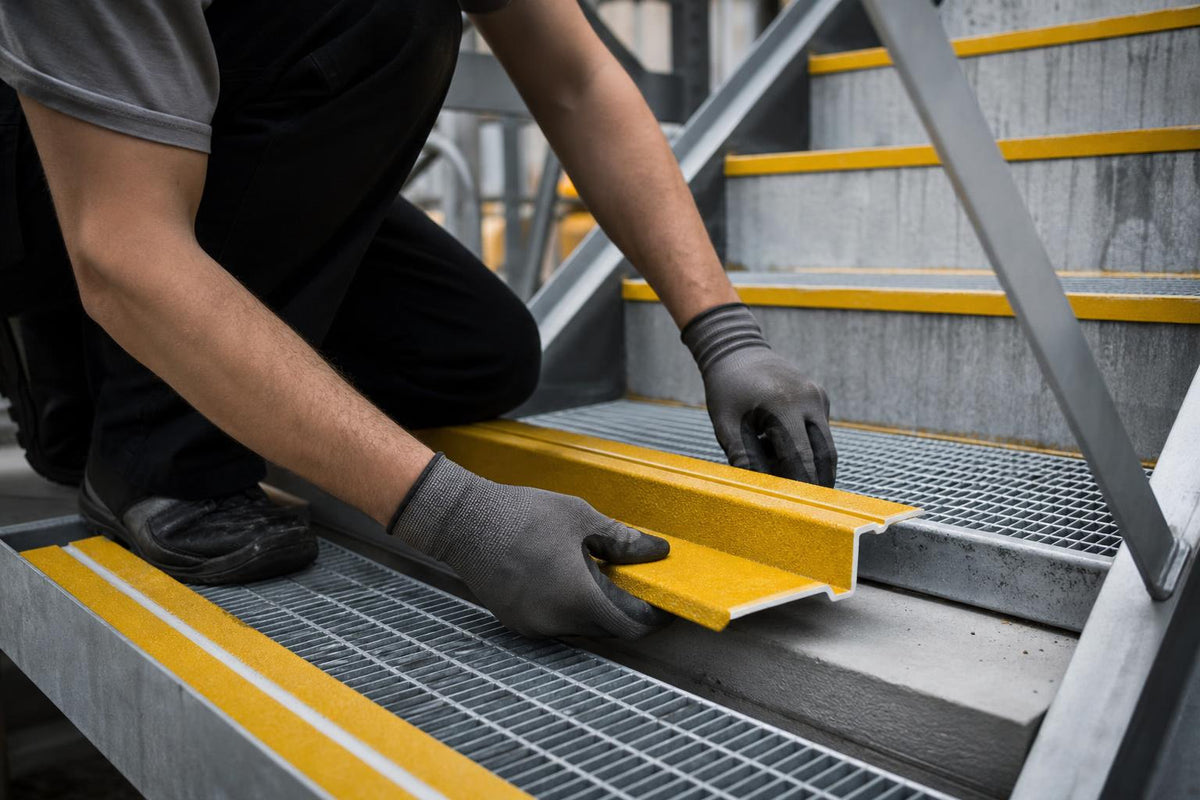
TL;DR: Pultruded FRP (Fiber Reinforced Polymer) is a composite material made by pulling continuous glass fibers through resin and a heated die, producing stair nosings that are roughly 75% lighter than steel, resistant to corrosion, and built to last 20 to 30 years outdoors. The pultrusion process creates nosings with 65% glass fiber content (nearly double that of molded FRP), which means higher strength, better delamination resistance, and a consistent cross-section that cuts cleanly on site.
This article is for facility managers, contractors, specifiers, and procurement buyers who have seen “pultruded FRP” on a product spec sheet and want to understand what it actually means before choosing a stair nosing. By the end, you’ll know how the manufacturing method directly affects nosing performance, durability, and total cost of ownership.
Browse FRP stair tread nosings to see sizes, colors, and pricing.
Why Stair Nosing Material Matters More Than You Think
Stairs are one of the most dangerous features in any building. The National Safety Council reports over one million stair-related accidents every year in the United States alone. In Canada, the numbers are similarly alarming: more than 100,000 stair-related injuries annually, with Ontario accounting for over 50,000 emergency visits from stair falls in a single year. Falls from stairs and steps represented 16% of all falls from height in British Columbia workplaces between 2004 and 2013, according to WorkSafeBC data.
The leading edge of each step, the nosing, takes the most abuse. It’s where feet land, where grip matters most, and where failure happens first. A nosing that delaminates, corrodes, or wears smooth doesn’t just look bad. It becomes a hazard.
The material and manufacturing method behind that nosing determines whether it holds up for two years or two decades. That’s where understanding pultruded FRP becomes a practical purchasing decision, not just a technical curiosity.
What Does “FRP” Mean?
FRP stands for Fiber Reinforced Polymer (sometimes called Fiber Reinforced Plastic). It’s a composite material made from two main components: reinforcing fibers (typically glass) that carry structural loads, and a polymer resin matrix that binds those fibers together and protects them from moisture, chemicals, and UV light.
You may also see the term GRP (Glass Reinforced Polymer or Glass Reinforced Plastic). GRP and FRP refer to the same material category. GRP is the more common term in the UK and Australia, while FRP is standard in North America.
The core properties that make FRP attractive for safety products are straightforward:
- Corrosion proof. Glass fibers carry the load; the resin matrix shields them from moisture, salt, and chemicals. In environments where steel corrodes within years, FRP maintains structural and safety performance for decades with essentially no maintenance.
- Lightweight. Up to 75% lighter than steel, roughly one-third the weight. This matters for handling, shipping, and installation.
- Non-conductive. FRP doesn’t conduct electricity, making it suitable for electrical and industrial environments.
- UV-resistant. With proper stabilization, FRP withstands prolonged outdoor exposure without degrading.
FRP is used across a wide range of safety applications, from anti-slip grating and platforms to stair nosings and ladder rung covers. But not all FRP is made the same way, and the manufacturing process changes the performance characteristics significantly.
What Is Pultrusion?
Pultrusion is a manufacturing process for creating continuous lengths of FRP composite with a constant cross-section. The word itself combines “pull” and “extrusion,” which describes exactly what happens: continuous glass fiber rovings are pulled (not pushed, as in traditional extrusion) through a resin bath and then through a heated steel die where the composite is shaped and the resin is cured.
The process has been in commercial use since 1951, making it one of the oldest composite manufacturing methods. Despite its age, it remains one of the most effective ways to produce high-strength linear profiles.
Here’s what happens step by step:
- Fiber feeding. Continuous glass fiber rovings are pulled from creels (large spools).
- Resin impregnation. The fibers pass through a resin bath where they are fully saturated with thermoset resin.
- Die forming. The wet fibers enter a heated steel die that shapes them into the desired cross-section (in this case, a stair nosing profile).
- Curing. Heat in the die hardens the resin, locking the fibers in their aligned orientation.
- Pulling and cutting. The continuous profile exits the die and is cut to length.
The critical outcome: fiber orientation is precisely controlled. Every glass fiber runs in the same direction along the length of the profile. This is what distinguishes pultruded FRP from other manufacturing methods and directly affects how the finished nosing performs under foot traffic.
Pultruded vs. Molded FRP: What’s the Difference?
This is the most commercially relevant distinction for anyone buying stair nosings. Understanding what is pultruded FRP and why it matters for stair nosings starts with comparing it to the alternative: molded FRP.
In molded FRP, chopped fibers are mixed into resin and pressed into a mold. The fibers end up randomly distributed throughout the material. In pultruded FRP, continuous fibers are aligned along the load axis and pulled through the die under tension, creating a material with fundamentally different mechanical properties.
The numbers tell the story:
| Property | Pultruded FRP | Molded FRP |
|---|---|---|
| Glass fiber content | ~65% | ~35% |
| Resin content | ~35% | ~65% |
| Fiber orientation | Aligned, controlled | Random |
| Unidirectional strength | ~60% higher | Baseline |
| Tensile strength (load axis) | Exceeds 300 MPa | Lower |
| Stiffness | Higher | Lower |
| Best application | Linear profiles, nosings, structural spans | Complex 3D shapes, gratings |
Pultruded fiberglass contains approximately 65% glass and 35% resin, which makes it much stiffer than molded fiberglass at roughly 35% glass and 65% resin. That near-doubling of glass fiber content, combined with controlled alignment, is why pultruded FRP stair nosings are stronger and more flex-resistant.
Molded FRP has its place. It’s better for producing complex three-dimensional shapes like certain grating patterns. But for a stair nosing, which is fundamentally a linear profile that needs to resist downward force along its length, pultrusion is the superior process.
Why Pultrusion Matters for Stair Nosings
Now for the practical question: what does all of this engineering actually mean when someone steps on your stairs ten thousand times a day? Here’s how pultruded FRP directly translates into nosing performance.
Delamination Resistance
This is the single biggest advantage, and it’s the one most competing pages fail to explain clearly.
Delamination is the primary failure mode for stair nosings in the field. In high-traffic environments, stair edges are a common source of slips, trips, and falls. Metal-backed nosings with surface-applied grit coatings are particularly vulnerable. The grit layer can separate from the metal substrate over time, creating a smooth, hazardous surface that looks intact from a distance but provides zero traction underfoot.
Multiple industry sources across Australia, the UK, and North America confirm this pattern. Practitioners on industry forums report finding delaminated nosings during routine inspections, sometimes with the grit layer peeling off in sheets.
With pultruded FRP stair nosings, the anti-slip grit surfaces are permeated into the substrate itself. The grit isn’t sitting on top of a separate material; it’s integrated into the resin matrix during manufacturing. This eliminates the bond line where delamination typically starts.
For a deeper look at long-term performance data, see our article on durability data for pultruded nosings.
Structural Consistency
Because pultrusion produces a continuous, constant cross-section, every inch of a pultruded nosing has identical mechanical properties. There are no weak spots, no resin-rich areas, no fiber-starved zones.
This consistency has a practical benefit that contractors appreciate: predictable on-site cutting. When you cut a pultruded nosing to length, you know exactly what you’re getting at the cut line. The material behaves the same at every point. With molded FRP, randomly distributed fibers mean the material can behave differently depending on where you cut.
If you need guidance on cutting techniques, our guide on how to cut pultruded FRP nosing on site safely covers tools, methods, and PPE requirements.
Weight Advantage
At roughly one-third the weight of steel, pultruded FRP nosings install with hand tools. No crane, no welding, no hot-work permit. For retrofit projects on existing stairs, this weight advantage reduces labor hours and simplifies logistics. A single worker can carry and position FRP nosings that would require two people (or equipment) in steel.
This matters especially for multi-story stairwell retrofits or remote site installations where heavy equipment isn’t practical.
Corrosion Immunity
FRP does not rust. Period. The glass fibers carry the load, and the resin matrix seals them from the environment. In coastal facilities with salt spray, chemical plants with acid splash, food processing areas with washdown cycles, or outdoor stairs exposed to Canadian freeze-thaw conditions, pultruded FRP maintains its structural integrity and anti-slip performance without repainting, galvanizing, or any other protective treatment.
For a direct comparison with aluminum in harsh conditions, see FRP vs. aluminum stair nosing in coastal environments.
Longevity
How long do pultruded FRP stair nosings actually last? The data is consistent across multiple industry sources:
| Material | Typical Outdoor Lifespan | Notes |
|---|---|---|
| Pultruded FRP | 20–30+ years | UV-stabilized, with proper installation |
| Aluminum | 15–25 years | Weather-resistant but can corrode in salt environments |
| Rubber | 5–10 years | UV degrades quickly outdoors |
| PVC/Vinyl | 2–3 years | Short-lived, especially outdoors |
A UV-stabilized FRP stair nosing installed correctly with structural epoxy and stainless fixings will typically last 20 to 30 years in outdoor conditions. The service life of FRP platforms and stairs typically exceeds 20 years when properly installed and maintained.
The total cost of ownership math is straightforward. A PVC nosing replaced every 2 to 3 years costs more over a decade than a single FRP nosing installed once. When you factor in the labor cost of each replacement (shutting down a stairwell, removing the old nosing, prepping the surface, installing the new one), the gap widens further.
View FRP stair tread nosings with pricing to compare costs by size and configuration.
Where Pultruded FRP Nosings Perform Best
Understanding what is pultruded FRP and why it matters for stair nosings becomes most obvious in environments where lesser materials fail quickly. These are the applications where the pultruded advantage is most meaningful:
Industrial plants and chemical facilities. Exposure to acids, alkalis, solvents, and washdown chemicals destroys steel and degrades rubber. FRP’s chemical resistance keeps nosings functional for years without maintenance. See industrial and commercial applications for more on this use case.
Outdoor stairs in Canadian winters. Freeze-thaw cycles, road salt, and standing water are the enemies of metal nosings. FRP won’t rust, and its embedded grit surface maintains traction through ice and snow. For detailed comparisons in winter conditions, read which stair nosing is best for salt and snow exposure.
Marine and coastal environments. Salt spray corrodes steel and aluminum at accelerated rates. FRP is immune to salt-induced corrosion.
Food processing and wastewater. Frequent washdowns with hot water and cleaning chemicals create hostile conditions. FRP handles them without degradation.
Fire escapes and egress stairs. These stairs must remain safe for decades with minimal inspection. The long service life and high-contrast visibility options (yellow nose, glow strips) make pultruded FRP a strong fit. For visibility requirements, see color contrast requirements for egress stairs.
Mining and heavy industrial. Abrasive foot traffic from work boots, combined with dust and moisture, wears through surface-applied coatings quickly. Embedded grit in pultruded FRP withstands this abuse.
FRP stair nosings are also used alongside related products like ladder rung covers and anti-slip sheets in facilities that need a comprehensive anti-slip strategy across stairs, platforms, and vertical access points.
Practical Installation Notes
Pultruded FRP nosings are lightweight enough to cut on site with basic power tools (a circular saw with a diamond or abrasive blade works well), which eliminates custom-fabrication lead times. The consistent cross-section means straight cuts are predictable and reliable.
PPE warning that many product pages skip: Cutting FRP produces fine glass fiber dust, which is a serious respiratory hazard. An N95 or P100 respirator is required, along with safety glasses and gloves. This isn’t optional. Work outdoors or in a well-ventilated area, and cut downwind when possible.
Nosings can be attached with structural adhesive, mechanical fasteners (screws into the substrate), or both. The right method depends on the substrate material and whether the installation is permanent or may need future removal. Stainless steel saddle clamp assemblies are available for installations requiring mechanical fixation.
The edge sealing question. Whether cut FRP edges need to be sealed against moisture intrusion is a topic where manufacturers disagree. Some state that no edge sealing is required for their products. Others recommend sealing cut edges to prevent moisture intrusion, enhance chemical resistance, and create a smoother finished appearance. Check the manufacturer’s guidance for the specific product you’re installing. When in doubt, sealing is a low-cost precaution.
What Pultruded FRP Nosings Won’t Do
Anti-slip nosings reduce slip risk significantly, but they don’t eliminate it entirely. A few honest limitations:
- Surfaces still need cleaning. Oil, grease, ice, and debris can reduce traction on any surface, including FRP grit. Regular cleaning and maintenance remain necessary.
- Ice and snow still need management. FRP nosings maintain better grip than smooth surfaces in winter, but they’re not a substitute for snow removal and de-icing.
- Code compliance varies by jurisdiction. FRP nosings can support compliance with building codes and accessibility standards, but specific requirements differ across provinces and municipalities. Always verify against the codes governing your project location.
- Not every stair needs FRP. For a low-traffic interior residential staircase with no moisture exposure, a simpler product like anti-slip tape may be sufficient. FRP’s strengths are most valuable in demanding environments.
Frequently Asked Questions
Is GRP the same as FRP?
Yes. GRP (Glass Reinforced Polymer) and FRP (Fiber Reinforced Polymer) refer to the same material category. GRP is the standard term in the UK and Australia; FRP is the North American convention.
How long do pultruded FRP stair nosings last?
With proper installation and UV stabilization, 20 to 30 years in outdoor conditions. This far exceeds rubber (5 to 10 years) and PVC (2 to 3 years). Multiple industry sources converge on this range.
Can FRP nosings be cut on site?
Yes, with a circular saw fitted with a diamond or abrasive blade. The consistent cross-section of pultruded profiles makes straight cuts clean and predictable. Respiratory protection (N95/P100) is essential due to glass fiber dust.
Do cut edges need sealing?
It depends on the manufacturer and the environment. Some products are designed to perform without edge sealing. Others benefit from a sealant to block moisture, especially in chemically aggressive or submerged applications. Check the product data sheet.
How much lighter is FRP than steel?
Approximately 75% lighter. A pultruded FRP nosing weighs roughly one-third what an equivalent steel nosing would weigh, making it significantly easier to handle, transport, and install.
Why does the glass-to-resin ratio matter?
Higher glass fiber content means higher strength and stiffness. Pultruded FRP at 65% glass is substantially stronger along its length than molded FRP at 35% glass. For a stair nosing resisting foot traffic and impact loads, that difference is significant.
What makes pultruded FRP nosings resist delamination?
The anti-slip grit is embedded into the composite substrate during manufacturing, not applied as a separate surface layer. There’s no bond line between the grit and the base material, so there’s nothing to delaminate. This is the most common failure mode in metal-backed nosings, and pultruded FRP avoids it by design.
Where can I learn more about choosing the right nosing?
Our frequently asked questions page covers common product questions, and the stair nosing buyer’s guide walks through codes, costs, and selection criteria.
Choose the Right Nosing for Your Project
Now that you understand what pultruded FRP is and why it matters for stair nosings, the next step is matching the right product to your specific stairs, environment, and traffic conditions.
Shop FRP stair tread nosings to see available sizes, colors (including glow-strip options), and per-piece pricing.
Need help choosing between FRP and aluminum, or figuring out the right size for a retrofit? Contact Safety Step Canada and the team can help you select the right product for your application.