
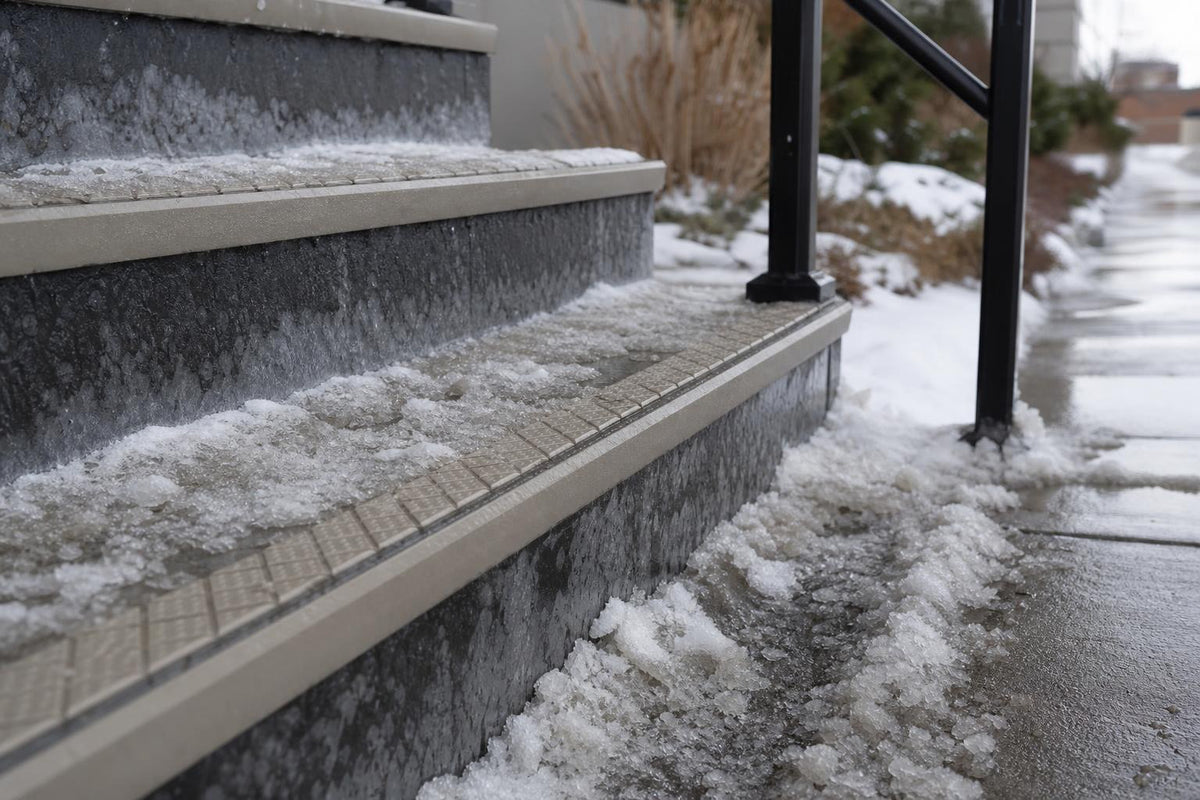
TL;DR: FRP (fiberglass reinforced polymer) stair nosing is the best choice for heavy salt and snow exposure. It resists chloride corrosion from all common de-icing salts, handles freeze-thaw cycling without degrading, and maintains traction in wet and icy conditions. Aluminum is a solid runner-up for moderate salt environments if you avoid rock salt. Rubber and vinyl nosings fail outdoors in winter.
This guide is for facility managers, contractors, property managers, and homeowners who need stair nosings that will survive Canadian winters (or any climate where de-icing salt and freeze-thaw cycling are facts of life). By the end, you’ll know exactly which material to choose, which de-icing salts to pair with it, and how to install it so it stays put.
Browse FRP stair tread nosings to see sizing, colors, and pricing.
Why Salt and Snow Destroy the Wrong Stair Nosing
Salt doesn’t just make stairs ugly. It actively destroys them through a combination of chemical attack and physical stress that most people underestimate.
The core problem is chloride ions. When de-icing salt dissolves in water (from melting snow, rain, or even humidity), it releases chloride ions that penetrate metal surfaces and trigger corrosion. Salt is also hygroscopic, meaning it pulls moisture from the air and keeps surfaces damp longer than rain alone would. A stair nosing coated in salt residue stays wet and reactive for days, even during dry weather.
Then there’s freeze-thaw cycling. Water seeps into joints, adhesive bonds, and micro-cracks. It freezes, expands, and cracks those gaps wider. The next thaw lets more water in, and the cycle repeats. Research published in the International Journal of Pavement Engineering found that concrete pavement damage from combined freeze-thaw and de-icing salt is roughly ten times worse than from freeze-thaw alone. That multiplier applies to the substrate your nosing sits on, too.
The combination is brutal. Salt accelerates corrosion while freeze-thaw cycling physically tears at adhesive bonds and rigid materials. A stair nosing that seems fine in October can be pitted, loose, or cracked by March.
This is why choosing the right material matters more than almost any other factor in winter stair safety. The wrong nosing doesn’t just wear out, it becomes the hazard it was supposed to prevent.
Material-by-Material Salt and Snow Performance
Not all stair nosing materials respond to salt the same way. Here’s how each one holds up, ranked from best to worst for salt and snow exposure.
FRP / GRP Stair Nosing: Best Overall for Salt Exposure
FRP stands for fiberglass reinforced polymer (sometimes called GRP, glass reinforced polymer). These nosings are manufactured through pultrusion, a process that pulls continuous fiberglass strands through resin to create a dense, uniform profile that resists delamination.
FRP is the clear winner for salt and snow environments, and the reasons are straightforward. It contains no metal, so chloride ions have nothing to corrode. Quality structural FRP has been tested under ASTM B117 salt spray conditions for 1,000 hours with no significant degradation in structural properties, only minor cosmetic changes. UV resistance testing under ASTM G154 protocols shows no significant loss of strength or color after 5,000 hours.
FRP also resists acids, bases, and petrochemical spillage, making it suitable for industrial stairs near loading docks and chemical storage areas.
There’s a lesser-known advantage that matters in winter: FRP has low thermal conductivity. Unlike metal nosings, FRP doesn’t become painfully cold to the touch in freezing weather, and it doesn’t promote ice adhesion as aggressively as aluminum or steel. Snow and ice are easier to clear, and the surface stays grippier during transitions between freezing and thawing.
FRP stair nosings achieve high slip-resistance classifications even when wet, thanks to embedded grit surfaces. Some manufacturers report P5 wet pendulum ratings, the highest available classification.
Best for: Industrial sites, marine environments, coastal properties, parking garages, loading docks, and any stairway where heavy salting is routine.
For a deeper look at how FRP compares to other materials across different conditions, see our guide on anti-slip stair treads by surface and weather.
Aluminum Stair Nosing: Strong Runner-Up With Caveats
Aluminum stair nosings are typically extruded from 6063 T5 alloy, which offers good corrosion resistance and holds up in harsh weather without rusting. Compared to rubber or vinyl, aluminum is significantly harder, longer-lasting, and better suited to outdoor environments.
But salt is aluminum’s weak point. When chloride ions attack aluminum, the result is pitting corrosion, localized holes that produce a white to grayish-white powder on the surface. Anodizing improves resistance, but it does not provide adequate long-term protection in environments where salt exposure is heavy and persistent.
The critical detail that most guides miss: the type of de-icing salt matters enormously. Common rock salt (sodium chloride) is not suitable for use on aluminum stairs, as it reacts with the metal and causes damage over time. Magnesium chloride ice melt is a far better choice for aluminum installations.
In coastal comparison studies, aluminum nosings show 15 to 25 year service life at medium cost, which is respectable but well short of the 30 to 40 years that stainless steel or FRP can deliver.
Aluminum nosings paired with carborundum (grit) inserts provide excellent traction in snow and ice. They can be cleared with a standard snow shovel (without a steel edge) without fear of damage.
Best for: Commercial outdoor stairs, public building entrances, and residential applications where salt use is moderate and the property manager can control which de-icing product is used.
Shop aluminum stair nosings for outdoor-ready options.
Stainless Steel Stair Nosing: Premium Salt Resistance, Premium Price
Stainless steel, particularly 316 grade, offers excellent corrosion resistance in salt environments. It was originally developed for marine applications, and it can withstand large amounts of salt water without adverse reaction. The 316 alloy contains molybdenum, which gives it superior resistance to chloride-induced pitting compared to the more common 304 grade.
Service life in coastal and heavy-salt environments reaches 30 to 40 years. The tradeoff is cost. Stainless steel nosings carry the highest price point of any common nosing material, and they’re heavier to work with during installation.
Like all metals, stainless steel has high thermal conductivity. It gets very cold in winter, promotes ice adhesion more than FRP, and can feel slippery when covered with a thin film of moisture unless it includes a grit or abrasive insert.
Best for: Marine stations, chemical processing facilities, high-budget commercial projects, and anywhere the upfront investment is justified by a 30+ year service life.
Rubber Stair Nosing: Indoor Only
Rubber nosings offer good barefoot grip and a softer landing if someone stumbles. But they are not well suited to outdoor salt and snow environments. Rubber can curl over time, trapping moisture underneath the nosing. That trapped moisture accelerates deterioration of both the rubber and the stair substrate.
In freeze-thaw conditions, rubber hardens and loses flexibility, reducing its grip. Standard rubber nosings exposed to persistent salt will degrade faster than composite or metal alternatives. Multiple practitioners and manufacturers recommend against rubber for outdoor use, suggesting instead an extruded aluminum profile paired with a grit insert.
For a detailed comparison between FRP and rubber in different environments, read our post on FRP vs. rubber stair treads.
Best for: Indoor stairs in healthcare, education, and residential settings where salt and snow are not factors.
Vinyl / PVC Stair Nosing: Not Suitable
Vinyl and PVC nosings are lightweight and inexpensive, but they are not engineered for persistent salt exposure or freeze-thaw cycling. They crack in cold temperatures, loosen as adhesives fail, and offer no meaningful salt resistance. They belong indoors in light residential settings only.
Quick Comparison: Stair Nosing Materials for Salt and Snow
| Material | Salt Resistance | Freeze-Thaw Performance | Typical Service Life (Salt Env.) | Cost Level | Best Use Case |
|---|---|---|---|---|---|
| FRP / GRP | Excellent | Excellent | 25–40+ years | Medium | Industrial, marine, heavy-salt outdoor |
| Aluminum (6063 T5) | Good (avoid rock salt) | Very good | 15–25 years | Medium | Commercial outdoor, public stairs |
| Stainless Steel (316) | Excellent | Excellent | 30–40 years | High | Marine, chemical, high-budget |
| Rubber | Fair | Poor to fair | 3–8 years outdoors | Low | Indoor only |
| Vinyl / PVC | Poor | Poor | Not recommended outdoors | Low | Light indoor residential |
Which De-Icing Salt Is Safest for Your Stair Nosing?
This is a gap in most buying guides. Not all de-icing salts are created equal, and the one your maintenance team spreads on the stairs directly affects how long your nosings last.
Rock Salt (Sodium Chloride, NaCl)
The cheapest and most common option. Effective down to about 15°F (minus 9°C). Also the most corrosive to metals, concrete, and stone. The United States alone applies roughly 20 million tons of road salt annually, and much of that ends up on stairs, walkways, and entrance areas near treated roads and parking lots. Rock salt will pit aluminum, damage concrete substrates, and harm landscaping.
Calcium Chloride (CaCl₂)
Melts ice faster and works at much lower temperatures (down to minus 25°F / minus 32°C). Generally considered safer for concrete than rock salt, but still corrosive to some metals. More expensive per pound. A better choice for aluminum stairs than rock salt, but not as gentle as magnesium chloride.
Magnesium Chloride (MgCl₂)
Effective down to about minus 13°F (minus 25°C). The least corrosive common de-icer for metals, and specifically recommended by aluminum stair manufacturers. More expensive than rock salt, but the reduced corrosion damage pays for itself over the nosing’s lifespan.
The FRP Advantage
FRP stair nosings are unaffected by all three common de-icing salt types. This eliminates the need to coordinate between your maintenance crew’s salt choice and your nosing material. It’s one less thing to go wrong.
| De-Icing Salt | Effective Temp | FRP Impact | Aluminum Impact | Steel (316) Impact |
|---|---|---|---|---|
| Rock salt (NaCl) | 15°F / −9°C | None | Pitting corrosion | Minimal |
| Calcium chloride | −25°F / −32°C | None | Moderate corrosion | Minimal |
| Magnesium chloride | −13°F / −25°C | None | Low corrosion | None |
Key Terms Buyers Should Know
Understanding a few technical concepts will help you evaluate products and ask better questions when specifying nosings for salt and snow environments.
Corrosion resistance is the ability of a material to resist chemical degradation from salt, moisture, and de-icing agents. FRP and 316 stainless steel have the highest corrosion resistance among common nosing materials.
Pitting corrosion is a localized form of attack where chloride ions eat small holes into metal surfaces. It’s the primary failure mode for aluminum in salty conditions, and it weakens the nosing without being immediately obvious.
Freeze-thaw cycling refers to the repeated freezing and thawing of water that has penetrated joints, adhesive bonds, or material surfaces. Each cycle widens cracks and loosens fasteners. It is the main physical stress that destroys outdoor stair nosings in winter.
Coefficient of friction (CoF) measures how much traction a surface provides. A higher CoF means better grip. This number must remain high when the nosing is wet, icy, or covered in salt residue, not just when it’s dry.
Mechanical fastening means securing nosings with screws or bolts rather than adhesive alone. It is essential for outdoor installations where adhesive bonds fail under freeze-thaw cycling.
Carborundum / grit insert is an abrasive material embedded in the nosing surface to provide high traction. It’s the textured strip you feel underfoot on quality stair nosings. Critical for maintaining grip on wet, icy, or salt-covered steps.
Salt spray test (ASTM B117) is a standardized corrosion test that exposes materials to continuous salt fog. It accelerates years of real-world salt exposure into measurable lab hours. Quality FRP nosings pass 1,000+ hours without significant degradation.
Pultrusion is the manufacturing process used to create FRP profiles. Continuous fiberglass strands are pulled through heated resin dies, producing a dense, uniform product that resists delamination. This matters because delamination is how cheaper composites fail in harsh conditions. For tips on working with pultruded products on the job site, see our guide on how to cut pultruded FRP nosing safely.
Installation Rules for Salt and Snow Environments
Choosing the right material is only half the job. How you install the nosing determines whether it stays put through winter.
Always Use Mechanical Fasteners Outdoors
This is the single most important installation rule for salt and snow environments. Adhesive alone fails under freeze-thaw cycling. Water infiltrates the bond line, freezes, expands, and peels the nosing away from the substrate. By the second or third winter, an adhesive-only installation is likely loose or completely detached.
Mechanical fastening (screws or bolts into the substrate) provides a physical anchor that freeze-thaw cannot defeat. If adhesive is part of your system, treat it as a supplement to mechanical fasteners, not a replacement.
For installations during cold months, use a cold-weather-rated adhesive when temperatures drop below 5°C. Standard construction adhesives lose bonding strength in the cold and may not cure properly.
Our detailed guide on installing aluminum stair nosing covers fastener selection and spacing for outdoor applications.
Ensure Proper Drainage
Nosings should not trap water against the stair edge. Standing water in winter means standing ice, which undermines the nosing’s anti-slip function and accelerates corrosion or adhesive failure. Confirm that the nosing profile allows water to drain away from the stair edge, not pool behind or underneath it.
Some FRP stair tread covers use a grated design that lets water, ice, and snow fall through, eliminating buildup entirely. This is particularly useful for industrial platforms and fire escapes.
Check the Substrate First
Salt damage to concrete is common in winter environments. Before installing any nosing, inspect the stair edge for spalling, crumbling, or cracking. If the concrete is deteriorating, your mechanical fasteners won’t hold. Repair the substrate first. Our article on making old concrete steps safer walks through assessment and preparation steps.
For corrosion-resistant fastening hardware, consider stainless steel saddle clamp assemblies that won’t degrade alongside the nosing.
Complement Nosings With Adjacent Surface Treatment
Stairs don’t exist in isolation. The landing, ramp, or walkway leading to and from the stairs faces the same salt and snow conditions. Anti-slip deck strips provide traction on flat areas near stairs, and heated anti-slip covers can address ice-prone hot spots where nosings alone are not sufficient.
What Anti-Slip Nosings Cannot Do
Anti-slip stair nosings reduce slip risk. They do not eliminate it. No nosing replaces winter maintenance.
Snow and ice on exterior stairs must still be managed through regular clearing, controlled de-icing, and inspection. Even the best FRP nosing cannot prevent a fall if it’s buried under three inches of packed ice.
Surfaces still need cleaning. Salt residue builds up over time and can create a slippery film even on grit surfaces. Periodic washing (especially in spring after salt season ends) extends the life and performance of any nosing material.
Code and accessibility requirements vary by jurisdiction. Any claims about compliance should be checked against your local authority having jurisdiction and the applicable building code for your province or municipality.
Choose the Right Nosing for Your Salt and Snow Conditions
Here’s the decision simplified:
Choose FRP stair nosing if you deal with heavy salting, coastal salt spray, industrial chemical exposure, or you want the longest maintenance-free life in winter conditions. FRP handles every common de-icing salt without corrosion, maintains traction in wet and icy conditions, and won’t become dangerously cold underfoot.
Choose aluminum stair nosing if your salt exposure is moderate, you can control which de-icer is used (magnesium chloride is ideal), and you want a clean commercial appearance. Avoid rock salt on aluminum.
Choose 316 stainless steel nosing if budget allows and the application is marine, chemical, or institutional, where a 30 to 40 year service life justifies the upfront cost.
Avoid rubber and vinyl outdoors. Neither material handles salt and freeze-thaw cycling well enough to be worth the risk.
Browse FRP stair tread nosings or aluminum stair nosings to find the right size for your stairs.
Need help choosing? Contact Safety Step Canada for product recommendations based on your specific environment.
Frequently Asked Questions
Can I use rubber stair nosing outdoors in winter?
It’s not recommended. Rubber hardens in freezing temperatures, curls at the edges over time, and traps moisture underneath, which accelerates deterioration of both the nosing and the stair substrate. For outdoor winter stairs, FRP or aluminum with grit inserts are far more reliable.
Does anodizing make aluminum stair nosing salt-proof?
No. Anodizing improves corrosion resistance but does not provide adequate long-term protection against heavy or repeated salt exposure. If you use aluminum nosings in a salt environment, pair them with magnesium chloride de-icer rather than rock salt, and inspect annually for pitting.
How do I know if my existing nosings are failing from salt damage?
On aluminum, look for white or grayish-white powder on the surface, which indicates pitting corrosion. On rubber or vinyl, check for cracking, curling, or edges lifting away from the stair. On any material, test whether the nosing is loose by pressing on it. If it shifts or rocks, freeze-thaw has likely broken the adhesive bond.
Is FRP stair nosing slippery when wet or icy?
Quality FRP nosings with embedded grit surfaces maintain high slip resistance even when wet. Some achieve the highest available wet pendulum classifications. However, a thick layer of ice or packed snow will reduce traction on any surface, which is why regular winter clearing remains essential.
Can I install stair nosings in cold weather?
Yes, but use mechanical fasteners rather than relying on adhesive alone. If adhesive is part of your installation system, use a product rated for application below 5°C. Standard construction adhesives may not bond or cure properly in cold conditions.
Which de-icing salt should I use on stairs with aluminum nosings?
Magnesium chloride is the best choice. It’s effective down to about minus 13°F (minus 25°C) and is the least corrosive common de-icer for aluminum. Avoid rock salt (sodium chloride) on aluminum stairs entirely.
How often should I inspect outdoor stair nosings in salt environments?
At minimum, inspect twice per year: once in late fall before salt season begins and once in spring after the last application. Check for loose fasteners, pitting on metal surfaces, cracking or lifting, and salt residue buildup. Clean nosings thoroughly in spring to remove accumulated salt deposits.
Do heated stair covers eliminate the need for nosings?
No. Heated covers melt ice and snow, reducing accumulation. Stair nosings provide traction and edge visibility. They serve different purposes and work best together. In high-risk areas, combining heated covers with FRP nosings provides both ice prevention and slip resistance.