
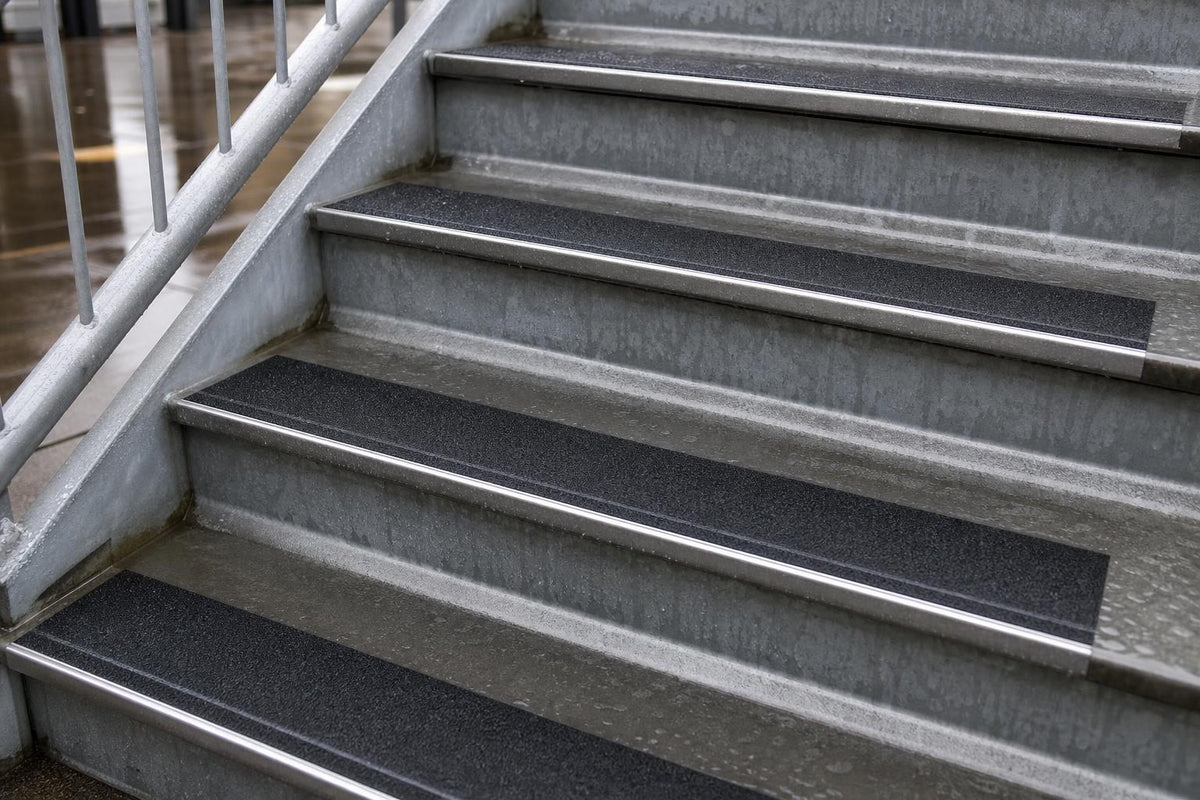
TL;DR
The best anti-slip stair treads depend on the stair surface, weather exposure, traffic level, and whether the fix needs to be permanent or temporary. For Canadian outdoor, commercial, and industrial stairs, mechanically fastened FRP or aluminum nosings are the strongest long-term choice. Adhesive tape, rubber mats, carpet treads, and coatings work in narrower situations but should be treated as surface-specific or temporary solutions, especially outdoors. This guide compares all nine major product types so you can match the right option to your stairs.
Who This Guide Is For
Slippery stairs are not one problem. A wet wooden deck stair, an icy concrete entrance, an oily industrial steel stair, and a polished indoor hardwood stair all need different anti-slip products. Choosing wrong means wasted money, repeated replacements, or worse, a product that becomes its own hazard.
This guide is for facility managers, contractors, property managers, plant managers, maintenance teams, and Canadian buyers choosing anti-slip stair products for existing stairs. It helps you decide whether to use FRP nosings, aluminum stair nosings, deck strips, full tread covers, grip tape, rubber treads, carpet treads, coatings, or heated mats.
The stakes are real. According to the Canadian Centre for Occupational Health and Safety (CCOHS), about 12% of accepted injury claims in Canada come from slips, trips, or falls, roughly 34,000 incidents annually. Stairs, entrances, and high-traffic areas are consistently flagged as high-risk zones.
Browse FRP stair tread nosings starting from $55 CAD.
At-a-Glance Comparison: Best Anti-Slip Stair Tread Options
| Rank | Option | Best for | Starting price | Winter/outdoor fit | Main tradeoff |
|---|---|---|---|---|---|
| 1 | FRP stair tread nosings | Commercial/industrial retrofits, wet or corrosive areas | From $55 CAD | Strong when mechanically fastened | Requires measuring and fastening |
| 2 | Aluminum stair nosings | Outdoor stairs needing durable, clean-looking edges | From $79 CAD | Strong for rain/snow with proper install | Higher upfront cost than tape |
| 3 | Full anti-slip tread covers | Worn, damaged, or high-traffic treads | Varies by size and material | Strong for industrial/severe wear | More coverage means more cost |
| 4 | Anti-slip deck strips | Wood decks, ramps, budget retrofits | $24.95 to $75 CAD | Good for localized traction | Less coverage than full tread/nosing |
| 5 | Abrasive grip tape | Short-term fixes, indoor stairs, low-budget projects | ~$24 USD for a 10-pack | Weak to moderate outdoors | Edges curl and peel, needs replacement |
| 6 | Rubber stair mats | Temporary residential comfort, pets | Under $4 USD per tread in bulk | Mixed outdoors; can shift or freeze | Can become a hazard if loose |
| 7 | Carpet stair treads | Indoor finished wood, noise control | Wide range | Poor outdoor/wet fit | Moisture, finish damage, fire concerns |
| 8 | Anti-slip coatings | Large prepared concrete or wood areas | Low material cost, high labor variability | Moderate; wears and needs recoating | Surface prep, cure time, grit wear |
| 9 | Heated stair mats | Ice-prone entrances with power access | ~$100 USD to $146 CAD per mat | Strong for snow/ice hot spots | Power, GFCI, operating cost, cords |
Why Stairs Get Slippery: Defining the Problem
Before comparing products, identify what is actually causing the slip risk. Different causes demand different solutions.
Water and ice are the most common outdoor culprits. Rain, snowmelt, and freeze-thaw cycles create surfaces that shift between wet, icy, and dry multiple times per day. WorkSafeBC reports that slips, trips, and falls are B.C.'s costliest workplace incidents, averaging 440,000 lost workdays and more than $148 million in claim costs annually.
Oil and grease turn industrial stairs into serious hazards. Smooth metal stairs in manufacturing plants, loading docks, and maintenance areas need aggressive grit surfaces that can cut through contamination.
Worn stair edges create invisible trip-and-slip zones. When the front edge of a step is rounded, chipped, or smooth, foot placement becomes unpredictable. This is especially dangerous when descending.
Smooth surfaces (polished concrete, painted metal, glazed tile, sealed hardwood) offer almost no natural traction when wet. Even dry, they can be risky in socks or smooth-soled footwear.
Poor visibility compounds every other problem. If a person cannot clearly see where one step ends and the next begins, grip alone will not keep them safe. CSA/ASC B651:23 includes guidance on stair nosing colour contrast for exactly this reason, recommending a 50 ± 10 mm deep contrasting strip across the full tread width.
High foot traffic accelerates wear on any anti-slip surface. Products that work fine under light residential use can fail within months in a commercial or institutional setting.
Identify the Surface First
The stair surface determines which anti-slip products will actually hold up. Here is a practical breakdown:
Concrete stairs accept most product types, but check for cracks, spalling, and freeze-thaw damage before installing anything. Coatings need sound substrate. Nosings and tread covers can bridge minor surface defects. For concrete-specific guidance, see this guide to making old concrete steps safer.
Metal stairs (steel, aluminum, grating) require products that account for oil, rust, paint condition, and grating flex. FRP and aluminum covers are the standard industrial solutions here.
Wood stairs move with seasons. Moisture, rot, and fastener holding strength all matter. Screw-down nosings handle wood movement better than adhesive-only products.
Composite/Trex stairs present a specific challenge. They can be surprisingly slick when wet, and standing water is common on flat composite treads. Adhesive products may discolor the boards. Practitioners on Reddit report that composite stair owners often cycle through tape and rubber mats before landing on screw-down options.
Indoor hardwood stairs are a different problem entirely. The buyer typically values removability and finish protection more than industrial durability. Carpet treads and runners are the usual answer here.
Grated stairs and platforms need products designed for flexing surfaces and mechanical attachment. Standard adhesive products will not stay put on open grating.
Anti-Slip Stair Treads vs. Stair Nosings vs. Strips: Know the Difference
Many buyers use “treads,” “nosings,” and “strips” interchangeably. They are not the same thing, and picking the wrong type wastes money.
A stair tread is the horizontal walking surface of the step. An anti-slip tread cover is a product that covers most or all of that surface.
A stair nosing is a product fitted to the front edge of the step, the part where your foot lands when descending and where most slips begin.
An anti-slip strip or deck strip is a narrower band added to part of the tread or ramp surface for localized traction.
Grip tape or cleats are adhesive-backed abrasive strips. They can serve as either edge strips or partial tread coverage.
Coatings and additives are grit or aggregate mixed into paint or sealer, applied as a surface layer.
For a deeper look at how stair parts relate to product selection, this article explains what a stair tread is and where each product type fits.
The key point: a nosing improves the front edge. A tread cover improves more of the walking surface. A strip adds localized traction. Each has a role. The best anti-slip stair treads for your situation depend on where on the step the hazard actually is.
The 9 Best Anti-Slip Stair Tread Options
1. FRP Stair Tread Nosings

Best for: Commercial, industrial, and institutional stair retrofits in wet, corrosive, or high-traffic environments.
FRP (fiberglass reinforced polymer) stair tread nosings are the strongest general recommendation for Canadian workplaces, outdoor stairs, and existing stair retrofits where the buyer wants more than a seasonal fix.
They solve two problems at once: traction at the leading edge (where most foot slips begin) and visibility of the stair edge through high-contrast colours.
Key features:
- Pultruded FRP construction, rust and corrosion resistant
- Lightweight and cuttable on site
- Retrofits existing steps without rebuilding
- Multiple sizes: 70 mm × 900 mm up to 150 mm × 1800 mm and larger
- Colour options: yellow, black, black with yellow nose, and glow-strip variants
- Pricing from $55 CAD per piece for entry-size nosings
Tradeoffs:
- Not the cheapest option upfront
- Requires measuring and mechanical fastening
- Best as a planned retrofit, not a quick temporary fix
- Product selection should consider stair width, tread depth, substrate, and any applicable project requirements
What practitioners say: In a Reddit carpentry thread about slippery wet outdoor steps, one user said they tried grip tape first but it “came off pretty quick” and did not help with ice, while a screw-down tread product held up despite not being the prettiest option. This pattern, adhesive failing outdoors and mechanical fastening proving more reliable, comes up repeatedly in community discussions.
For buyers comparing FRP against aluminum in coastal or harsh environments, this FRP vs. aluminum comparison covers the key differences.
2. Aluminum Stair Nosings and Treads

Best for: Outdoor commercial stairs, building entrances, and property-managed stairs where a clean, permanent look matters.
Aluminum stair nosings are the “commercial-looking permanent retrofit” choice. They are stronger than tape for exterior use, cleaner-looking than many industrial covers, and weather-resistant enough for year-round Canadian conditions.
Key features:
- Durable outdoor-ready finishes including matte black
- Mechanically fastened (no reliance on adhesive alone)
- Weather and corrosion resistant
- Clean appearance for commercial and institutional settings
- Pricing from $79 CAD
Tradeoffs:
- Higher upfront cost than tape or deck strips
- Fastener selection matters for each substrate
- On some stairs, full tread coverage may be better than nosing-only
- Aluminum products still need snow/ice management; no tread eliminates winter maintenance
What practitioners say: In a Reddit thread about Trex/composite stairs, one commenter advised skipping loose mats and using products that become part of the tread, like aluminum stair nosing with an anti-slip insert, because loose products shift underfoot when wet. Another user warned that glued rubber nosing warped and lifted, contributing to a fall.
Browse aluminum stair nosings from $79 CAD.
3. Full Anti-Slip Stair Tread Covers

Best for: Worn, damaged, or high-risk treads where the hazard covers the whole walking surface, not just the edge.
When the entire tread face is slick, chipped, or worn smooth, a nosing alone will not solve the problem. Full tread covers protect and add traction across the step.
Key features:
- More surface coverage than nosings or strips
- Protects deteriorated tread surfaces while adding grip
- Available in aluminum and specialty options (such as Hi-Traction step covers)
- Appropriate for industrial stairs, maintenance areas, loading zones, and high-traffic entries
Tradeoffs:
- Usually more material and cost than a narrow nosing
- Requires accurate measurement to avoid creating raised trip edges
- Installation detail matters; a poorly fitted cover can introduce a new hazard
- Check that the finished step height and profile remain consistent
For commercial or industrial buying, do not stop at the phrase “non-slip.” Ask what test method, surface condition, and wear condition the claim is based on. The NFSI lists B101.16 as a test method for measuring wet and dry coefficient of friction of stair treads and nosings.
4. Anti-Slip Deck Strips

Best for: Wood decks, ramps, outdoor steps, and walkways where a fast, lower-cost retrofit is needed.
Deck strips sit between tape and full tread covers in both cost and durability. They provide localized traction without covering the entire step.
Key features:
- Adhesive, cut-to-size strips
- Suitable for wood, concrete, brick, stone, or metal surfaces
- Standard 1000 mm and long 2400 mm lengths
- Colours include yellow, black, hazard stripe, and beige
- Pricing: $24.95 CAD (hazard 1000 mm), $32 CAD (standard 1000 mm), $75 CAD (black 2400 mm)
Tradeoffs:
- Less coverage than a full tread cover
- Adhesion depends on surface preparation and condition
- For severe winter, high traffic, or heavy shovelling, a mechanically fastened product may hold up better
- Needs periodic inspection for edge lift, damage, or wear
What practitioners say: Reddit discussions about outdoor stairs repeatedly emphasize water management. One user noted that if the stair design does not move water away, every anti-slip solution fights a losing battle against refreezing puddles. Surface prep guidance for adhesive strips matters more than most buyers realize; this installation guide for adhesive strips covers the essentials.
Shop anti-slip deck strips starting at $24.95 CAD.
5. Abrasive Grip Tape and Adhesive Cleats

Best for: Short-term, low-budget, or indoor fixes where easy replacement is acceptable.
Grip tape is the most accessible anti-slip option. A 10-pack of 6" × 24" adhesive treads runs about $24 USD at large retailers. That low price is why tape attracts so many buyers, and why so many buyers end up replacing it.
Key features:
- Lowest upfront cost
- Easy to install with minimal tools
- Many colours, widths, and grit levels available
- Works as warning strips or localized traction
- Acceptable for indoor utility stairs and light-duty covered steps
Tradeoffs:
- Edges curl and peel, especially outdoors
- Adhesive performance depends on surface prep, temperature, dryness, and porosity
- Lifted tape becomes a trip hazard
- Outdoor performance is often poor in wet and freeze-thaw environments
- Better treated as a maintenance item than a permanent solution
What practitioners say: In a home improvement thread, one user said hazard-stripe tape held fairly well on composite stairs but needed replacement about every 18 months. Another warned that cheap grit tape starts peeling at the edges within weeks. In a carpentry thread, a user said grip tape came off quickly and did not help much with ice. The pattern is consistent: tape is not “bad,” it is just often used where it should not be.
6. Rubber Stair Mats and Rubber Treads
Best for: Temporary residential comfort, pet traction, and light-duty sheltered entries. Not for demanding outdoor or commercial stairs.
Budget rubber-backed stair tread sets can be found for under $4 USD per tread in multi-packs at big-box stores. That affordability makes rubber treads tempting, but outdoor and commercial buyers should be cautious.
Key features:
- Soft underfoot, comfortable for bare feet and pets
- Easy to place and reposition
- Some options are removable without residue
- Can reduce noise on hard indoor stairs
Tradeoffs:
- Loose mats shift, especially when wet
- Rubber can trap moisture underneath, accelerating rot on wood or creating ice sheets in winter
- Some products curl, warp, or lift in heat and cold cycles
- Not recommended for high-traffic commercial stairs unless specifically designed and secured for that use
What practitioners say: Community discussions capture common rubber-mat failures clearly. In one Reddit thread, users described rubber-backed mats freezing into slick shelves that were worse than bare stairs. In another, a homeowner shared that previous owners had glued down rubber nosing on composite stairs; it warped in the sun, came loose in winter, and caused a fall. Sure-Foot Industries, a longstanding safety product manufacturer, explicitly states that rubber and vinyl products are designed for interior use and should not be used outdoors with prolonged ice or water exposure.
7. Carpet Stair Treads and Runners
Best for: Indoor finished wood stairs, sock traction, noise reduction, and residential aesthetics.
Carpet treads are the go-to answer for homeowners with polished hardwood stairs who want grip without an industrial look.
Key features:
- Comfortable and quiet
- Better aesthetics for residential settings
- Some products are removable with no residue
- Runners can be professionally installed for a permanent look
Tradeoffs:
- Not suitable for outdoor, wet, oily, or industrial stairs
- Adhesives, staples, or double-sided tape can damage wood finishes
- Carpet holds dirt and moisture over time
- Edges and corners must stay flat or they become trip hazards
- Cleaning, fire, and smoke requirements may matter in commercial buildings
What practitioners say: In a Reddit flooring thread, users strongly favoured removable carpet treads for indoor slippery stairs. One user reported their removable treads did not slide, left no residue, and still looked new after extended use. Others warned that anything sticky enough to be truly safe could damage the finish underneath. This is a fundamentally different problem from outdoor or workplace stair safety, and the solution set should not be mixed.
8. Anti-Slip Coatings and Paint Additives

Best for: Large, sound concrete or wood surfaces where full recoating is acceptable and the buyer can control surface prep.
Coatings can cover irregular shapes and large areas at lower material cost than tread covers. But they demand serious surface preparation, and they wear.
Key features:
- Can cover large, irregular surface areas
- Lower material cost than covers or nosings
- Preserves the existing surface appearance more than a cover
- Various grit levels available for different traction needs
Tradeoffs:
- Surface prep is critical and labor-intensive
- Coatings wear smooth under traffic, UV, freeze-thaw, and deicer
- Cure time can disrupt building access
- Grit distribution may be uneven if applied poorly
- Coatings do not protect or make visible a worn, rounded stair edge
What practitioners say: In a Reddit thread about refinishing steps, users recommended using a purpose-made anti-slip additive designed for polyurethane rather than mixing in random sand, which clumps unevenly and can look terrible. The broader lesson: coatings work when the surface is sound and the buyer follows proper preparation. They are not the best answer for stair noses that are worn, icy, or high traffic.
9. Heated Stair Mats and Heated Covers
Best for: Ice-prone entrances where power is available and the buyer is solving a specific, persistent melt/refreeze problem.
Heated mats actively melt snow and ice. They are the premium winter hot-spot solution, not the default anti-slip stair tread choice for every stair. A residential heated stair mat runs about $100 USD, while Canadian-market examples run around $146 CAD per mat.
Key features:
- Actively melts snow and ice on contact
- Useful where ice forms repeatedly (shaded north-facing stairs, roof drip lines)
- Can be seasonal and removable
- Good for small, targeted high-risk areas
Tradeoffs:
- High upfront cost per step
- Power access and GFCI protection required
- Operating cost can be significant if many mats run for long periods
- Cord routing can create a trip hazard if poorly managed
- Not a substitute for proper stair geometry, traction, handrails, and maintenance
What practitioners say: Reddit users in home automation and winter-safety threads consistently say heated mats work well for specific icy spots but emphasize cost: mats are expensive per piece, power control units may be extra, and electricity costs add up over a Canadian winter.
Best Anti-Slip Stair Treads by Surface
| If your stairs are… | Start with… |
|---|---|
| Outdoor commercial/industrial | FRP or aluminum nosings/tread covers |
| Wet/icy wood deck stairs | FRP/aluminum nosings or anti-slip deck strips |
| Concrete steps | FRP/aluminum nosings, tread covers, or coatings if surface is sound |
| Metal stairs | FRP/aluminum covers or industrial tread covers |
| Indoor hardwood stairs | Carpet treads/runners or non-damaging pads |
| Temporary/rental | Removable mats or tape, with regular inspection |
| Severe ice hot spot | Heated mats plus active snow/ice maintenance |
Composite/Trex stairs deserve special attention. They can be dangerously slick when wet, and most tape and rubber solutions underperform on composite materials. Users debate tape versus screw-down strips extensively online. If the manufacturer allows mechanical fastening, aluminum nosings or tread covers with anti-slip inserts are the most reliable option. If only adhesive is acceptable, use strips designed specifically for composite surfaces and plan for periodic replacement.
For readers trying to upgrade existing stairs without a full rebuild, this guide to retrofitting stairs covers the practical steps.
Canadian Winter Changes the Buying Decision
Winter is not just a season for Canadian stairs. It is the primary test of whether an anti-slip product actually works.
If stairs see snow, freeze-thaw, deicer, standing water, or shovelling, do not choose only by initial grip. Choose by fastening method, drainage, edge stability, corrosion resistance, snow-clearing compatibility, and maintenance interval.
A stair safety guide from government research recommends well-drained tread surfaces to prevent beadlike rainwater formation and shoe hydroplaning on treads. That principle applies directly to Canadian conditions where melt-refreeze cycles can turn pooled water into black ice overnight.
OSHA’s winter guidance reinforces this point: employers should clear snow and ice from walking surfaces and spread deicer promptly after storms. Anti-slip products supplement winter maintenance. They do not replace it.
If water pools on the tread, anti-slip products are fighting the symptom. Improve drainage and maintenance first, then add traction.
What to Check Before Buying Anti-Slip Stair Treads
Use this checklist to narrow your options before contacting a supplier or placing an order.
- Stair material: concrete, metal, wood, composite, tile, grating
- Indoor or outdoor exposure
- Contaminants: ice, snow, water, oil, grease, dust, chemicals, leaves
- Tread width and depth: measure accurately
- Nosing condition: rounded, chipped, smooth, or missing
- Drainage and slope: does water pool or run off?
- Traffic volume: residential, commercial, industrial
- Footwear type: boots, dress shoes, safety shoes, bare feet
- Snow removal method: shovel, plow, broom, blower
- Whether drilling/fastening is allowed
- Whether the product creates a raised trip edge
- Colour contrast requirement for visibility or accessibility
- Test data or slip-resistance standard (ask the supplier)
- Maintenance and replacement interval
- Shipping lead time and quantity needed
- Whether local building code or accessibility review is required
For workplace buyers, CCOHS recommends identifying high-risk areas such as stairs, entrances, and high-traffic zones, conducting regular inspections, and including slip prevention in the health and safety program.
For more detail on the procurement process, see this stair nosing buyer’s guide covering glossary, codes, and costs.
5 Common Mistakes When Choosing Anti-Slip Stair Treads
Mistake 1: Choosing by price per tread only. Cheap tape can be economical indoors or short term, but not if it needs repeated replacement, creates edge lift, or fails in its first winter. Total cost of ownership, including labour, downtime, and replacement materials, often favours a more durable product.
Mistake 2: Treating snow and ice as a “traction-only” problem. Snow and ice also require clearing, deicer where appropriate, drainage, and maintenance. No anti-slip product eliminates winter maintenance obligations.
Mistake 3: Ignoring the stair nose. The front edge of the step is where most descending slips begin and where visibility matters most. CSA/ASC B651:23 emphasizes nosing geometry and colour contrast for good reason. A product that covers the tread surface but ignores the edge misses the highest-risk zone.
Mistake 4: Using indoor products outdoors. Rubber, vinyl, and carpet products designed for interior use will fail when exposed to prolonged ice, water, UV, and temperature swings. This is not a gray area.
Mistake 5: Assuming “non-slip” is enough proof. Many products say “non-slip” without specifying a test method, surface condition, or wear state. For commercial or industrial buying, ask for product suitability documentation, test method reference, installation instructions, and maintenance requirements.
Do not only inspect the stairs that look bad. Inspect the stairs everyone has stopped noticing. As one LinkedIn practitioner in industrial safety pointed out, painted steel stairs and familiar surfaces can become overlooked hazards precisely because they seem routine.
Final Recommendation
The best anti-slip stair tread is not the same for every stair. For Canadian facilities, the right choice depends on substrate, exposure, traffic, contaminant, installation method, and maintenance plan.
For outdoor, commercial, and industrial stairs, start with FRP or aluminum stair nosings or tread covers. They retrofit existing steps, protect the leading edge, add visibility, and do not rely solely on adhesive. Use anti-slip deck strips when you need a lower-cost retrofit for decks, ramps, or localized slippery areas.
Tape, rubber, carpet, coatings, and heated mats can all be useful, but only when their limitations match the site. Do not use an indoor product outdoors. Do not skip winter maintenance because you installed a traction product. And do not assume any single product removes all slip risk.
| Situation | Best recommendation |
|---|---|
| Best overall for Canadian commercial stairs | FRP stair tread nosings |
| Best clean-looking outdoor edge retrofit | Aluminum stair nosings |
| Best for worn full treads | Full anti-slip tread covers |
| Best budget outdoor retrofit | Anti-slip deck strips |
| Best temporary low-cost fix | Abrasive grip tape |
| Best indoor residential comfort | Carpet treads or runner |
| Best pet-friendly temporary option | Rubber stair treads (if secured) |
| Best for large prepared surfaces | Anti-slip coating/additive |
| Best for recurring ice hot spots | Heated stair mats |
Need help choosing? Contact Safety Step Canada for help matching the right product to your surface, exposure, and traffic level.
Frequently Asked Questions
What are the best anti-slip stair treads for outdoor stairs?
For outdoor stairs in Canada, FRP stair tread nosings, aluminum stair nosings, and full anti-slip tread covers are usually stronger long-term options than adhesive tape or loose mats. They handle rain, snow, freeze-thaw, and high traffic when selected and installed correctly. Anti-slip deck strips are a good lower-cost alternative for decks and ramps.
Are anti-slip stair treads better than anti-slip tape?
For permanent outdoor or commercial use, yes. Mechanically fastened stair treads or nosings are more durable than tape. Tape works indoors, under cover, or as a low-cost temporary fix, but it depends heavily on surface prep and tends to peel outdoors, especially through Canadian winters.
What is the difference between stair treads and stair nosings?
A stair tread is the walking surface of the step. A stair nosing is the front edge. An anti-slip tread cover improves more of the walking surface, while an anti-slip nosing focuses on the edge where visibility and foot placement matter most during descent.
What is the best anti-slip solution for slippery wooden outdoor stairs?
Consider FRP nosings, aluminum nosings, or anti-slip deck strips. Tape may work temporarily, but wood movement, moisture, and freeze-thaw cycles reduce adhesive life significantly. Screw-down products handle seasonal wood expansion and contraction better.
Do anti-slip stair treads work on ice?
Anti-slip treads improve traction, but they do not eliminate the need to clear snow and ice. Winter safety still requires maintenance, drainage, snow removal, and deicer where appropriate. No traction product replaces a cleared stairway.
Are rubber stair treads good for outdoor use?
Some rubber treads are marketed for outdoor use, but loose or poorly secured rubber can shift, trap water, curl, or freeze into a slick shelf. For demanding outdoor or commercial stairs, mechanically fastened FRP or aluminum products are a more reliable long-term choice.
Do stair nosings help with accessibility?
Stair nosings can improve stair-edge visibility when they provide colour contrast and a slip-resistant surface. CSA/ASC B651:23 includes specific guidance on nosing projection, leading-edge radius, and contrasting strips. Do not claim code compliance without checking the exact project requirements and local authority having jurisdiction.
How do I choose between FRP and aluminum stair nosings?
FRP is lightweight, corrosion-proof, and well-suited to chemical or saltwater exposure. Aluminum offers a cleaner commercial appearance and strong weather resistance. Both are mechanically fastened and outperform adhesive-only options outdoors. The choice often comes down to environment, aesthetics, and budget.