
TL;DR
Choosing the right anti-slip product starts with identifying your surface material. Concrete, metal, wood, tile, and brick each demand different product types, fastening methods, and adhesives. This anti-slip product selection guide by substrate type maps six common substrates against the full range of solutions (nosings, tread covers, deck strips, tapes, coatings, ladder rung covers, and grating) so facility managers, contractors, and procurement buyers can match surface to solution in one reference.
Facility managers and contractors rarely deal with just one surface type. A single building might have concrete stairs at the front entrance, a metal fire escape on the side, wood decking at the back, and tile flooring in the lobby. Each surface demands a different anti-slip approach, and picking the wrong product for the wrong substrate is one of the most common reasons anti-slip installations fail within months.
This guide is built for the people making those decisions. It covers what “substrate” actually means, defines every major anti-slip product type, and then walks through each substrate with specific recommendations, failure warnings, and installation notes.
Browse FRP stair nosings to see sizing, colors, and pricing for the most common retrofit solution.
What “Substrate” Means in Anti-Slip Product Selection
In construction, a substrate is the underlying surface that receives another material. For anti-slip purposes, the substrate is the existing stair tread, ramp surface, deck board, or walkway material that will receive the anti-slip product. It is not the anti-slip product itself. It is what the product bonds to, screws into, or clamps onto.
Substrate is the single most important variable in anti-slip product selection. More important than price. More important than color or brand. The reason is straightforward: adhesion, fastener type, thermal behavior, porosity, and surface texture all depend on what the substrate is made of. A product that performs perfectly on concrete may lift off metal within weeks. A tape that grips sealed wood will fail on porous brick.
The six substrates covered in this guide are concrete, metal (steel, aluminum, diamond plate), wood and timber, tile and stone, brick and masonry, and composite decking.
Anti-Slip Product Types: A Working Glossary
Before matching products to substrates, it helps to understand what each product type actually is and when it applies.
Stair Nosing (FRP and Aluminum)
A stair nosing is the horizontal, protruding edge of a stair where most foot traffic occurs. Anti-slip nosings are retrofit profiles, typically made from FRP (fibre reinforced plastic) or aluminum, that bolt or bond to the front edge of existing steps. FRP nosings are manufactured through pultrusion, which embeds the grit into the material during production. This resists delamination in a way that surface-applied grit cannot match. GRP (glass reinforced plastic) stair nosings are hard-wearing, resistant to chemicals and corrosion, and will not rust, making them effective in harsh environments.
Aluminum stair nosings offer a different profile, with weather-resistant finishes suited to outdoor commercial applications. For a deeper comparison of these two materials, especially in coastal or high-moisture settings, see this guide on FRP vs. aluminum nosings.
Stair Tread Cover
A full-surface overlay that covers the entire step, not just the edge. The distinction matters: choose a nosing when only the leading edge is slippery, and choose a full tread cover when the entire surface of each step is the problem. For a detailed breakdown of stair parts and where each product fits, the stair tread definition guide is a useful companion to this page.
Anti-Slip Tape
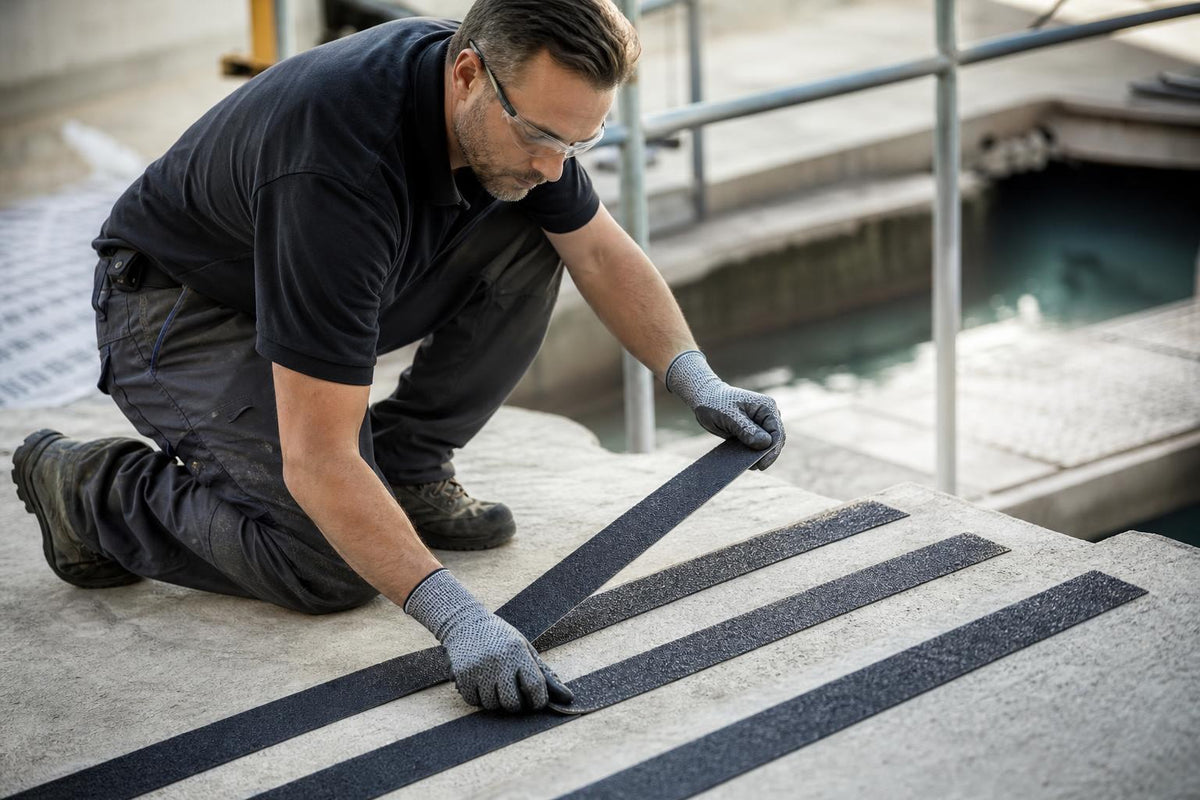
Self-adhesive strips with an abrasive grit surface, typically aluminum oxide or silicon carbide. Quality tape can meet SCOF requirements for ASTM, OSHA, ADA, and ANSI/NFSI standards. Tape is the most affordable option and works well as a short-term fix. But when anti-slip tape on stairs fails, it usually starts with a small lifted corner that eventually becomes a trip hazard. Installation quality determines whether tape lasts weeks or years.
Anti-Slip Deck Strips
Rigid or semi-rigid strips designed for screw-down or adhesive installation on flat surfaces like decks, ramps, and walkways. They are a significant step up from tape in durability and are available in standard and long lengths with multiple color options.
Ladder Rung Covers
FRP or metal sleeves that slide over or clamp onto existing ladder rungs to add a grit-surface for traction. They are rust and corrosion resistant, designed for wet, oily, or dusty environments where bare metal rungs become dangerously slick. Ladder rung covers are available in square and round steel sizes.
Anti-Slip Coatings and Chemical Treatments
These fall into two categories. Paint-based coatings add a textured layer to an existing surface. Chemical treatments (often used on tile and stone) etch micro-channels into the surface to create grip without changing the appearance. Each approach has substrate-specific limitations covered in the selection guide below.
FRP Grating and Sheets
Flat panels with embedded grit, used on platforms, ramps, and walkways where the entire surface needs traction. Anti-slip sheets and FRP grating are common in industrial settings where metal grating corrodes or becomes slick with oil.
Tactile Indicators
Surface-applied or cast-in-place truncated dome panels used for accessibility compliance at curb ramps, transit stops, and building entries. While not an anti-slip product in the traditional sense, they are part of the broader safety surface ecosystem and are often specified alongside nosings and deck strips.
Substrate-by-Substrate Anti-Slip Product Selection Guide
This is the core reference: a substrate-by-substrate selection guide that maps each surface to its best-fit products, warns about common failure modes, and includes installation notes drawn from practitioner experience.
Concrete Substrates
Concrete is the most forgiving substrate for anti-slip product installation. It accepts both mechanical fasteners (masonry anchors, Tapcon screws) and adhesive bonding. Its porosity gives adhesives something to grip, but that same porosity creates risks if the surface is not properly prepared.
Best-fit products: FRP stair nosings (screw-fixed with masonry anchors plus polyurethane adhesive), aluminum nosings, full tread covers, anti-slip deck strips, FRP grating overlays.
Also works: Anti-slip tape (but seal the porous surface first), anti-slip coatings.
What to watch for:
Check for spalling, dishing, or chipped edges before installing anything. A stair nosing is only as strong as the surface it attaches to. Never install metal or FRP profiles over crumbling concrete. If the stair edge is heavily chipped, use a high-quality leveling compound to rebuild a solid, 90-degree base before proceeding. Porous surfaces must be sealed prior to tape application to prevent moisture from interfering with adhesion.
The 28-day rule is critical and widely overlooked. New concrete releases gas and moisture during curing. Wait a full 28 days before applying any adhesive-based anti-slip product. Industry sources including GripFactory and multiple installation guides confirm that ignoring this timeline is a leading cause of early adhesive failure on new pours.
Installation note: Use a hammer drill with a masonry bit for screw-fixed nosings on concrete. For a complete walkthrough of concrete-specific installation, see this guide on installing FRP nosings on concrete steps.
For aging concrete stairs that need more than just nosings, the guide on making old concrete steps safer covers the full assessment and product matching process.
Metal Substrates (Steel, Aluminum, Diamond Plate)
Metal stairs get slippery fast when wet because there is no inherent texture to create friction. The bigger challenge with metal is thermal expansion. Metal expands and contracts with temperature changes, and this movement breaks adhesive bonds over time.
Best-fit products: FRP or aluminum nosings (mechanically fastened with TEK screws or saddle clamp assemblies), FRP grating overlays, ladder rung covers.
Also works: Conformable anti-slip tape with an aluminum foil backing (specifically designed for irregular surfaces like diamond plate).
What to watch for:
Standard grip tape often lifts at the edges once metal expands and contracts through temperature cycles. Most anti-skid tape has a memory that slowly pulls it back toward a flat condition, which means tape applied over curved or textured metal surfaces like stair nosings and diamond plate will eventually peel. Conformable tape with a foil base carrier molds itself to the shape and stays put, but mechanical fastening remains the more reliable long-term solution on metal.
Practitioners on industry forums and installation guides consistently point to thermal expansion as the number one reason adhesive-only products fail on metal substrates. Perforated or diamond-plate aluminum nosing, or grit-based epoxy coating rated for metal, are the two solutions that maintain their bond through temperature swings.
Installation note: Use cobalt or titanium drill bits for pilot holes in metal. Standard bits dull quickly and create poor anchor points.
Wood and Timber Substrates
Wood surfaces present unique challenges because they move. They expand, contract, absorb moisture, and may already have sealers, stains, or coatings that interfere with adhesion.
Best-fit products: Anti-slip deck strips (adhesive plus screw-fixed), FRP nosings (screw-fixed), aluminum nosings.
Also works: Anti-slip tape on sealed wood only, anti-slip coatings and paints.
What to watch for:
Adhesive selection is where most wood-substrate installations go wrong. Water-based adhesives cause wood substrates to warp and do not bond well to FRP or aluminum. Polyurethane construction adhesive is the standard for good reason. Apply it in a serpentine (zigzag) pattern covering the full underside of the nosing. This single detail, choosing polyurethane over water-based adhesive, prevents the majority of nosing failures on wood.
Existing sealers, stains, or old coatings must be removed or assessed before any adhesive product will bond properly. If the wood has been recently sealed, adhesive tape will peel within weeks. For screw-fixed products, a standard drill bit works for pilot holes in wood, unlike the masonry or metal-rated bits needed for other substrates.
The surface preparation guide for anti-slip strips covers wood-specific prep steps in detail.
Tile and Stone Substrates
The correct product choice for tile depends on the tile finish rather than the tile material. Glazed versus unglazed surfaces behave very differently. Glazed tile is smooth and nonporous, which means adhesive products bond to a fragile surface layer rather than the tile body. Unglazed tile and natural stone have more texture and porosity, giving adhesives and coatings a better grip.
Best-fit products: Chemical anti-slip treatments (which etch micro-channels into the surface for grip without changing appearance), adhesive tape or strips on sealed tile.
Also works: Rubber nosings on tile stair edges (self-adhesive or mechanical), thin-profile aluminum nosings.
What to watch for:
Profile-to-substrate thickness matching is critical on tile. Forcing a half-round aluminum extrusion onto a thin tile tread leaves an exposed gap underneath that becomes a trip hazard and collects debris. The nosing profile must match the substrate thickness. This is a specification-level detail that architects and contractors miss more often than they should.
Chemical treatments work well on tile but require professional application and periodic reapplication. They are best for large floor areas where mechanical products are impractical.
Brick and Masonry Substrates
Brick and masonry surfaces are textured and uneven, with mortar joints creating gaps that make adhesive-only installations unreliable.
Best-fit products: Anti-slip deck strips (screw-fixed into masonry), FRP nosings (screw-fixed with masonry anchors).
What to watch for:
Mortar joints create an uneven bonding surface. Adhesive-only products rarely maintain full contact across the irregular surface, leading to lifted edges and premature failure. Mechanical fastening is almost always necessary on brick. Use masonry-rated anchors and pre-drill carefully to avoid cracking the brick face.
Composite Decking
Composite decking materials (wood-plastic blends) have become common in residential and commercial settings. They are smoother than natural wood and react differently to adhesives and fasteners.
Best-fit products: Anti-slip deck strips (screw-fixed plus adhesive), FRP nosings.
What to watch for:
Composite materials can soften and expand in direct sun more than natural wood. Adhesive-only strips may shift on hot days. Screw-fixed installations handle thermal movement better. Pre-drilling is important because composite boards can crack if screws are driven without pilot holes.
Key Technical Terms Explained
Coefficient of Friction (COF)
The coefficient of friction is a measurement indicating the amount of traction a surface exerts on an object. There are two types. SCOF (static coefficient of friction) measures the force needed to start an object moving across the surface. DCOF (dynamic coefficient of friction) measures the force on an object already in motion. For level floors, the common safety criterion was an SCOF of 0.60 or higher (per ASTM C1028-07, which was withdrawn in 2014 but is still referenced in some specifications) or a DCOF of 0.43 or higher (per ANSI B101.3).
Grit Rating
Expressed as a number: 36, 46, 60, 80. Lower numbers mean coarser, more aggressive grit. 60-grit is the most common commercial standard. Using fine-grit tape in a messy industrial area or on outdoor paths with mud is a common cause of failure. Match the grit size to the environment. For mining or heavy industrial applications, extra-coarse grit (36) is the only practical choice.
Pultrusion
The manufacturing method used for FRP stair nosings. Fiberglass reinforcement is pulled through a resin bath and then through a heated die that shapes and cures the profile. The grit surface is embedded during this process rather than applied afterward, which is why pultruded FRP resists delamination far better than products with surface-applied abrasives. More detail is available on the FAQ page.
Mechanical Fixing vs. Adhesive-Only
Mechanical fixing means screws, bolts, anchors, or clamps physically hold the product to the substrate. Adhesive-only means the product relies entirely on a glue bond. In general, mechanical fixing is more durable and more forgiving of substrate imperfections. Adhesive-only works on smooth, clean, sealed surfaces in temperature-stable environments. For high-traffic or outdoor applications, the combination of mechanical fixing plus adhesive is the standard approach.
Delamination
The separation of bonded layers within a product or between a product and its substrate. In anti-slip products, delamination typically means the grit surface peeling away from the backing, or the entire product lifting from the substrate. Pultruded FRP resists internal delamination because the grit is part of the structure, not a surface coating.
Surface Preparation
The process of cleaning, repairing, and priming the substrate before installing an anti-slip product. When anti-slip products fail early, it is rarely because of bad material. Usually, the failure happens because the product does not match the environment or a shortcut was taken during surface preparation. Every substrate type has specific prep requirements, and skipping them is the single fastest path to a failed installation.
Common Substrate-Matching Mistakes
Knowing what works is only half the picture. Here are the substrate-matching mistakes that cause the most failures, drawn from installation guides and practitioner reports.
Using adhesive-only tape on unsealed porous concrete. The adhesive soaks into the pores rather than bonding to the surface. Moisture wicks through the concrete and breaks the bond from beneath. Seal the surface first, or use mechanically fixed products.
Choosing water-based adhesive on wood. This causes the wood to swell and warp under the nosing, breaking the bond. Polyurethane adhesive is the correct choice for wood substrates. Practitioners consistently identify this as the leading reason stair nosings fail on wooden steps.
Applying standard flat tape on diamond plate. The tape’s material memory pulls it back toward a flat shape, lifting it off the raised diamond pattern. Only conformable aluminum-backed tape will hold on textured metal.
Skipping the 28-day cure on new concrete. New concrete continues to release gas and moisture for about four weeks. Applying adhesive products before this period ends traps moisture under the product, preventing proper bonding.
Ignoring nosing profile thickness on thin tile. A thick nosing profile mounted on a thin tile tread creates an overhang and gap that is both a trip hazard and a dirt trap. The profile must match the substrate thickness.
Not measuring each step individually. Practitioners report that steps vary by 3 to 10 mm even in well-built staircases. Using one measurement for every nosing creates gaps or overhangs that compromise both safety and appearance. The guide on measuring stairs for nosings covers how to avoid this.
Why Substrate Selection Matters: The Cost of Getting It Wrong
In Canada, slips, trips, and falls are one of the leading causes of workplace injuries, with approximately 60,000 workers injured annually according to the Canadian Centre for Occupational Health and Safety. About 67% of falls occur on the same level, meaning walking surfaces, not heights. These are the falls that properly selected anti-slip products directly prevent.
According to WorkSafe BC, 20% of workplace injuries in British Columbia are related to slips, trips, and falls, costing businesses 440,000 lost workdays and more than $148 million in compensation costs annually.
Adhesive failure from improper surface preparation, wrong adhesive selection, and high peel stress is the most common technical cause of anti-slip product failure. The cost is not just the replacement product. It is the liability exposure during the period when the failed product is either missing or, worse, partially attached and creating a new trip hazard.
Product Lifespan Comparison
Understanding lifespan by product type helps contextualize why substrate matching matters for long-term value.
| Product Type | Typical Outdoor Lifespan | Approximate Cost |
|---|---|---|
| Adhesive grip tape | 6 months to 1 year | $10–$30 |
| Anti-slip deck strips | 3–5 years | $25–$75 |
| FRP stair nosings | 10+ years | $55–$210 |
| Aluminum stair nosings/treads | 10+ years, often warrantied for life | $35–$80+ |
The cheapest option per unit is almost never the cheapest option over time. A $15 roll of tape replaced every 8 months on an outdoor concrete staircase costs more in five years than a single FRP nosing installed once.
Canadian Winter Considerations
Canadian freeze-thaw cycles act as a modifier on every substrate in this guide. Cold weather does not change which substrate you have, but it changes which products will hold up on it.
Rubber and PVC become rigid in extreme cold, reducing their shock-absorbing benefit and making them brittle. FRP and aluminum maintain their performance characteristics through freeze-thaw cycles. If the stair, ramp, or walkway is exterior or in an unheated space, FRP and aluminum are the practical choices.
This applies across substrates. Concrete stairs with rubber nosings will see those nosings crack and loosen after repeated freeze-thaw exposure. Metal fire escapes with PVC edge strips will see those strips harden and detach. Wood decks with flexible tape will see the tape lift as the wood contracts in cold and expands in thaw.
For any exterior installation in Canada, the selection hierarchy is clear: FRP or aluminum with mechanical fastening, combined with polyurethane adhesive. Flexible-only products should be reserved for interior, temperature-controlled environments.
Anti-Slip Product Selection Matrix
This table summarizes the full substrate-by-product mapping covered in this guide. Use it as a quick-reference lookup.
| Substrate | Best Products | Acceptable | Avoid |
|---|---|---|---|
| Concrete | FRP nosings, aluminum nosings, full tread covers, deck strips | Anti-slip tape (sealed surface), coatings | Adhesive-only tape on unsealed concrete |
| Metal (steel, aluminum, diamond plate) | FRP/aluminum nosings (mechanically fixed), FRP grating, ladder rung covers | Conformable foil-backed tape | Standard flat tape, adhesive-only products |
| Wood/Timber | Deck strips (screw + adhesive), FRP nosings, aluminum nosings | Tape on sealed wood, coatings | Water-based adhesives, tape on unsealed wood |
| Tile/Stone | Chemical treatments, adhesive strips on sealed tile, thin-profile nosings | Rubber nosings (matched profile) | Thick profiles on thin tile, adhesive on glazed surface |
| Brick/Masonry | Deck strips (screw-fixed), FRP nosings (masonry anchors) | — | Adhesive-only products |
| Composite Decking | Deck strips (screw + adhesive), FRP nosings | — | Adhesive-only in direct sun exposure |
Limits of Anti-Slip Products
Anti-slip products reduce slip risk. They do not eliminate it entirely. Surfaces still need regular cleaning and maintenance. Ice, oil, standing water, and debris accumulation still need to be managed through housekeeping and drainage. No anti-slip product replaces winter maintenance on exterior surfaces.
Code and accessibility requirements vary by province and municipality. Any compliance claims should be verified against the specific building code applicable to your project location. Standards like ASTM C1028-07 (withdrawn 2014) and ANSI B101.3 are referenced in specifications, but the applicable test method depends on your jurisdiction and the specifying authority.
Frequently Asked Questions
What is the most important factor when selecting an anti-slip product?
The substrate. The surface material determines which products will bond properly, which fasteners to use, which adhesives work, and how the product will perform through temperature changes and weathering. Price, color, and brand are secondary to substrate compatibility.
Can I use anti-slip tape on any surface?
No. Anti-slip tape requires a smooth, clean, sealed surface to bond properly. It fails on porous unsealed concrete, textured diamond plate (unless you use conformable foil-backed tape), and unsealed or freshly stained wood. Tape is best treated as a short-term solution on indoor, temperature-stable surfaces.
How long should I wait before installing anti-slip products on new concrete?
Wait a minimum of 28 days. New concrete continues to release gas and moisture during curing. Applying adhesive products before the curing period ends prevents proper bonding and leads to early failure.
Why do anti-slip products fail on metal stairs?
Thermal expansion. Metal expands in heat and contracts in cold. This cyclical movement breaks adhesive bonds over time. Mechanical fastening (screws, bolts, saddle clamps) is necessary for reliable long-term performance on metal substrates. Standard flat-backed tape will lift at the edges as the metal moves.
Are FRP nosings better than aluminum nosings?
It depends on the environment. FRP resists corrosion and chemicals, making it ideal for coastal, industrial, and chemical-exposure settings. Aluminum is durable and weather-resistant with a clean appearance for commercial applications. Both outperform tape and coatings by a wide margin in lifespan.
Do anti-slip products work in Canadian winters?
FRP and aluminum products maintain performance through freeze-thaw cycles. Rubber and PVC products become rigid and brittle in extreme cold, making them unsuitable for exterior Canadian installations. Mechanical fastening with polyurethane adhesive is the standard for any outdoor application in Canada.
Next Steps
This anti-slip product selection guide by substrate type covers the major surface-product combinations, but every project has specifics that a general guide cannot anticipate. Mixed substrates, unusual dimensions, high-chemical environments, and heritage buildings all add complexity.
Contact Safety Step Canada for substrate-specific guidance on your project, or browse completed project examples to see how these products perform in real installations across industrial, commercial, government, and residential settings.