
What Is a Stair Tread? Definition, Parts, and Anti-Slip Uses
TLDR: A stair tread is the horizontal walking surface of a step, the flat part your foot lands on. It is different from the riser (vertical face) and nosing (front edge). In product catalogs, “stair tread” can also mean a retrofit cover or strip installed over an existing step to add traction, visibility, or wear protection. Understanding the difference matters when buying anti-slip products.
This guide is for facility managers, contractors, property managers, and anyone trying to understand stair parts before repairing, measuring, or improving a set of stairs. It covers definitions, related stair components, safety context, and how to choose between anti-slip tread covers, nosings, and strips.
Browse FRP stair tread nosings to see what retrofit options look like before reading further.
The Quick Answer: What Is a Stair Tread?
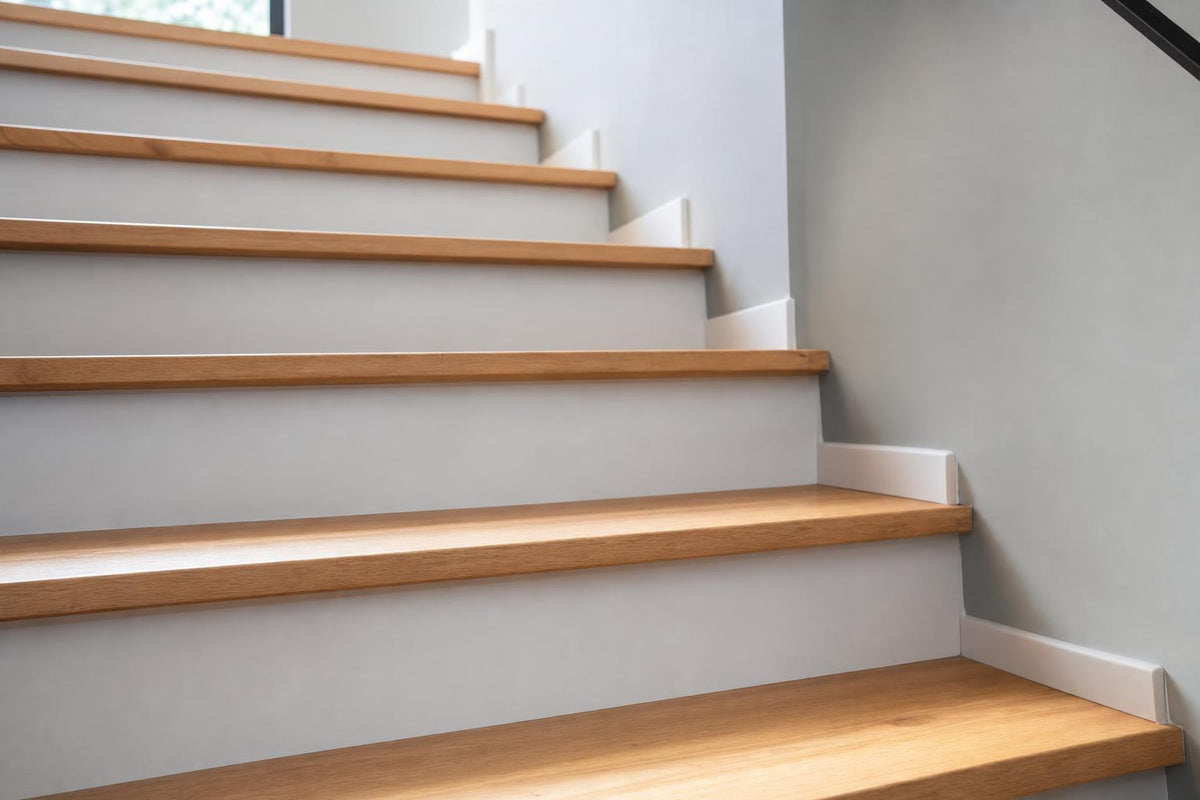
A stair tread is the flat, horizontal part of a step. It is the surface your foot lands on when you walk up or down stairs. The Stairbuilders and Manufacturers Association defines a tread as the “horizontal walking surface of a stair.”
That definition sounds simple, but the term carries a second meaning that trips people up. In construction, the tread is the structural part of the step itself. In anti-slip product buying, “stair tread” often means a manufactured cover, cap, or strip installed over an existing step to improve grip. A flooring industry article from Cavalieri Flooring explains that this double meaning regularly causes customer confusion and ordering mistakes.
If someone asks “what is a stair tread,” they might mean the stair part or the safety product installed on top of it. Both meanings matter, and the rest of this guide covers both.
Stair Tread vs. Riser vs. Nosing
These three terms describe the main visible parts of a single step. Confusing them leads to wrong measurements and wrong product orders.
| Part | Location | Description | Safety Role |
|---|---|---|---|
| Tread | Top of the step | The flat horizontal walking surface | Where the foot lands; needs grip and usable depth |
| Riser | Vertical face between steps | The upright panel connecting one tread to the next | Controls step height and walking rhythm |
| Nosing | Front edge of the tread | The leading edge, sometimes projecting past the riser below | Defines the step edge; key zone for traction and visibility |
The nosing is part of the tread, not a separate stair component. It is simply the front edge. But because the nosing takes the most wear and is the most important area for slip prevention, it gets its own name and its own category of safety products.
Think of it this way: every nosing is part of a tread, but treating only the nosing does not treat the entire tread.
Why Stair Treads Matter for Safety
A stair tread is not just a piece of material. It is a walking surface, and its condition directly affects whether someone slips, trips, or falls.
According to the Canadian Centre for Occupational Health and Safety (CCOHS), approximately 12% of accepted injury claims in Canada come from slips, trips, and falls, roughly 34,000 incidents per year. Stairs are one of the highest-risk surfaces in that picture, especially when treads are wet, icy, worn smooth, oily, or hard to see.
CCOHS notes that good stair design can reduce misstepping risk, though it cannot eliminate falling hazards entirely. The tread’s depth, texture, surface condition, and edge visibility all play a role.
For a deeper look at how edge treatments reduce incidents, read about how stair nosings reduce slip injuries.
Tread dimensions matter too
CCOHS cites National Building Code of Canada 2020 values: tread run (front-to-back depth) should fall between 25.5 cm and 35.5 cm, riser height between 12.5 cm and 18 cm, and dimensions within a single staircase should be uniform, with variation no more than 0.5 to 1 cm. Inconsistent tread depths throw off a person’s stepping rhythm and increase the chance of a misstep.
The Two Critical Zones of a Step
When evaluating a stair tread for safety, think about two zones rather than one.
Zone 1: The tread surface
This is where the foot lands. It needs adequate traction for the environment (dry, wet, oily, icy), a surface that drains or can be cleaned, and enough usable depth for secure foot placement.
Zone 2: The leading edge
This is the nosing zone, the front of the tread where you identify where one step ends and the next begins. It needs two things: grip and visibility.
A practitioner on LinkedIn describes how stairs with uniform colour and no contrasting edge can visually blur into a “ramp effect,” especially during descent. The steps appear to merge, making it difficult to judge where each one starts. The recommendation: install contrasting anti-slip nosings rather than relying on paint alone.
Published research supports this. A study of older adults found that higher-contrast tread-edge markings improved safety-related measures during stair descent, with the abstract suggesting at least 50% contrast difference provides adequate visual information. A separate 2024 study confirmed that transverse highlighting strips positioned at or near the lip of each step produced the best improvement in staircase-configuration judgments, and that high visual contrast is especially important for elderly users, visually impaired users, and low-light environments.
In plain terms, a stair tread should not only grip the shoe. It should also show the user where the next step begins.
Practitioners on Reddit echo this. One user asking about slippery hardwood stairs noticed that small runner rugs sat in the middle of each tread but did not cover the front edge, which they believed was where the slip risk was greatest. CCOHS agrees: non-slippery surfaces on the whole step, or at minimum on the leading edges, are critical.
What Is an Anti-Slip Stair Tread?
In product catalogs, the phrase “stair tread” takes on a different meaning. An anti-slip stair tread is a safety product installed on top of an existing step to improve grip. Some cover only part of the tread surface. Others cover the full walking area or include a nosing extension that wraps over the front edge.
This is where the “structural part vs. product” confusion becomes a real purchasing problem. When a buyer searches for a stair tread, they could be looking for the definition of the stair part, or they could be shopping for a retrofit tread cover. Knowing which meaning applies changes the entire buying decision.
Grainger’s product guide distinguishes several anti-slip product categories by how much of the step they cover:
- Anti-slip tread strip: covers part of the top surface for targeted grip
- Stair nosing: covers the front edge only, adding traction and contrast
- Tread cover: covers more of the walking surface
- Tread cover with nosing: covers the walking surface and extends over the front edge
- Anti-slip tape: cut-to-length strips for stairs, ramps, or walkways
These are not interchangeable. A nosing does not solve a slippery tread surface. A tread strip does not protect a worn leading edge.
When to Use a Tread Cover, Nosing, or Anti-Slip Strip
The right product depends on what part of the stair needs help and what conditions it faces.
| Situation | Better Fit | Why |
|---|---|---|
| Only the front edge is worn or hard to see | Stair nosing | Treats the leading edge, adds contrast and traction |
| Entire step surface is slippery | Tread cover or tread strip | Adds grip where the foot lands |
| Outdoor stairs in rain, snow, or ice | FRP or aluminum nosing or tread cover | More durable than adhesive-only fixes in harsh weather |
| Wood deck steps or ramps | Anti-slip deck strips | Targeted traction on the walking path |
| Industrial metal or concrete stairs | FRP or aluminum products | Suited for wet, oily, high-traffic, or corrosive conditions |
| Low-light stairwell or emergency exit | High-contrast or glow edge product | Helps users identify each step |
| Ladder rungs (not stairs) | Ladder rung covers | Shaped for rungs, not flat step surfaces |
| Platforms, ramps, or landings | Anti-slip sheets or walkway covers | Stair nosings do not solve flat-surface slip risk |
For wood or composite deck steps, anti-slip deck strips are often the simplest option because they bond directly to the walking path in standard or long lengths.
For outdoor stairs that need full tread coverage, consider aluminum stair tread covers designed to handle weather exposure and heavy foot traffic.
Common Stair Tread Materials
Structural stair materials
The tread itself can be built from many materials, each with different slip characteristics:
- Wood: common in residential and deck stairs; can become slippery when wet, worn, or algae-covered
- Concrete: common in commercial and industrial settings; can be slick when polished, wet, or oily
- Metal (steel, aluminum): found in industrial stairs, fire escapes, and exterior staircases; smooth metal is very slippery when wet
- Tile or stone: used in entrances, lobbies, and public buildings; polished surfaces reduce traction
- Composite decking: popular for outdoor stairs; some composite textures lose grip when wet or icy
- Vinyl or LVP: used in residential and light commercial settings
Retrofit anti-slip materials
When the stair tread itself is slippery or worn, retrofit products add traction on top:
- FRP (fiberglass-reinforced plastic): lightweight, corrosion-resistant, cuttable on site; strong fit for wet, chemical, or coastal environments
- Aluminum: weather-resistant, long-lasting, suited to outdoor and commercial stairs
- Rubber or vinyl: common for indoor residential or light commercial use
- Grit tape or adhesive cleats: low cost and fast to install, but can peel in outdoor or high-traffic conditions
- Coatings or paint additives: surface treatments that add texture but may wear under heavy use
For a comparison of FRP and aluminum options in harsh conditions, the guide on FRP vs. aluminum stair nosings covers material differences in coastal and industrial settings.
Browse aluminum stair nosings to compare profiles, sizes, and finishes.
Canadian Facility and Winter Considerations
Canada’s climate makes stair treads a year-round concern. Ice, snow, rain, freeze-thaw cycles, road salt, and algae all degrade traction on outdoor stairs. Even indoor stairs near building entrances collect moisture tracked in from outside.
Workplace surface requirements
Canada’s federal Occupational Health and Safety Regulations (section 2.14) state that exterior stairways, walkways, ramps, and passageways used by employees must be kept free of accumulations of ice and snow or other slipping and tripping hazards. The same section requires that every travelled surface in a workplace be slip-resistant and free of defects. Provincial and local requirements may add further obligations, so buyers should always check the rules that apply to their specific building and jurisdiction.
Accessibility standards for stair edges
Accessibility Standards Canada’s outdoor spaces standard (CAN/ASC-2.1) specifies that stair treads should be slip-resistant and that the leading edge of each tread should have a durable strip with high luminance contrast, extending the full width of the tread and between 40 mm and 60 mm in depth. The nosing should project no more than 38 mm.
These are useful reference points for public buildings, transit stations, institutional facilities, and projects with accessibility requirements. They are not universal rules for every stair, so confirm what applies to the project at hand.
Winter maintenance still matters
More texture improves grip, but exterior stairs still need snow, ice, water, and debris management. Practitioners on Reddit note that heavily textured or grit-coated surfaces can make shovelling harder. Choose products that work with the actual maintenance routine, not against it.
How to Identify and Measure a Stair Tread
Before ordering any anti-slip product, measure the stair correctly. Here is a simple process:
- Stand facing the stairs. The flat surface under your foot is the tread. The vertical face in front of your toe is the riser. The front edge of the tread is the nosing.
- Measure the width from side to side (wall to wall, or stringer to stringer).
- Measure the depth (also called “run”) from the front edge to the riser behind it.
- Check whether the tread has an overhanging nosing that projects past the riser below.
- Measure several steps, not just one. In real buildings, stair dimensions can vary from step to step.
- Note the substrate material: wood, concrete, steel, aluminum, composite, tile, or something else.
- Record the hazard: wet, oily, icy, low-light, worn edge, heavy traffic, outdoor exposure, or a combination.
For detailed measuring guidance, the step-by-step guide on how to measure a stair for correct nosing size walks through each measurement with product ordering in mind.
Common Mistakes When Choosing Stair Tread Products
Confusing the nosing with the tread
The nosing is only the front edge. A nosing product protects that edge but does not cover the full walking surface. If the entire tread is slippery, a nosing alone is not enough.
Treating only the middle of the step
One Reddit user noted that small runner rugs sat in the centre of their hardwood stairs but left the front edge exposed, exactly where slips are most likely to start. CCOHS guidance confirms that the leading edge is the priority zone for non-slip treatment.
Using indoor adhesive products outdoors
Multiple practitioners on Reddit and StackExchange report problems with adhesive-only anti-slip mats and tapes on exterior stairs. Cheap grit tape peels at the edges. Rubber nosings warp and lift in sun and winter conditions. One StackExchange user described how adhesive safety mats peeled off outdoor composite treads and resorted to mechanical fasteners as a workaround. For exterior stairs, consider the attachment method, not just the traction surface.
Creating a raised lip that catches footwear
Practitioners on Reddit consistently flag this issue. Overlap stair noses that lift or peel create a foot-catch point. In one flooring thread, a user described overlap stair noses lifting within days of installation, with commenters debating whether better adhesive, flush profiles, or mechanical fasteners would fix the problem. On stairs, a small product-choice mistake becomes a new trip hazard.
Ignoring cleaning and snow removal
Aggressive grit textures improve grip but can complicate shovelling, sweeping, and mopping. For outdoor stairs in Canada, choose products that can be cleaned and maintained in the conditions they will actually face.
For more practical solutions to slippery stairs, see how to fix slippery stairs with proven methods for different surfaces.
Frequently Asked Questions
Is a stair tread the same as a step?
Not exactly. A step usually includes both the tread (horizontal walking surface) and the riser (vertical face between treads). The tread is one part of the step, not the whole thing.
What is the difference between a stair tread and a stair nosing?
The tread is the full walking surface of the step. The nosing is just the front or leading edge of that tread. A nosing may be built into the stair or added as a separate anti-slip profile. Treating the nosing helps the edge; treating the tread helps the whole surface.
What is an anti-slip stair tread?
An anti-slip stair tread is a product installed over an existing step to add grip. Options range from partial tread strips to full tread covers with integrated nosings. The right choice depends on how much of the step needs traction and what environment it faces.
Are stair tread dimensions regulated?
Stair tread depth, riser height, and uniformity are addressed in building codes, but exact requirements vary by jurisdiction and building type. CCOHS cites National Building Code of Canada 2020 values of 25.5 to 35.5 cm for tread run and 12.5 to 18 cm for riser height, and advises checking local jurisdiction for applicable rules.
What material is best for anti-slip stair treads?
It depends on the stair and the hazard. FRP and aluminum are commonly used in commercial, industrial, wet, and outdoor settings because they resist corrosion and hold up under heavy traffic. Tape or adhesive strips can work for lighter-duty or lower-cost needs but may require more frequent replacement outdoors.
Where should anti-slip material go on a stair tread?
Put traction where the foot lands, and pay special attention to the leading edge. CCOHS says non-slippery surfaces on the whole step, or at minimum on the leading edges, are the priority. Research on tread-edge contrast supports placing high-visibility markings at or near the stair lip.
Can I install a tread cover over existing stairs?
In most cases, yes, if the existing stair is structurally sound and the product fits the substrate. Tread covers and nosings can be installed with adhesive, mechanical fasteners, or both, depending on the product and surface. Always follow the manufacturer’s installation guidance.
Are anti-slip tape and stair tread covers the same thing?
No. Anti-slip tape is a roll or strip that can be cut to any length. A stair tread cover is a more defined product shaped to cover part or all of the walking surface, sometimes including an integrated nosing. They serve different coverage needs and have different durability profiles.
Choose the Right Product for Your Stairs
Understanding what a stair tread is, and which part of the tread needs attention, is the first step toward making stairs safer. The tread surface needs grip. The leading edge needs grip and visibility. The product needs to match the environment: indoor or outdoor, wet or dry, light traffic or heavy.
Contact Safety Step Canada for help choosing between FRP nosings, aluminum tread covers, deck strips, and other anti-slip products for your stair material, traffic level, and climate conditions.