
TL;DR: Replacing stair nosing costs $25 to $75 per step for nosing-only installs, depending on material and whether you hire a contractor. Vinyl and rubber nosings are cheapest upfront ($10 to $19 per piece) but wear out in 2 to 3 years. Aluminum and FRP nosings cost more initially ($40 to $65 per step installed) but last 10 to 20+ years. For a standard 13-step staircase, budget $650 to $1,500 in total labor. Retrofit nosings save 30 to 40% compared to full tread replacement.
Facility managers, property managers, contractors, and building owners all land on this question eventually: what does it actually cost to replace stair nosing, and is the pricing per step or per linear foot? This guide breaks down every variable so you can build an accurate budget, whether you’re costing out a single residential staircase or a multi-floor commercial building.
Browse FRP stair tread nosings to compare sizes and pricing by material.
What Does “Replacing Stair Nosing” Actually Mean?
Stair nosing is the profiled strip that protects the front edge of each step. It’s the part of the stair that takes the most abuse from foot traffic, and it’s usually the first component to show wear, cracking, or delamination.
When people search for the cost to replace stair nosing per step, they’re usually dealing with one of three situations:
- Nosing-only replacement. The existing tread is sound, but the front edge is worn, cracked, or missing its anti-slip profile. You remove the old nosing and install a new one.
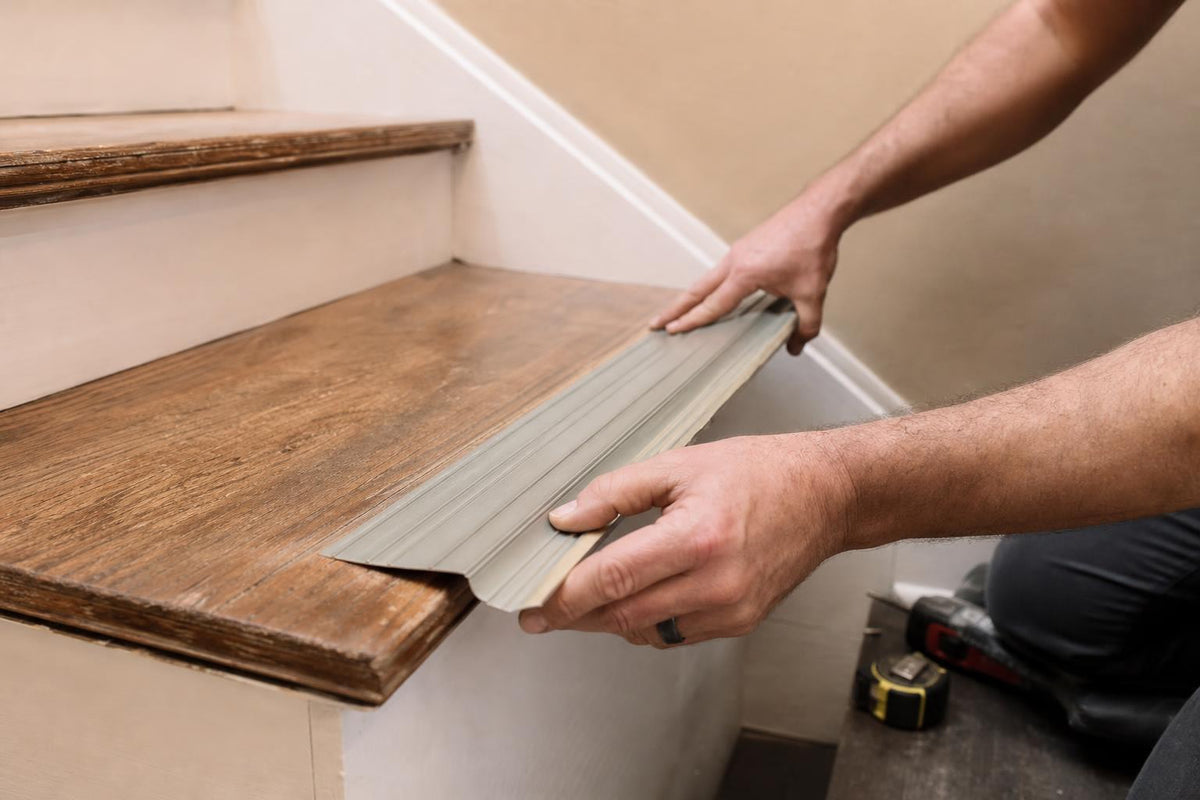
- Retrofit nosing installation. There’s no existing nosing, or the old one was a peel-and-stick strip that failed. You bolt or adhesive-mount a new nosing profile over the existing tread surface.
- Full tread and riser replacement. The entire step surface is damaged, warped, or structurally compromised. This is a different project with different pricing.
Most buyers only need the first or second option. If your treads are structurally intact, retrofitting stairs without rebuilding them is the faster, cheaper path. Full tread replacement should be reserved for steps with rot, severe concrete spalling, or structural failures.
Stair Nosing Cost Per Step by Material
Material choice is the single biggest factor in your per-step pricing estimate. Here’s what each material costs before installation:
| Material | Cost Per Piece/Linear Foot | Estimated Per-Step Cost (Material Only) | Best For |
|---|---|---|---|
| PVC / Vinyl | $2 to $12 per linear foot; $10 to $19 per piece | $10 to $19 | Budget residential, indoor |
| Rubber (adhesive strip) | $10 to $14 per piece | $10 to $14 | Light residential, temporary |
| Wood (red oak, 48") | $35 to $50 per piece | $35 to $50 | Hardwood staircase matching |
| Aluminum (anti-slip) | $15 to $45 per linear foot | $45 to $135+ | Commercial, outdoor, high traffic |
| FRP (pultruded fiberglass) | $55 to $115 per piece | $55 to $115 | Industrial, outdoor, corrosive environments |
| Bronze / Lighted | Up to $50 per linear foot | $150+ | Architectural, hospitality |
A few notes on reading this table. Per-step cost depends on stair width. A standard residential stair is 36 inches wide, while commercial stairs commonly run 48 inches or wider. A 48-inch aluminum nosing at $30 per linear foot costs $120 for material alone, while the same product on a 36-inch residential stair costs $90.
For a deeper look at how FRP and aluminum compare on corrosion resistance and lifespan, read this FRP vs. aluminum nosing comparison.
Labor and Installation Costs
Contractor Rates
Contractors typically charge $50 to $150 per hour for stair nosing work, according to estimates from Oak Valley Designs. The wide range reflects geography, project complexity, and whether the contractor specializes in flooring or general handyman work.
For a 12 to 15 step staircase, expect $650 to $1,500 in labor alone. That number assumes nosing-only work on a straight staircase with sound substrates.
Per-Step Installed Costs (Material + Labor)
| Installation Type | Per-Step Installed Cost | Notes |
|---|---|---|
| Vinyl/rubber nosing (DIY) | $25 to $50 | Peel-and-stick or adhesive |
| Vinyl/rubber nosing (professional) | $40 to $75 | Includes surface prep |
| Aluminum nosing (professional) | $40 to $65 | Screw-down with anti-slip inserts |
| Full tread + riser replacement | $100 to $200 | Demolition, new material, finishing |
| Concrete step repair + nosing | $70 to $150 | Patching, leveling, then nosing install |
Practitioners on Reddit’s r/Flooring forum report being quoted $100 per nosing piece for LVP stair installs, with multiple commenters calling that overpriced and suggesting $50 as a more reasonable per-nosing charge. This kind of price sensitivity is common: real buyers compare stair nosing replacement costs aggressively, and getting two to three quotes is standard practice.
Installation Time
How long each step takes depends on the fastening method:
- Adhesive nosing (vinyl, rubber): 15 to 30 minutes per step for an experienced installer
- Screw-down metal or FRP nosing: 30 to 45 minutes per step, including drilling and countersinking
- Full 13-step staircase: 4 to 8 hours total
For mechanical fastening, stainless steel saddle clamp assemblies provide a secure mounting method that doesn’t rely on adhesive alone.
DIY Savings
If you’re handy and the project is straightforward, DIY installation saves roughly $15 to $25 per step. Vinyl and basic aluminum nosings are the most DIY-friendly options. FRP nosings can be cut on site with standard tools and installed without specialized equipment, making them practical for competent DIYers as well.
Retrofit Nosing vs. Full Tread Replacement: The Cost Gap
This is where the biggest savings hide. One of the most common misconceptions in staircase renovation is that fixing a damaged edge requires tearing out the entire step.
It usually doesn’t.
When the underlying tread structure is sound, installing retrofit nosings costs 30 to 40% less than full tread replacement. Here’s a direct comparison for a 13-step staircase:
| Approach | Per-Step Cost | 13-Step Total | Includes |
|---|---|---|---|
| Retrofit nosing (aluminum or FRP) | $40 to $80 | $520 to $1,040 | Surface-mount nosing, fasteners, labor |
| Full tread + riser replacement | $100 to $200 | $1,300 to $2,600 | Demolition, new treads, risers, finishing |
| Full staircase rebuild | $150 to $300+ | $1,950 to $3,900+ | Structural work, stringers, treads, risers, finishing |
Traditional full-replacement installations run $1,200 to $3,000 in labor because they require demolition of existing treads, disposal, substrate prep, and new material fitting. Surface-mounted retrofit nosings skip all of that. They install directly over existing surfaces.
When retrofit is the right call: The tread surface is worn or slippery but structurally intact. The substrate (concrete, metal, or wood) is solid underneath.
When full replacement is necessary: The tread is rotting, crumbling, warped, or structurally compromised. Never install nosing over a failing substrate. As industry guidelines make clear, you should remove loose debris, old adhesive, or damaged material and use leveling compound if needed before installing any metal profile.
For sizing guidance on retrofit projects, see how to size stair nosings for retrofit applications.
Factors That Affect Your Per-Step Cost
Beyond material and labor, several variables shift the cost to replace stair nosing per step on any given project:
1. Stair Width and Length
Standard residential stairs are 36 inches wide. Commercial stairs often run 48 inches or wider. A wider stair means a longer nosing piece, and materials priced per linear foot scale accordingly. A 48-inch aluminum nosing at $25 per linear foot costs $100 for material, while a 36-inch version costs $75.
2. Indoor vs. Outdoor
Outdoor-rated materials (aluminum with anti-slip inserts, FRP) cost more upfront but resist UV, moisture, freeze-thaw cycling, and algae. Indoor vinyl nosings are cheaper but will fail quickly if exposed to weather. For outdoor steps, aluminum stair nosings designed for weather exposure are the practical choice.
3. Staircase Complexity
Straight staircases are simple. Curved, spiral, or winding staircases require custom-cut nosings, more installation time, and often higher labor rates. Expect a 20 to 40% cost increase for complex layouts.
4. Substrate Condition
If the existing surface needs repair before nosing installation, add prep costs. Concrete patching, wood filler, or leveling compound adds $10 to $30 per step in materials and extra labor time.
5. Visual Contrast and Code Requirements
Building codes require a minimum 30% difference in Light Reflectance Value (LRV) between the nosing and the stair tread. High-visibility nosings (yellow, glow-in-the-dark) may cost slightly more than standard black or grey options. Glow-in-the-dark strips can supplement nosing visibility for egress compliance.
6. Bulk Ordering
Purchasing full staircase quantities yields better per-unit pricing. Many suppliers offer 15 to 20% discounts for complete stair sets. If you’re outfitting multiple staircases in a facility, ask for volume pricing.
Lifespan by Material: The Total Cost of Ownership View
The cheapest nosing per step is not always the cheapest nosing over time. This is where cost-per-step pricing estimates become misleading if you only look at the upfront number.
| Material | Expected Lifespan | Replacement Frequency | 10-Year Cost Per Step |
|---|---|---|---|
| PVC / Vinyl | 2 to 3 years | 3 to 5 replacements | $30 to $95 (material only) |
| Rubber (basic adhesive) | 1 to 3 years residential; 6 months to 2 years commercial | 3 to 10+ replacements | $30 to $140+ |
| Aluminum (quality) | 10 to 20+ years | 0 to 1 replacement | $45 to $135 (one-time) |
| FRP (pultruded) | 10+ years | 0 to 1 replacement | $55 to $115 (one-time) |
A $10 PVC nosing replaced every two to three years costs $30 to $50 over a decade in materials alone, plus repeated labor costs. A $55 to $115 FRP nosing installed once, with virtually zero maintenance, is the cheaper option over any reasonable timeframe.
Community discussions consistently flag problems with vinyl plank stair nosings that crack, break off, shift, or fail when the nose edge is unsupported. Cheap nosings don’t just cost more in replacement cycles; they create trip hazards that are worse than having no nosing at all.
Industry data from Latham Australia confirms there’s no universal replacement schedule. Lifespan depends on foot traffic volume and construction materials. The practical approach is inspection-based replacement, not calendar-based. For more on FRP durability data, see pultruded nosing durability testing.
The Cost of Not Replacing Worn Nosing
Stair nosing replacement is a safety investment, not a cosmetic one. When you run the numbers, the per-step cost becomes trivial compared to the liability exposure.
According to the Canadian Centre for Occupational Health and Safety, approximately 60,000 workers in Canada are injured each year due to slip-and-fall accidents. The Canadian Institute for Health Information reported 162,222 unintentional slip-and-fall injuries in 2020 to 2021, representing nearly 60% of all injury hospitalizations.
The financial impact is severe. The average slip, trip, or fall costs an employer $2,000 in direct WSIB costs and approximately $22,000 in total direct and indirect costs. In British Columbia alone, slip-trip-and-fall injuries cost businesses 440,000 lost workdays and more than $148 million in claim costs each year.
A $600 to $1,000 nosing project for a 13-step staircase is pocket change compared to a single $22,000 claim. For commercial properties, this math makes nosing replacement one of the highest-ROI safety expenditures available. As one industry cost guide put it: a $600 nosing installation equals liability protection worth thousands in potential claim prevention.
Loose or worn nosing creates trip hazards that are worse than bare stairs. A partially detached nosing strip catches shoe edges in a way that a smooth, worn tread edge does not. If your nosings are lifting, cracking, or missing chunks, replace them now.
For commercial and industrial facilities, the case for quality nosing is even stronger given higher foot traffic and regulatory scrutiny.
How to Estimate Your Project
Use this formula to build a quick pricing estimate for stair nosing replacement cost per step:
Total Cost = (Number of Steps × Per-Step Material Cost) + (Number of Steps × Install Time Per Step × Hourly Rate)
Example: 13-Step Residential Staircase, Aluminum Nosing, Professional Install
- Material: 13 steps × $50 per step = $650
- Labor: 13 steps × 0.5 hours × $75/hour = $487.50
- Estimated total: $1,137.50
Example: 13-Step Commercial Staircase, FRP Nosing, Professional Install
- Material: 13 steps × $85 per step = $1,105
- Labor: 13 steps × 0.625 hours × $100/hour = $812.50
- Estimated total: $1,917.50
Tips for Accurate Budgeting
- Get two to three quotes. Pricing varies significantly by region and contractor specialization.
- Order 10% extra. Cutting waste, measurement errors, and keeping spares for future repairs justify the small additional cost.
- Measure carefully. Stair width determines nosing length, which directly affects per-step material costs. A guide on how to measure stairs for correct nosing size can prevent ordering mistakes.
- Check substrate condition before ordering. Rotting wood or crumbling concrete needs repair before any nosing goes on, and that adds cost.
Contact Safety Step Canada for help choosing the right nosing material and size for your project.
Frequently Asked Questions
How much does it cost to replace stair nosing per step?
The cost to replace stair nosing per step ranges from $25 to $75 for nosing-only installation. Vinyl and rubber nosings run $25 to $50 per step (DIY) or $40 to $75 (professional). Aluminum and FRP nosings cost $40 to $65 per step installed. Full tread and riser replacement is a different project, costing $100 to $200 per step.
Can I install stair nosing myself to save money?
Yes. Adhesive vinyl and rubber nosings are straightforward DIY projects, requiring no special tools. Screw-down aluminum and FRP nosings need a drill, appropriate bits, and basic measuring skills. DIY installation saves roughly $15 to $25 per step compared to hiring a contractor. Expect 15 to 45 minutes per step depending on the fastening method.
How long does stair nosing last before it needs replacement?
Cheap PVC nosings last 2 to 3 years. Basic rubber adhesive strips last 1 to 3 years in residential settings and may need replacement every 6 months in commercial spaces. Quality aluminum and FRP nosings last 10 to 20+ years with normal maintenance. Actual lifespan depends on foot traffic volume, weather exposure, and installation quality.
Is it cheaper to replace just the nosing or the entire tread?
Replacing just the nosing is significantly cheaper. Retrofit nosing installation costs $40 to $80 per step, while full tread and riser replacement runs $100 to $200 per step. If the existing tread structure is sound, nosing-only replacement saves 30 to 40% compared to a full rebuild.
What is the best stair nosing material for outdoor stairs?
Aluminum with anti-slip inserts and pultruded FRP are the two best options for outdoor stairs. Both resist moisture, UV, and freeze-thaw cycling. FRP has the added advantage of being corrosion-proof and lightweight. PVC and rubber nosings are not suitable for outdoor applications because they degrade quickly in weather.
How do I know when stair nosing needs to be replaced?
Replace stair nosing when you see visible cracking, chipping, or delamination. Nosing that is lifting from the tread surface is an immediate trip hazard. Other signs include worn-smooth anti-slip texture, visible substrate underneath the nosing surface, and any nosing that moves when you step on it. Inspection-based replacement is the standard approach rather than following a fixed calendar schedule.
Do building codes require stair nosing?
Most Canadian and North American building codes require a minimum 30% Light Reflectance Value (LRV) contrast between the nosing and the tread surface for visibility. Many codes also specify nosing projection limits and shape profiles to prevent tripping. Check your local building code or consult with your contractor, as requirements vary by jurisdiction and building classification.
Does buying in bulk reduce the cost to replace stair nosing per step?
Yes. Purchasing complete staircase quantities often yields 15 to 20% discounts. If you’re outfitting multiple staircases in a commercial or institutional building, volume pricing can significantly reduce your per-step cost. Ask suppliers about bulk pricing before ordering individual pieces.