
TL;DR
Tactile surface indicators for curb ramps come in two main installation types: cast-in-place (embedded in wet concrete during a new pour) and surface-applied (fastened and adhered to existing cured concrete). Cast-in-place is the better choice for new construction and plowed exterior locations. Surface-applied is the practical option for retrofitting existing ramps. A third category, replaceable cast-in-place, is gaining ground by combining flush integration with easier panel swaps. Your substrate condition, winter exposure, and provincial code requirements should drive the decision.
This guide is for contractors, municipal engineers, architects, and facility managers in Canada who need to specify or purchase tactile surface indicators (surface-applied or cast-in-place) for a curb ramp project. It covers definitions, installation methods, material options, Canadian code references, and a decision framework to help you pick the right approach before placing an order.
Browse tactile indicator options to see surface-applied and cast-in-place panels with published pricing.
What Are Tactile Surface Indicators and Why Do Curb Ramps Need Them?
CSA/ASC B651:23 defines a tactile walking surface indicator (TWSI) as “a standardized surface, detectable underfoot or by a long white cane, to assist people with low vision or blindness by alerting or guiding them.” The specific type used at curb ramps is a tactile attention indicator, which features raised truncated domes that signal a change in elevation or the transition from a pedestrian zone to a vehicular route.
A standard curb provides a clear physical cue that a sidewalk ends and a road begins. Curb ramps remove that cue, which is the whole point for wheelchair users and people with mobility devices. But removing the curb also removes a critical safety signal for people who are blind or have low vision. Tactile surface indicators restore that warning through a surface pattern detectable by foot or cane.
This is distinct from directional bar tiles, which use flat-topped elongated bars for wayfinding in open areas like transit platforms. Attention indicators (truncated domes) and directional indicators (bars) serve different purposes, and confusing them at a curb ramp is a common specification error.
Practitioners on The Building Code Forum frequently clarify that detectable warnings are typically required at curb ramps, blended transitions, platform edges, and wherever an accessible route enters a vehicle way. Regular ramps inside buildings don’t always need them. That distinction matters for spec writers.
Cast-in-Place Tactile Indicators: Definition and Installation
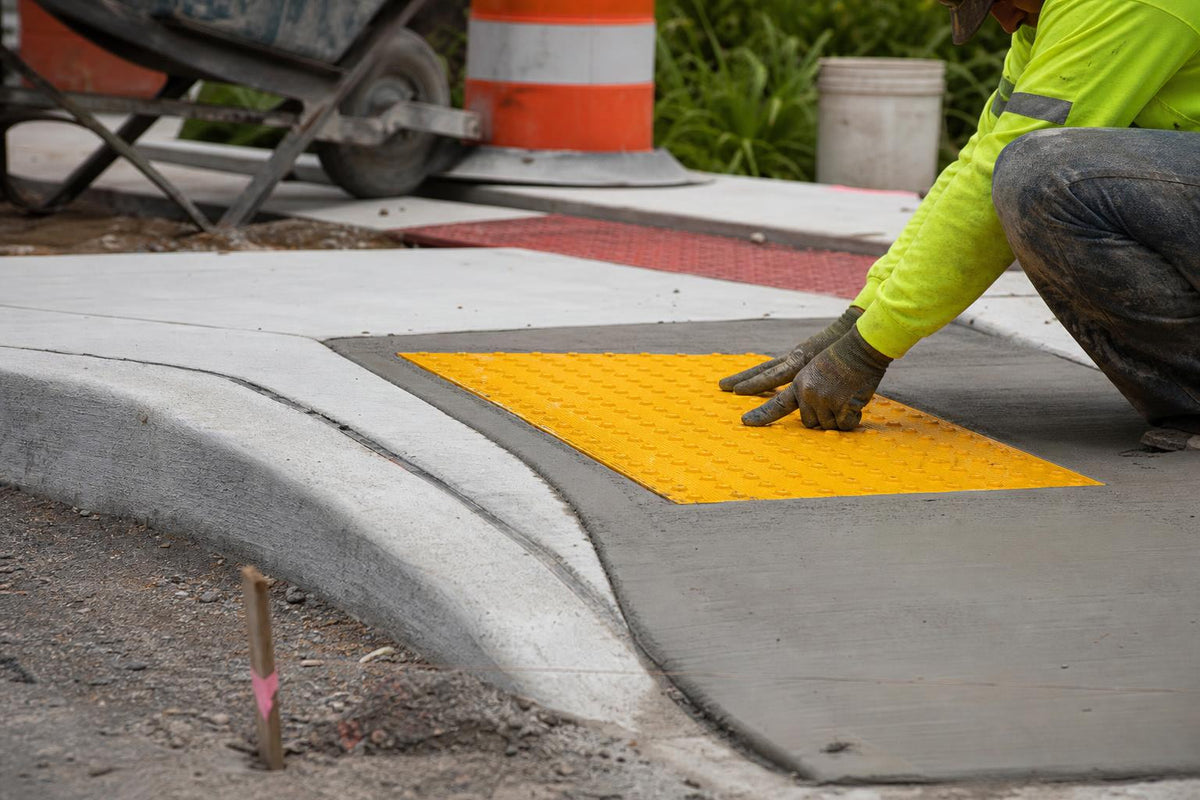
Cast-in-place (CIP) tactile indicators are panels set directly into a bed of fresh concrete during the pour, becoming a permanent part of the sidewalk structure. The installer positions the panel in the wet concrete, ensures proper alignment and depth, and the concrete cures around it.
Where CIP Fits
New construction is the primary use case. When you’re pouring a new curb ramp from scratch, cast-in-place tactile surface indicators are the logical choice because the concrete is already open and wet. There’s no separate demolition step, no adhesive to apply, and no fasteners to drill. The panel integrates flush with the surrounding surface.
CIP is also the preferred method for high-traffic municipal curb ramps where longevity matters more than ease of future replacement. Full ramp rebuilds, intersection upgrades, and new subdivision construction are all CIP territory.
Materials
To hold up under heavy pedestrian and vehicular-adjacent traffic over years, CIP panels need to be made from durable materials. Options include polymer concrete, cast iron, and steel. Composite materials that aren’t engineered for load and freeze-thaw cycling tend to deteriorate under real-world conditions.
For projects requiring cast iron specifically, cast-iron tactile plates are available in 12"×24", 24"×24", and 24"×30" sizes. Heritage-style projects sometimes use heritage brick cast-in-place panels that match the surrounding streetscape aesthetic while still meeting truncated dome specifications.
Pros
- Flush profile. No raised leading edge means snow plows, wheelchairs, and strollers pass over without catching.
- Permanent bond. The concrete encases the panel, so there’s no adhesive to fail and no perimeter sealing to maintain.
- Snow plow resistance. This is the single biggest advantage in Canadian climates. Cast-in-place or recessed installations handle plow contact far better than surface-applied panels because there’s no protruding edge for a blade to catch.
Cons
- Replacement is expensive. Once the concrete is set, the underlying substrate must be at least partially demolished to remove and replace a traditional CIP panel. If the panel cracks, fades below contrast requirements, or is damaged by utility work, you’re looking at concrete removal and a new pour.
- Requires pour coordination. The installation window is tied to the concrete pour schedule. If the panel isn’t on site when the concrete crew is ready, you’ve got a problem.
Surface-Applied Tactile Indicators: Definition and Installation
Surface-applied tactile panels are installed on top of a finished, cured concrete substrate. They attach using a combination of mechanical fasteners (typically concrete anchors or screws) and adhesive, with perimeter caulking to seal the edges and reduce water intrusion.
Where Surface-Applied Fits
Retrofitting existing concrete is the primary use case. The biggest pain point for municipalities and facility managers is adding tactile surface indicators to curb ramps where the concrete is already in place. Tearing out and re-pouring a ramp just to embed a cast-in-place tile is expensive and disruptive, especially on active sidewalks.
Surface-applied panels are also the right choice for space-constrained substrates like multi-level parking garages, where the concrete deck is populated with electrical conduit, plumbing, rebar, and wire mesh that make embedding a panel impractical. And they’re commonly used to bring non-compliant ramps up to code quickly, since the existing surface doesn’t need to be disturbed.
Installation hardware like stainless steel saddle clamp assemblies can simplify the fastening process for complete, secure installations.
Installation Speed
Surface-applied panels can be installed in approximately 10 to 15 minutes per panel. For a municipality facing an audit deadline or a contractor trying to close out a punch list, that speed matters. No concrete cure time. No waiting for a pour crew. Drill, fasten, adhere, caulk, move on.
Materials
Common materials for surface-applied panels include composite, fiberglass-reinforced polymer (FRP), polyurethane, and aluminum. The choice depends on traffic volume, climate exposure, and budget. Polyurethane flexible tiles (300 mm × 300 mm) work for smaller areas or temporary installations. Larger composite panels handle higher-traffic exterior applications.
Pros
- No demolition. The existing concrete stays intact.
- Fast installation. Minutes per panel rather than coordinating with a concrete pour.
- Easier replacement. Remove the fasteners, heat the adhesive, strip the old panel, and install a new one.
- Cost-effective for retrofits. The primary cost drivers are adhesive, fasteners, and caulking, not concrete demolition and re-pouring.
Cons
- Raised profile. Surface-applied panels sit above the surrounding concrete, creating a leading edge that snow plows can catch. Colorado DOT’s curb ramp design resource warns that “some models of truncated domes cannot withstand snow plowing equipment and the effects of snow and ice.” A U.S. patent filing documented that domes made of plastic “tend to be sheared off, nicked or cracked when snowplows hit them.”
- Color fading. An Oregon DOT study (Report SPR-304-241) monitored four surface-applied products on curb ramps over two years and found that while adhesion to the concrete was good and physical damage was not a problem, three out of four products exhibited noticeable color fading. Since luminance contrast is a code requirement, fading isn’t just cosmetic.
- Perimeter sealing. The gap between the panel edge and the concrete needs caulking to minimize water intrusion, and that caulking degrades over time.
Replaceable Cast-in-Place: The Third Category
A newer approach addresses the main objection to traditional CIP (costly removal) while keeping its flush-profile advantage. Replaceable cast-in-place systems use corrosion-resistant concrete inserts embedded during the original pour, combined with a heavy-duty bolt anchoring method. The tactile surface panel bolts onto the inserts and can later be removed and replaced without disturbing the concrete base.
This matters most when a municipality expects to maintain a ramp for decades. Colors fade, materials wear, and codes evolve. Being able to swap the panel without jackhammering the ramp saves significant lifecycle cost.
When to Consider Replaceable CIP
- New construction where long-term maintenance is a priority
- Transit stops and high-visibility public infrastructure
- Locations where code standards may change and panels will eventually need upgrading
- Winter-exposed curb ramps that need flush profiles but also need a practical replacement path
How to Choose: Decision Checklist for Curb Ramps
Choosing between tactile surface indicators (surface-applied or cast-in-place) for a curb ramp comes down to five questions.
1. Is This New Concrete or Existing?
This is the gateway question. If you’re pouring new concrete, cast-in-place is the default. If the concrete already exists, surface-applied is the practical route. Everything else follows from this starting point.
2. Will the Area Be Plowed?
In Canada, the answer is usually yes for exterior municipal curb ramps. If snow plows will contact the surface, a flush-profile installation (CIP or replaceable CIP) is strongly preferred. Surface-applied panels with a raised edge are vulnerable to plow damage, especially over multiple winters.
3. What Does the Specification Require?
Some municipal specs explicitly call for one type or the other. Others reference a performance standard and leave the installation method to the contractor. Check the project specification before assuming you have a free choice. For a deeper look at how Canadian specifications work, the TWSI compliance guide for Canadian specifiers covers the standards landscape in detail.
4. Does Replaceability Matter?
For a single curb ramp on a private property, probably not. For a city-wide program maintaining hundreds of ramps, it matters a lot. Replaceable CIP or surface-applied both offer easier swap-outs than traditional CIP, but with different trade-offs in profile and durability.
5. Is the Ramp Curved?
Radius curb ramps require panels that match the curve. Standard flat panels don’t fit properly on a radiused ramp, and gaps between panels compromise both accessibility and durability. Radius tactile panels are designed specifically for this geometry.
Comparison Table
| Factor | Cast-in-Place | Surface-Applied |
|---|---|---|
| Best for | New concrete pours | Retrofitting existing concrete |
| Installation | Set into wet concrete during pour | Fasteners + adhesive on cured surface |
| Install time | Minutes during pour (coordination-dependent) | ~10–15 minutes per panel |
| Profile | Flush with surrounding concrete | Slightly raised above surface |
| Snow plow resistance | Higher (no leading edge to catch) | Lower (raised edge vulnerable to blade catch) |
| Replacement | Requires partial concrete demolition (traditional) or bolt removal (replaceable CIP) | Remove fasteners, heat adhesive, strip panel |
| Cost driver | Concrete pour coordination, low material waste | Adhesive, fasteners, caulking, no demolition |
| Typical materials | Composite, polymer concrete, cast iron, steel | Composite, FRP, polyurethane, aluminum |
| Code context | Preferred for new construction | Accepted for retrofit and alteration projects |
Canadian Code Context
Almost every top-ranking page on this topic is written for U.S. ADA compliance. Canadian projects operate under a different set of standards. Here’s what applies.
CSA B651:23
This is the foundational Canadian reference. CSA B651 is not a building code itself, but it’s a referenced document in the National Building Code of Canada and many provincial and territorial building codes. It defines tactile attention indicators (truncated domes for hazard warning) and tactile direction indicators (elongated bars for wayfinding), along with dome dimensions, spacing, and contrast requirements.
ISO 23599
CSA B651 is aligned with ISO 23599, meaning products meeting one standard generally satisfy the other. The 70% minimum luminance contrast requirement between the indicator and the adjacent surface originates from ISO 23599. This contrast requirement is why color fading (documented in the Oregon DOT study) is a code compliance issue, not just an aesthetic one.
Ontario Building Code (OBC)
Section 3.8.3.18 of the current OBC outlines standards for tactile attention indicators and states they shall conform to ISO 23599 specifications. The OBC mandates that the depth of the tactile attention indicator field (in the direction of travel) be between 300 mm and 610 mm. For more on Ontario-specific requirements, the AODA tactile requirements guide covers the compliance path in detail.
AODA
The Accessibility for Ontarians with Disabilities Act, passed in 2005, aims to make Ontario fully accessible by 2025. Its Design of Public Spaces standard directly relates to tactile warning systems and legally mandates installing compliant systems in indoor and outdoor public spaces.
Accessible Canada Act
Federal legislation targeting a barrier-free Canada by January 1, 2040. It covers identifying, removing, and preventing barriers in federal jurisdiction, including the built environment. Federal buildings, airports, and transit facilities fall under this act.
Watch for Provincial Variation
A 2026 Hamilton city report reveals that while most Ontario municipalities follow the widely accepted TWSI design with raised truncated domes, Hamilton’s guidelines differ from provincial standards in both design and materials. Specifiers working across multiple municipalities should verify local requirements rather than assuming province-wide uniformity.
Key Dimensions for Curb Ramp Tactile Indicators
| Specification | Requirement | Source |
|---|---|---|
| Depth of warning field (direction of travel) | 610 mm minimum (24 in) | CSA B651:23 |
| Width | Full width of curb ramp (excluding flares) | PROWAG R305.1 |
| Dome height | 4–5 mm | CSA B651:23 |
| Dome top diameter | 12–15 mm | CSA B651:23 |
| Centre-to-centre spacing | Per Table 2 in CSA B651:23 | CSA B651:23 |
| Luminance contrast | Minimum 70% between indicator and adjacent surface | ISO 23599 |
| Setback from curb edge (Ontario) | 150–200 mm | AODA/OPSD |
For a broader view of testing requirements and how these specs are verified, see the tactile walking surface indicators testing standards in Canada guide.
Water, Freeze-Thaw, and Why Both Types Can Fail
Neither installation method is immune to water problems. Both cast-in-place and surface-applied panels can suffer from air and water infiltration that compromises structural integrity over time. This is particularly problematic at the intersection of pedestrian ramps and sidewalks, where standing water is difficult to drain.
In Canadian climates, trapped water means freeze-thaw cycling. Water seeps under or around the panel, freezes, expands, and gradually loosens the bond or cracks the substrate. This is why perimeter sealing on surface-applied panels needs periodic inspection, and why CIP panels in areas with poor drainage can still fail despite their permanent bond.
Common Mistakes When Specifying Tactile Surface Indicators for Curb Ramps
Installing surface-applied panels on plowed exterior sidewalks. If the ramp will see regular plow contact (which in Canada means most exterior municipal ramps), surface-applied panels with a raised profile are at higher risk of damage. The cost savings on installation can be wiped out by repeated repairs.
Ignoring luminance contrast requirements. The 70% contrast ratio isn’t optional. Specifying a yellow panel on light concrete or a dark panel on dark asphalt can put you out of compliance from day one. And as the Oregon DOT study showed, even products that start compliant can fade below the threshold within two years.
Using non-compliant dimensions. Canadian dome specs (12–15 mm top diameter, 4–5 mm height per CSA B651:23) differ from U.S. ADA specs (approximately 23 mm top diameter, 5 mm height). Products designed for the U.S. market may not meet Canadian dimensional requirements. Always verify against the applicable Canadian standard.
Confusing attention indicators with directional indicators. Curb ramps require truncated dome attention indicators, not elongated bar directional indicators. Directional bars are for wayfinding in open areas. Installing the wrong type at a curb ramp is a code violation and a safety hazard.
Assuming all ramps need tactile indicators. As practitioners on building code forums point out, detectable warnings are required at curb ramps and blended transitions where pedestrian routes meet vehicular ways. A ramp inside a building between floor levels does not typically require them. Confirm the requirement before ordering material.
Limits to Keep in Mind
Tactile surface indicators reduce risk for pedestrians with vision impairments, but they don’t eliminate all hazards. Surfaces still need regular cleaning, ice management, and maintenance. Panels need periodic inspection for damage, loosening, and contrast fading. Code or accessibility compliance claims should always be checked against the specific code edition and jurisdiction that applies to your project, as standards vary between provinces and municipalities.
Next Steps
Choosing between tactile surface indicators (surface-applied or cast-in-place) for a curb ramp is a substrate-first, climate-second decision. If you’re pouring new concrete, go cast-in-place. If you’re retrofitting, go surface-applied. If you want the best of both worlds for long-lifecycle infrastructure, consider replaceable CIP.
View tactile indicator products with published pricing for both surface-applied and cast-in-place panels.
For projects requiring guidance on panel sizing, material selection, or provincial code requirements, contact Safety Step Canada for specifier support.
Frequently Asked Questions
What is the difference between surface-applied and cast-in-place tactile indicators?
Cast-in-place panels are embedded in wet concrete during a new pour and sit flush with the surrounding surface. Surface-applied panels are fastened and adhered on top of existing cured concrete and sit slightly raised. The substrate condition (new pour vs. existing concrete) determines which method is appropriate.
Can I use surface-applied tactile indicators on a curb ramp that gets plowed?
You can, but it’s higher risk. The raised profile of surface-applied panels creates a leading edge that snow plow blades can catch, potentially shearing domes or lifting the panel over time. Cast-in-place or replaceable CIP panels with a flush profile are the safer bet for regularly plowed locations.
What Canadian codes govern tactile indicators at curb ramps?
CSA B651:23 is the primary referenced standard, aligned with ISO 23599. In Ontario, Section 3.8.3.18 of the OBC and the AODA Design of Public Spaces standard apply. Federal facilities fall under the Accessible Canada Act. Municipal requirements can vary, so always check local guidelines.
How deep should the tactile warning field be on a curb ramp?
CSA B651:23 and the Ontario Building Code specify a minimum depth of 610 mm (24 inches) in the direction of pedestrian travel. The field should span the full width of the curb ramp, excluding the flared sides.
Do all ramps require tactile surface indicators?
No. Tactile attention indicators are required at curb ramps and blended transitions where pedestrian routes meet vehicular ways. Interior ramps between floor levels in a building typically do not require them. The requirement is tied to the hazard (vehicle traffic), not the slope.
How long do surface-applied tactile panels last before needing replacement?
Durability depends on material, traffic, and climate. Physical damage from foot traffic alone is generally not a problem over multiple years. Color fading is the more common issue. The Oregon DOT documented noticeable fading in three out of four tested products within two years, which can push panels below the 70% luminance contrast requirement.
Are U.S. ADA-compliant tactile panels also compliant in Canada?
Not necessarily. Canadian dome dimensions under CSA B651:23 (12–15 mm top diameter) differ from U.S. ADA specifications (approximately 23 mm top diameter). A product that meets ADA requirements may fail to meet Canadian dimensional standards. Always verify against the specific standard referenced in your project’s jurisdiction.
What is replaceable cast-in-place and when should I use it?
Replaceable CIP systems embed corrosion-resistant inserts into the concrete during the original pour. The tactile panel then bolts onto those inserts and can be removed and replaced later without demolishing the concrete. It’s worth considering for new construction projects where long-term maintenance, evolving code requirements, or high-visibility public infrastructure make future panel swaps likely.