
TL;DR
TWSI stands for Tactile Walking Surface Indicator. TWSI compliance in Canada means meeting the dimensional, material, contrast, and placement requirements set by CSA B651, ISO 23599, the National Building Code, your provincial code, and any applicable accessibility legislation like the AODA. There are two distinct types (attention and direction), and confusing them is a compliance failure. This guide covers the full standards hierarchy, key dimensions, required locations, and the most common errors that lead to failed inspections.
Introduction
This entry is for contractors, architects, facility managers, and procurement buyers who are specifying or purchasing TWSIs for Canadian projects. Whether you’re working on a municipal sidewalk in Toronto, a transit platform in Calgary, or a federal government building, understanding TWSI compliance is a prerequisite for passing inspection and avoiding costly rework.
This glossary article covers what TWSI means, the layered Canadian standards system that governs compliance, the exact dimensional specs you need, where installation is required, and the mistakes that trip up even experienced teams.
Browse tactile indicator products to see surface-applied and cast-in-place options that meet CSA and ISO requirements.
What Does TWSI Stand For?
TWSI stands for Tactile Walking Surface Indicator. CSA B651 defines it as a standardized surface, detectable underfoot or by a long white cane, that assists persons with low vision or blindness by alerting or guiding them.
That definition contains a critical distinction most people miss: TWSIs serve two completely different functions depending on their type.
Attention Indicators (Warning)
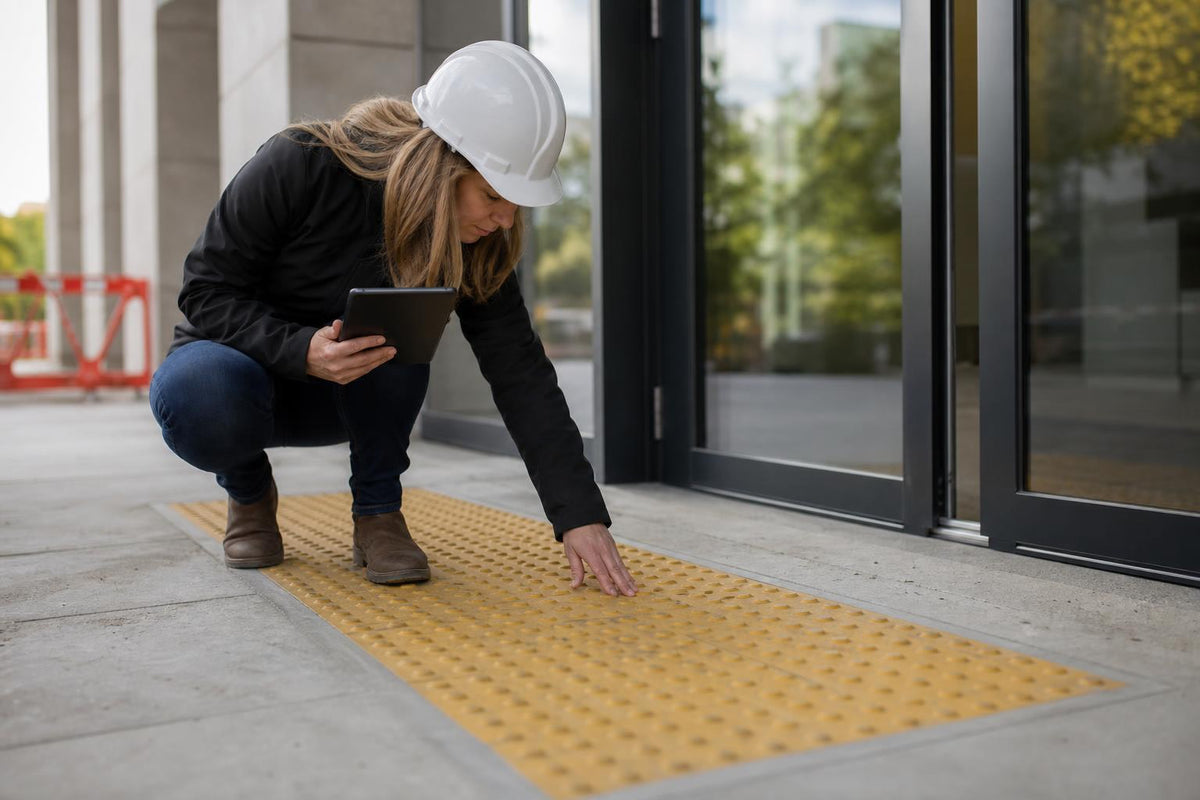
Attention indicators use truncated domes, those raised circular bumps arranged in a grid pattern. Their job is to signal a hazard: a change in elevation, a vehicular route crossing, train tracks, or a platform edge. Safety yellow is the preferred colour for attention indicators specifically.
Direction Indicators (Guidance)
Direction indicators use flat-topped elongated bars. They guide pedestrians along a path in open areas where spatial orientation is difficult. These should not be safety yellow, because preserving the colour distinction between warning and wayfinding is essential for users who have low vision but are not fully blind.
Why the Naming Confusion Matters
You’ll hear people call TWSIs “truncated domes,” “detectable warning surfaces,” “tactile paving,” or simply “the yellow bumps.” These informal names blur the line between the two types. That confusion leads to specification errors. Ordering direction bars when the project calls for attention domes is not just an inconvenience. It is a compliance failure. For a deeper breakdown, see this tactile indicators compliance guide.
What Is TWSI Compliance?
TWSI compliance means meeting the dimensional, material, contrast, placement, and installation requirements in the applicable standard(s) for a given project location. It is not one national rule. Canada uses a layered system, and misunderstanding this hierarchy is one of the most common errors specifiers make.
The Canadian Standards Hierarchy
Here is how the layers stack, from technical specification down to local enforcement:
1. CSA/ASC B651:23 (Primary Canadian Standard)
Now in its sixth edition, CSA B651:23 contains the technical requirements for making buildings and facilities accessible to people with physical, sensory, and cognitive disabilities. It governs TWSI design, placement, and maintenance specifications. This is the document your product submittals need to reference.
2. ISO 23599 (International Standard)
The international standard for TWSI use and installation. CSA B651 is aligned with ISO 23599, so products meeting one standard generally satisfy the other.
3. National Building Code of Canada (NBC)
The NBC references CSA B651 for TWSI specifications. But here is the catch: the federal government publishes the NBC as a model code. It carries no legal force until a province, territory, or municipality adopts it.
4. Provincial and Territorial Building Codes
British Columbia, Alberta, Ontario, and Quebec maintain their own published codes. Most other provinces and territories adopt the NBC directly, sometimes with provincial supplements. Ontario’s Building Code, for example, specifies different dimensional ranges for TWSI depth at stairs than the CSA standard itself.
5. AODA (Ontario)
The Accessibility for Ontarians with Disabilities Act mandates TWSIs wherever pedestrian routes intersect vehicle zones. It carries significant enforcement penalties.
6. Accessible Canada Act (Federal)
This act aims to make Canada barrier-free by January 1, 2040. If you’re buying TWSIs for a federal building, transit system, or military installation, this applies directly. Projects in institutional and government sectors need to account for both federal and provincial requirements.
7. Municipal Standards
Cities layer on their own requirements. Toronto’s Accessibility Design Guidelines prescribe detailed TWSI requirements for municipal facilities. Calgary’s Access Design Standards regulate location and technical specifications for city infrastructure.
Watch the Edition Numbers
Some current project documents still reference CSA B651-18, where TWSI requirements appear in Clause 4.3.5. The current CSA/ASC B651:23 places them in Clause 4.4.5. Section numbering and some dimensional details differ between editions. Always confirm which edition your project’s authority having jurisdiction (AHJ) has adopted.
Key TWSI Dimensions and Specifications
These are the numbers that matter for TWSI compliance. The table below covers attention indicators (truncated domes), which are the most commonly specified type.
| Parameter | CSA/ISO Specification |
|---|---|
| Dome height | 4 to 5 mm |
| Dome top diameter | ~12 mm |
| Dome base diameter | ~23 mm |
| Centre-to-centre spacing | ~60 mm |
| Depth at stairs (CSA B651) | 600 to 650 mm |
| Depth at stairs (Ontario Building Code 3.8.3.18) | 300 to 610 mm |
| Setback from stair edge | One tread depth back from the nosing |
| Base surface tolerance | Installed level with surrounding surface, or no more than 3 mm above or below |
| Luminance contrast (ISO 23599) | Minimum 70% |
| Preferred colour (attention indicators) | Safety yellow |
Two items in this table deserve extra emphasis.
Luminance contrast is a compliance requirement, not an aesthetic preference. ISO 23599 specifies a minimum 70% luminance contrast between the TWSI surface and the adjacent ground surface. A yellow panel on a light concrete sidewalk may look fine to sighted observers but fail to meet the 70% threshold that people with low vision depend on. Practitioners on forums recommend including a luminance contrast verification step in your procurement checklist to catch this before installation.
The stair setback rule has a specific purpose. The attention indicator surface must begin one tread depth back from the leading edge of the nosing at the top step, then extend across the full width of the stairs. This gives the person enough space to stop after detecting the domes and before reaching the stair edge.
For projects involving curved curb ramps, radius tactile panels are designed to fit the geometry without cutting standard rectangular panels.
Where Are TWSIs Required?
CSA B651 requires a tactile attention indicator surface at:
- Stairs that are not enclosed
- Each landing incorporating an entrance into a stair system
- Locations where the regular stairway pattern is broken
- Landings where the run with no continuous handrail exceeds 2,100 mm
Beyond stairs, AODA and provincial codes require TWSIs at curb ramps and pedestrian crossings. Transit agencies install them at subway, bus, and train platform edges to warn of drop-offs. The transportation sector is one of the earliest and most heavily regulated areas for TWSI installation in Canada.
Direction indicators (elongated bars) go in large open areas where spatial orientation is difficult, such as transit concourses or open plazas. For these applications, directional bar tiles serve a fundamentally different function than attention indicators.
One rule that catches people off guard: indicators belong on the landing only, never on the stair treads themselves. Stair treads serve a different safety function. For tread-edge protection, stair tread nosings work alongside TWSIs but are a separate product category entirely.
Common TWSI Compliance Errors
These are the mistakes that lead to failed inspections, expensive rework, or (worse) injuries.
Specifying the Wrong Type
Ordering attention indicators when you need direction indicators, or vice versa, is a compliance failure. The two types are not interchangeable. This is the most basic error, and it happens more often than you’d expect because informal names like “tactile paving” don’t distinguish between the two.
Installation Failures
One installer described a site visit where a facility was missing dozens of tactile indicators from a previous contractor. On closer inspection, some studs had been “banged in” without adhesive, giving them no bond to the substrate. In other areas, studs were glued onto the surface without proper drilling. These inconsistencies create direct danger for vision-impaired users.
Common installation mistakes include incorrect spacing, weak adhesive bonds, poor alignment, and using the wrong tile type for the environment (indoor product used outdoors, or the reverse).
Failing the Luminance Contrast Check
A yellow panel installed on a light-coloured substrate can look compliant to the naked eye but fall below the 70% contrast threshold specified by ISO 23599. This is one of the most expensive mistakes to fix after installation because it usually means replacing every panel.
Ignoring Canadian Winter Conditions
For exterior projects, failing to account for mechanical snow removal at the specification stage is a procurement mistake with costly consequences. Surface-applied panels in plow zones will eventually get damaged or torn off entirely. Plastic plates have been shown to crack from snowplow impact over time.
CSA/ASC B651:23 itself notes that product selection should consider potential wear in high-traffic areas or where snow and ice clearing equipment is used. In a Canadian climate, durability is a compliance issue, not just a maintenance concern. Cast iron plates are one option for high-durability applications in plow zones.
Referencing the Wrong CSA Edition
If your project spec calls out CSA B651-18 but your AHJ has adopted B651:23, the clause numbers don’t match and some dimensional details differ. This seemingly minor administrative error can cause real problems during inspection. For more detail on testing and standards, see this testing standards overview.
Missing Mechanical Fasteners
Adhesive-only installations are risky, especially outdoors. Temperature changes, moisture, and heavy foot traffic can cause panels to lift. Mechanical fasteners or a combination approach is strongly recommended for long-term durability.
Why TWSI Compliance Matters
The Human Case
An estimated 1.5 million Canadians identify as having sight loss, with an estimated 5.59 million more living with an eye disease that could cause sight loss. According to CNIB, over 50,000 Canadians lose their sight every year. Approximately 30% of Canadian adults live with some form of disability.
Falls are the leading cause of hospitalization and death among older adults in Canada. In 2022, there were 78,076 fall-related hospitalizations among adults 65 and older (excluding Quebec), with falls accounting for 89% of injury-related hospitalizations in that age group.
TWSIs exist to prevent exactly these outcomes. When they’re installed correctly, they work. When they’re missing, damaged, or non-compliant, they fail the people who need them most.
The Financial Case
Under the AODA, corporations face fines of up to $100,000 per day for non-compliance. Individuals and unincorporated organizations face up to $50,000 per day. Directors and officers can be held personally liable for penalties of up to $50,000 per day.
Retrofitting is expensive too. The City of Ottawa estimated intersection retrofits at $30,000 per intersection to install the necessary curb depressions and TWSIs required for AODA compliance. Getting it right the first time costs a fraction of that.
The Regulatory Trajectory
The Accessible Canada Act targets a barrier-free Canada by January 1, 2040. Provincial codes are tightening. Municipal standards are becoming more detailed. TWSI compliance requirements are expanding, not contracting. Past project examples across government, commercial, and transit sectors show how widespread these requirements already are.
Attention vs. Direction Indicators: Quick Comparison
| Attention (Warning) | Direction (Guidance) | |
|---|---|---|
| Surface pattern | Truncated domes | Elongated flat-top bars |
| Function | Signals a hazard or change in condition | Guides along a route |
| Preferred colour | Safety yellow | Not safety yellow |
| Typical locations | Stairs, curb ramps, platform edges, vehicular crossings | Open concourses, plazas, wayfinding routes |
| CSA/ISO standard | CSA B651, ISO 23599 | CSA B651, ISO 23599 |
Practitioners on Reddit have noted confusion even among sighted users. A Calgary thread about blue tactile strips at CTrain stations showed that many people did not understand what the new surfaces meant. Calgary Transit explained that the pilot included surveys and focus groups with low-vision customers to test effectiveness. In an r/accessibility thread, a user worried that tactile paving near crosswalks might lead blind pedestrians diagonally into traffic. Commenters clarified that truncated domes indicate the sidewalk edge or hazard, not the walking direction, which is exactly the distinction between attention and direction types.
Material and Durability Considerations
TWSI compliance doesn’t end at geometry and colour. Material selection affects whether a product stays compliant over its service life.
Common TWSI materials include cast iron, polyurethane, stainless steel, concrete, and ceramic. Products that rely on surface paints, coatings, or supplemental compounds are not permitted in many specifications.
For exterior Canadian applications, the combination of freeze-thaw cycles, salt, moisture, and mechanical snow removal creates conditions that degrade inferior materials quickly. Schedule full tile replacement every 10 to 15 years for maximum longevity, depending on traffic levels.
Tactile indicators were originally developed in Japan in the 1960s. The ISO standard was created in 1999, and Canada incorporated TWSIs first into transportation and then into other areas of the built environment by the early 2000s. The CSA standard was created in 2004 and updated in 2012, 2018, and 2023. Decades of international use have demonstrated which materials hold up and which don’t.
Limits of This Guide
This article provides general guidance on TWSI compliance in Canada based on published standards and codes. It does not constitute legal advice. Building codes vary by province, territory, and municipality, and they change over time. Always verify requirements with your local authority having jurisdiction and confirm which edition of CSA B651 applies to your project. Surfaces still need regular cleaning and maintenance. Snow, ice, and debris management remain necessary even with compliant TWSIs installed.
Next Steps
Need help choosing the right TWSI type, size, or material for your project?
- Browse tactile indicators including surface-applied panels, flexible tiles, and cast-in-place options
- Contact Safety Step Canada for specification support and product selection guidance
- Check the TWSI procurement checklist for a step-by-step buying workflow
Frequently Asked Questions
What is the difference between TWSI compliance and ADA compliance for detectable warnings?
TWSI compliance refers to the Canadian standards framework (CSA B651, ISO 23599, provincial codes, and AODA). ADA compliance refers to the American system under the Americans with Disabilities Act and PROWAG guidelines. The dimensional specs differ. Dome heights, spacing, and panel sizes are not identical between the two systems. A product that meets ADA requirements does not automatically meet Canadian TWSI compliance, and vice versa.
Do TWSIs need to be yellow?
Safety yellow is the preferred colour for attention indicators (truncated domes) because it provides high visual contrast. However, the actual compliance requirement is a minimum 70% luminance contrast between the TWSI and the surrounding surface. Direction indicators should not be safety yellow, to preserve the distinction between warning and guidance functions.
How often should TWSIs be inspected or replaced?
There is no single mandated inspection frequency across all jurisdictions, but general guidance suggests scheduling full tile replacement every 10 to 15 years depending on traffic levels and exposure to snow clearing equipment. High-traffic exterior locations in Canadian climates may need replacement sooner. Regular visual inspections should check for cracking, lifting, fading, and loss of dome profile.
Can I use adhesive-only installation for exterior TWSIs?
Adhesive-only installation outdoors is risky and often fails within a few years due to temperature swings, moisture infiltration, and mechanical stress from foot traffic or snow removal. Mechanical fasteners, or a combination of adhesive and fasteners, are strongly recommended for exterior applications. Some specifications explicitly prohibit adhesive-only methods.
Which CSA B651 edition should I reference?
Reference the edition adopted by your project’s authority having jurisdiction. The current edition is CSA/ASC B651:23, but some jurisdictions still reference B651-18. The clause numbers differ between editions (Clause 4.3.5 in B651-18 vs. Clause 4.4.5 in B651:23), so using the wrong edition can cause confusion during submittal review and inspection.
Are TWSIs required on enclosed stairways?
CSA B651 requires attention indicators at stairs that are not enclosed. Enclosed stairways (those within walls on both sides with doors at landings) typically do not require TWSIs, though some municipal standards or project-specific accessibility consultants may recommend them. Always check your local code.